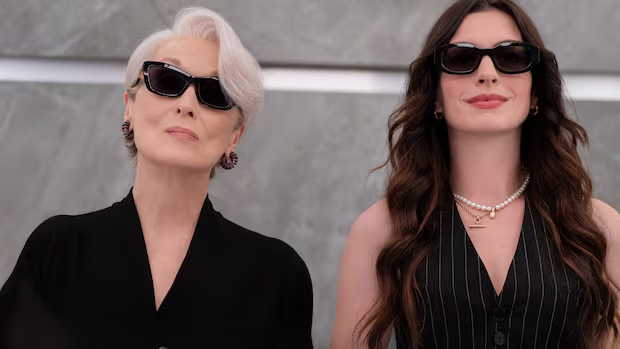
Midway through The Devil Wears Prada 2, Meryl Streep’s Miranda Priestly is doing something the Runway magazine boss would never have allowed 20 years ago, during the first installment of David Frankel’s fashion-forward franchise.
She’s being lectured.
To be fair, things haven’t been working out too well in the remix. All throughout The Devil Wears Prada 2, hitting theatres this Friday, we’re reminded of that: how journalism is dying, how people don’t care about so-called tastemakers anymore and how the trendsetting magazine’s glorious days are probably coming to a close.
All of which Priestly is patronizingly reminded of by billionaire tech bro Benji Barnes (Justin Theroux), a guy so Silicon Valley-brained he eschews drinking water in order to keep himself in a dubiously advisable “aqua deficit.”
A man who openly muses about the day when Runway magazine won’t need articles, models or any humans at all anymore — a future when all those glorious elements will be mindlessly produced by AI.
WATCH | The Devil Wears Prada 2 trailer:
It’s a future he grinningly, bizarrely, compares to no less happy a circumstance than the lava flows that covered and crushed the ancient city of Pompeii.
“One day it’s going to come and it’s going to smother us all,” he says to an uncharacteristically timid Priestly. “Maybe that’s the way it has to be.”
If that all sounds like something of a left turn from the glitz and glam of the crotcheted pageboy hats and trips to Paris in the 2006 original, don’t worry too much. On the surface at least, this is another cute and fun story about the heights of fashion — if not as clearly focused or anywhere near as iconic.
We still get to follow Anne Hathaway’s Andy Sachs — though instead of a ditzy aspiring reporter, she’s now a ditzy established one. Simultaneously presented with yet another news award and fired from the New York Vanguard paper due to a greedy CEO’s writedown as the film opens, she once again has to crawl with her tail between her legs to Runway for another beneath-her fashion journalism job.
We still get Stanley Tucci’s coolly catty artistic director Nigel — who, in between choosing whether his models should pose with their purses cross-body or not, wistfully recalls how he used to get month-long expense-paid trips. Now that the magazine has shifted almost entirely online, he laments that there’s only enough money for a couple days in a nearby city to gather “content” that readers will scroll past as they pee.
And we still get Emily Blunt’s (conveniently named) Emily, the unequivocal standout in this revisit. Having moved on from her career as Miranda’s underling, she now manages to keep her old boss on a leash as a Dior executive.
When Andy, Runway’s new features editor, naively pushes back on Emily’s demand for them to run a multi-page advertorial (with their brand name in every photo caption), the latter gets to stick the knife in again.
Without advertisers, Emily says, there is no Runway. So why doesn’t Andy take her adorable little complaints about journalistic integrity and stick them where the Chanel don’t shine?

And of course we get Miranda, whose uncharacteristic (and oddly compounding) mistakes landed them in this mess in the first place.
Since another outlet published an exposé on Runway — revealing one of their articles celebrated a company that pumps out fast fashion from a sweat shop — their reputation has been in tatters. And the only effective damage control Miranda’s boss, Irv Ravitz (Tibor Feldman), and his son Jay (B.J. Novak) can imagine is hiring someone with a reputation for hard-hitting journalism: Andy.
All that should constitute a compelling reason to watch, especially given all of the returning faces and nostalgic moments on offer. Outside of the stars, there are inside jokes for fans, like the spring florals at the opening fashion show — a callback to Miranda calling them wholly unoriginal two decades ago. There’s the reference to only idiots walking up Miranda’s stairs — a callback to one of the most infuriating decisions Andy made in the original film. Or the deconstructed cerulean sweater she sports as the movie closes — a callback to, well, the cerulean sweater she wore in the first film.
And there’s Miranda seemingly forgetting that Andy was her secretary at all — mirroring the fact that former Vogue editor-in-chief Anna Wintour, upon whom Priestly’s character was based, reportedly forgot that she’d hired Lauren Weisberger, who went on to write the original Devil Wears Prada book.
Hitting the highs
What more do we really want from a Prada movie than to hit the highs of the original? Unfortunately, this time around, that’s only accomplished by ignoring or undoing any character development or introspection that occurred in the first film.
Instead of a self-assured Andy with an investment in her future, we get one fundamentally back in the role as Miranda’s assistant: yearning for Nigel’s validation, accomplishing some impossible “get the Harry Potter manuscripts”–esque task for Miranda, condescendingly stating she wants to leave fashion for a “real” journalism job or engaging in a comically frantic phone-call montage to get her boss’s plans across the finish line.
And instead of a new or even revamped character arc for the most iconic character in the franchise, Streep’s imperiousness is treated as such an inherent audience draw that director Frankel seemingly didn’t feel he needed to even try reinventing the wheel. We just get Streep doing a fairly good Miranda impression, without the slow and subtle peek into her crumbling personal life — the Jaws-like strategy of allowing only glimpses of the real horror, to make it hit harder when it actually arrives.
Otherwise, she is just a sad woman without any of the confidence or backbone of the original. Her HR-inspired attitude adjustments are either played for laughs or written in as afterthoughts to allow the under-thought progress-versus-tradition theme to pop up.

Which is one of the main problems at play. There is also the fact that The Devil Wears Prada 2 is less about fashion than the first film — lacking even a single monologue about the importance of the industry we’re seemingly here to fawn over.
And there is the fact that the often returned to — but never-unpacked — motif of a capitalistic world cannibalizing its artistry is muddy at best and, realistically, self-defeating if taken at face value. Virtually every character who fundamentally affects the plot is at least a multi-millionaire, while Andy’s equally depressing romantic arc this time around amounts to learning to love landlords who renovate historic buildings into overpriced luxury apartments.
That said, the drama’s still there, the looks are even sharper and the general comfort-watch feeling is never absent. But in ignoring the character growth, self-acceptance narrative or cultural commentary of fashion’s inherent worth, this sequel struggles to make a case to be in any way as memorable as the first.
Behind the swishing gowns and star-studded cameos, the film’s plot is so thin and scattered it feels like it’s eternally searching for excuses to keep going. Like the biggest-budget Family Channel movie of all time, it’s honestly hard to distinguish the bubbly but barren enthusiasm of The Devil Wears Prada 2 from a really good episode of The Suite Life of Zack & Cody.