This edition of the Auto Market Weekly Summary highlights some key readings on inflation trends as all eyes continue to be on the path of interest rates and their impact on the consumer.
Bottom Line Up Front
I had the opportunity to attend the National Association of Business Economists annual conference last week, which had two key themes, both of which were hot topics for markets: AI investment and concentration risks, coupled with overall inflation trends and the path of interest rates as we move into 2027.
Reports on both Consumer Price Index, or CPI, and Producer Price Index, or PPI, show that energy prices continue to impact the costs of goods, and there’s little reason to think those trends will regress anytime soon. Yet, some weakening in investments related to AI cooled enthusiasm mid-week, and that drove more investor interest in bonds, pushing interest rates lower as of Friday.
Another important topic that came up regularly in meetings last week was the overall impact of the wealth effect and how beneficial it had been to consumer spending patterns. We have been highlighting this trend for the better part of the year, as it particularly pertains to new vehicle sales and wrote a piece about it specifically last month. With increased reliance on the top end of the market, paying close attention to the many factors that support the wealth effect is paramount.
These updates have pushed market expectations lower for a Fed funds hike in October, yet increased odds of a quarter-point hike to roughly 75% for the December meeting, a rise of about 5 points over the week.
For automotive, we continue to see affordability concerns surrounding total vehicle ownership costs, as well as the cost of money via interest rates. Insurance rates continue to be a factor against vehicle ownership, yet they are down roughly 5% year over year, while maintenance and repair costs push higher, and up 5.8% year over year. That’s a clear factor a consumer may not have their finger on, but it weighs on ownership. And yes, another 50-basis-point rate increase from here may only increase a new or used monthly loan payment by $11 or $8, respectively. But, against pre-pandemic times, consumers are paying much more in interest. Total interest over the life of a used vehicle loan in 2019 was roughly $5,600, or 19% of all payments to own a vehicle. Today, that math works out to almost $11,000 of financing costs, or 26% of every dollar a consumer pays for a used car, going toward interest.
The oldest car parc in history will support used demand for quite some time, but consumers need to see some good news on the compounding trends of inflation, and the outlook for that keeps getting pushed further down the road.
Inflation Impact on Core Automotive Sectors
Benchmark and Auto Loan Rates
Benchmark interest rates had another volatile week, and in some respects moved against expectations on the back of higher inflation readings. The 10-year treasury remains elevated at around 5.10% but down from 5.24% as of last week. With rates remaining higher since the beginning of September, we are observing increases in both new and used consumer loan rates. The rise in consumer loan rates should impact demand for vehicle purchases, but it will likely be offset by an increased mix of cash purchases by consumers.
- 10-year Treasury yields have fallen roughly 14 basis points last week, even as inflation readings showed an acceleration in price movements. Demand for bonds rose over the week as worries about AI investment drove investors to purchase bonds as a safety net, pushing yields lower. So far for the month, the 10-year is higher by 24 basis points and up 118 basis points year over year.
- New loan rates for consumers have increased this month, with the new prime rate higher by 42 basis points month over month and up 78 basis points against the same time last year.
- Used loan rates held fairly steady in September but are rising in October, with used prime rates increasing to 12.9%, up 37 basis points against September and higher by 41 basis points against last year.
Consumer Price Inflation
September readings on consumer prices showed that growth reaccelerated, continuing to be driven by gains in gas and energy prices. Overall consumer inflation ticked higher than anticipated in September, leading the market to anticipate future Fed hiking to tame inflationary trends on a standalone basis.
- CPI rose 0.6% in September, up from 0.4% the prior month and now runs higher by 3.7% against last year. The increase against both last month and last year was higher than expected.
- Core CPI rose 0.3% month over month, keeping pace with August levels and also stronger than expectations.
- The increase was driven by a 20.4% rise in the overall energy category, with gas prices rising 34% year over year.
- Related to the automotive industry, new vehicle prices – as reported by the CPI – rose 0.6% year over year while used prices declined 0.1% against August and are down 1.5% against last year. This compares with Cox Automotive’s data showing new vehicle prices are higher by 0.7% year over year, and the average used price is higher by 3.3% year over year (comparing with CPI methodology).
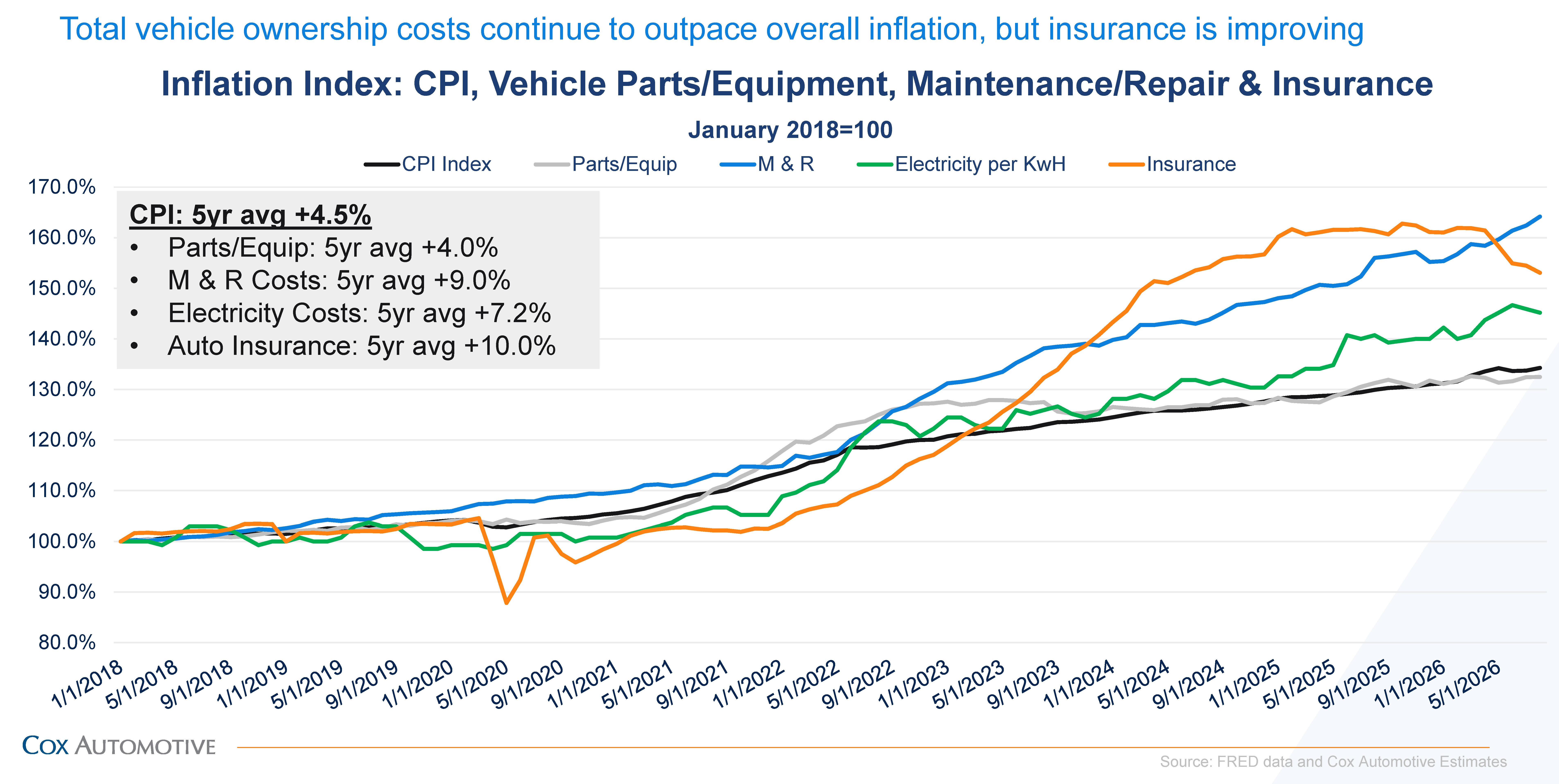
- Vehicle ownership costs show mixed trends in September. Parts/Equipment costs grew by 0.4% month over month and are higher by 0.8% year over year, while insurance costs continued to decline, falling by 0.3% month over month and 5% lower year over year.
- Maintenance and repair costs moved higher for five months in a row, rising 0.7% in the month alone and higher by 5.8% year over year. When we index these costs to 2018, M&R expenses have risen the most, up 65% since January 2018, more than insurance, showing an increase of 53%, and much higher than new and used vehicle prices over the period.
Producer Prices
Producer prices rose markedly in September, with 80% of the rise for goods due to higher energy costs over the month. This was the highest monthly increase in the index since March 2022, driven mostly by the rising cost of goods, which showed the highest increase since the data series began in December 2009.
- The PPI for final demand increased 1.3% against August and is now up 6.3% year over year, the strongest year-over-year gain since late 2022.
- The increase in the index for goods was the strongest ever recorded for the month, rising 2.6%, with half of the gain driven by the cost of gasoline.
- Services prices also increased 0.8% month over month, the strongest move since April of this year.
- For goods, passenger car price trends held steady while light trucks rose 0.1%. Motor vehicle parts declined from 0.6% month over month in August to 0.2% in September.
- For services, machinery and vehicle wholesaling prices accelerated and were called out in the written section of the report. Price trends from automotive retailing decelerated from August, while retail automotive parts services increased.
GDP
Real GDP growth was revised higher in the third estimate, and the annual update also lifted first-quarter growth, suggesting the first half of 2026 was firmer than previously reported.
- Real GDP grew at a 2.2% annualized rate in the second quarter, up 0.7 percentage points from the second estimate of 1.5% and above the consensus forecast of 1.6%. First-quarter growth was revised to 2.5% from 2.1%.
- Consumer spending contributed 2.51 percentage points, up from 0.49 in the first quarter. AI-related investment, reported under nonresidential fixed investment, added 1.25 points, down from 1.36 in the revised first-quarter report.
- Real final sales to private domestic purchasers rose 4.6%, revised up 0.4 percentage points, suggesting underlying private demand was stronger than the headline figure.
- Real gross national income also accelerated, rising at an annual rate of 2.9%, up from 1.7% in the first quarter.