Stay informed with free updates
Simply sign up to the US equities myFT Digest — delivered directly to your inbox.
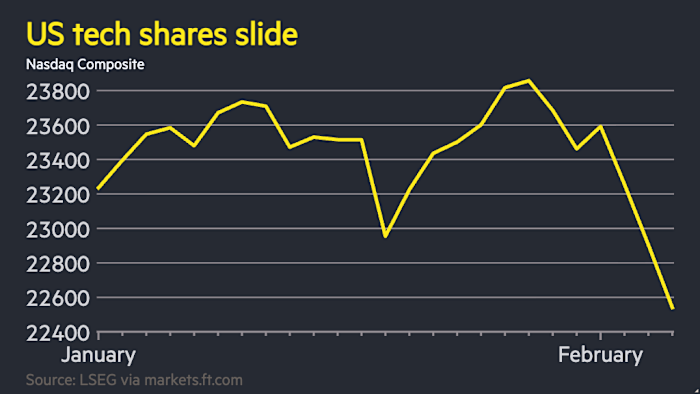
US tech stocks fell on Thursday, as weak jobs data piled further pressure on a market reeling from a big sell-off in the software sector.
The tech-heavy Nasdaq Composite fell 1.6 per cent, its third consecutive session of heavy losses and leaving it on track to post its worst week since US President Donald Trump’s “liberation day” tariffs rocked markets last April. The blue-chip S&P 500 dropped 1.2 per cent.
Bitcoin, a speculative asset that tends to fall sharply during times of market strife, dropped more than 12 per cent, pushing it below $65,000 for the first time since 2024.
A private labour market survey for January from Challenger, Gray & Christmas on Thursday showed job cuts in the US jumped last month, the worst start to the year since 2009.
“You have a bigger macroeconomic story here about a weak labour market,” said Kristina Hooper, chief market strategist at Man Group. The Challenger data, alongside separate figures showing US job openings fell to their lowest level in more than five years in December, “have caused concern about growth this year”, Hooper added.

Qualcomm fell 8.5 per cent after the chipmaker signalled on Wednesday that a shortage of memory chips could limit the production of smartphones. Amazon and Microsoft each lost about 4 per cent.
Amazon slid a further 7.6 per cent in extended trading in New York on Thursday after it said its capital spending would surge more than 50 per cent in 2026 to $200bn.
Palantir, which has been among Wall Street’s best performers in recent years as traders bet on AI stocks, dropped nearly 7 per cent.
Software stocks and chipmakers have been hit particularly hard over the past few trading sessions, as investors worry that new coding tools, including those released by AI group Anthropic last week, will upend sectors such as law, publishing and advertising.
The software worries ricocheted through the market, helping pull down the stocks of private credit groups Ares and Blue Owl, which have been major lenders to software companies in recent years. Both groups reported earnings on Thursday morning, with Ares falling 11.2 per cent and Blue Owl down 3.4 per cent, having earlier hit its lowest level since 2023.
The Vix, a measure of market volatility expectations popularly known as Wall Street’s “fear gauge”, reached its highest level since late November.
The drop in stocks sent investors into safer corners of the market, including Treasury debt. The two-year Treasury yield, which moves with interest rate expectations, hit its lowest level in a month, falling 0.08 percentage points to 3.48 per cent.
Additional reporting by Ian Smith in London. Data visualisation by Ray Douglas