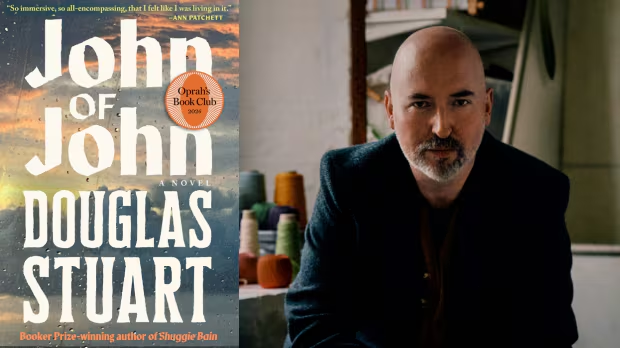
Douglas Stuart has lived many lives in one — but they each began when he was growing up as a working class queer kid in Glasgow.
“I was raised by a wonderful mother, but she was a single mother and she struggled with addiction my entire childhood. And it often meant that I spent hours with her just sort of watching her, and wanted to be around her,” Stuart told Mattea Roach on an episode of Bookends.
In their time together, his mother taught him to knit, and they poured over clothing catalogues. That set him on the path to a life in the fashion industry, working for brands including Calvin Klein and Banana Republic.
He was an executive at Kate Spade when fashion began to lose its shine. After 10 years of secret writing and many rejections, he published his first novel Shuggie Bain. It won the Booker Prize in 2020.
Stuart’s novels examine the working-class Scotland of his memories, each from different angles. In his latest, John of John, Stuart returns to familiar themes in a new Scottish setting: the Hebridean island of Lewis and Harris. The novel centres on young returning islander Cal and his relationships with his father and grandmother, his queerness, their Calvinist religion and belonging.
Stuart spoke to Mattea Roach about his fascinating career, and why Scotland is still on his mind despite having made his home in New York City.
What was that process of falling out of love with fashion and starting your writing career like?

It was very slow. And in fact, they dovetailed for many years when in about 2008, I started to write the first draft of Shuggie Bain. At the time, I was the head or one of the heads of menswear design for Banana Republic. And I think to my family and my friends, I looked like I had everything that I had ever wanted. But it was a very demanding job. And anytime you were creative in the fashion studio, there was someone right beside you asking you to make it faster, cheaper, just wanting to change your idea constantly. I sat down one Sunday and I just started to write, and it poured out of me. And for the 10 years that I worked on Shuggie Bain, I didn’t tell anybody. I was very careful not to tell any of my colleagues in fashion. I didn’t tell any of my friends because I wanted to have something in this world that I could protect and nurture, and that was just for me. But also I wanted to be able to fail in private if I was going to fail.
John of John is your first novel where you’re moving away from Glasgow and writing about the Hebrides, off the west coast of Scotland. This is an area that has a very distinct cultural identity. Can you describe for our listeners what it’s like there?
The Outer Hebrides are an archipelago of islands off the northwest coast of Scotland. And each island has its own culture. It has its own unique personality. But the island that I was very interested in is the Isle of Harris and Lewis, specifically the portion that’s known as Harris. It’s a place where many things converge and hold on. It’s one of the last strongholds of the Gaelic language in Scotland, which of course is a minority language. It is a stronghold of a very devout, strict form of Calvinism or Presbyterianism. It is a place where crofting or subsistence farming, which is sort of a dying tradition, is still going strong.
In 2019, a few months before Shuggie Bain was about to publish, I really wanted to start writing a new novel. And I thought, I’m going to go to the Outer Hebrides because I felt like there was a story there. I thought, I want to write what it is to be young and queer and working class, but also living on a farm and living somewhere that feels a little separate to the large cosmopolitan areas. And so I went for 12 weeks only knowing two people on the islands. And it was a trip that transformed my life.

Your main character Cal returns to Harris from mainland, urban Scotland. One thing about being in these small, isolated rural communities is everybody knows your business. What’s that transition like for Cal as a character? I’m also curious for you as an outsider whether you even started to feel that a little bit, during your time on the islands.
Yeah. In fact, my 12 weeks on the islands were some of the loneliest times of my life. And I found that even though I was alone all of the time, whenever I would go to the shop, someone would say, oh, you were on the beach on Wednesday, or you did this on Thursday. And I realised I was alone, but I was never quite unobserved. That was an idea that really stuck with me.
I set the house that they live in at the end of the road because it means anytime Cal has to go somewhere, he has to walk past all of his neighbours. As a young queer person, that was one of the feelings that I remember most, is every time I left the house, I would sort of change how I walked and how I stood and how I presented myself, because I was aware our neighbors were watching us.
One thing that I so enjoy about your writing is that there’s a lot of really difficult material that you’re dealing with, but there’s also a lot of humor and tenderness. How do you strike that balance when you’re crafting a novel?
I don’t think you can write a truthful novel about Scotland and not make it funny. I find my own people incredibly funny. Humour was often the only thing we ever had to make things a little better. It’s just a lifeblood of Scotland, and anybody that’s ever spent an afternoon in a Glaswegian pub, where the guy that sits next to you at the bar will tell you the saddest story you’ll ever hear in your life that will also have you howling with laughter, sort of understands how it’s part of a national nature.
Edinburgh is a beautiful city and it’s full of middle class people, and Glasgow is a very working class city. There is a saying in Scotland that says you will always have more fun at a Glaswegian funeral than you ever will at an Edinburgh wedding, and I think that captures the sense of the country altogether. It captures the unsinkable spirit of the working class and how humour is always available to us even in the darkest of times.
All of your novels have been focused on Scotland. You’ve been living in New York City for more than 25 years now, which is a place that’s also famous for its abundance of stories. Why do you keep returning to Scotland as a writer?
There’s a deep homesickness in me. I think the fact that I’ve lived at a distance has made me long for both a place, but also a certain time in that place. The country has transformed so utterly since it deindustrialized at the end of the 20th century. And now it’s one of the most liberal countries in all of Europe. But with that change feels like a sweeping away of a childhood or a sweeping away of an experience. You never really see working class voices in fiction or celebrated in the arts and now that the country is utterly changed, I also fear that it will be lost forever. I think that’s been one of the unmovable heartbreaks of my life.
I think that’s been one of the unmovable heartbreaks of my life.– Douglas Stuart on watching the Scotland of his childhood change
Many of us leave home and go to live other places, but when my mother died when I was 16, I lost my family home. And I think that rupture in my life has left me with a lot of questions I have to answer, and that’s what’s really fueled these three novels. So though they’re very different stories, the central theme I think is belonging. And I think in a way it’s just me wrestling with bigger questions of home in my own life.