Key events
What we learned today, Monday 17 August
That’s a wrap on our live coverage for today!
Before we go, let’s take a look at the day’s top headlines:
-
Dozens of non-profit groups, multicultural advocacy organisations and social service agencies have urged the federal government not to proceed with changes to limit work rights for temporary migrants.
-
The Nationals senator Bridget McKenzie says the first and only deal so far negotiated between the commonwealth and NSW to buy back guns in the wake of the Bondi terror attack might not work with the constitution.
-
The NSW government has committed to assessing new datacentre proposals within 75 days if they meet “world-class” energy, water and environmental standards, under a framework announced today.
-
Gordon de Brouwer has been appointed chancellor of Australian National University, to replace Julie Bishop after months of turbulence.
-
The deputy Liberal leader, Jane Hume, has responded to Jim Chalmers’ claim that the Coalition would end the super guarantee, accusing him of making stuff up.
-
National Australia Bank has recorded an increase in the number of struggling customers amid relentless pressure on Australian households.
-
North Sydney Olympic pool has reopened following a temporary closure just one week after its five-year restoration.
-
Victorian public school teachers accepted the state government’s latest pay offer, calling off a statewide strike planned for this week and ending the year-long negotiations.
-
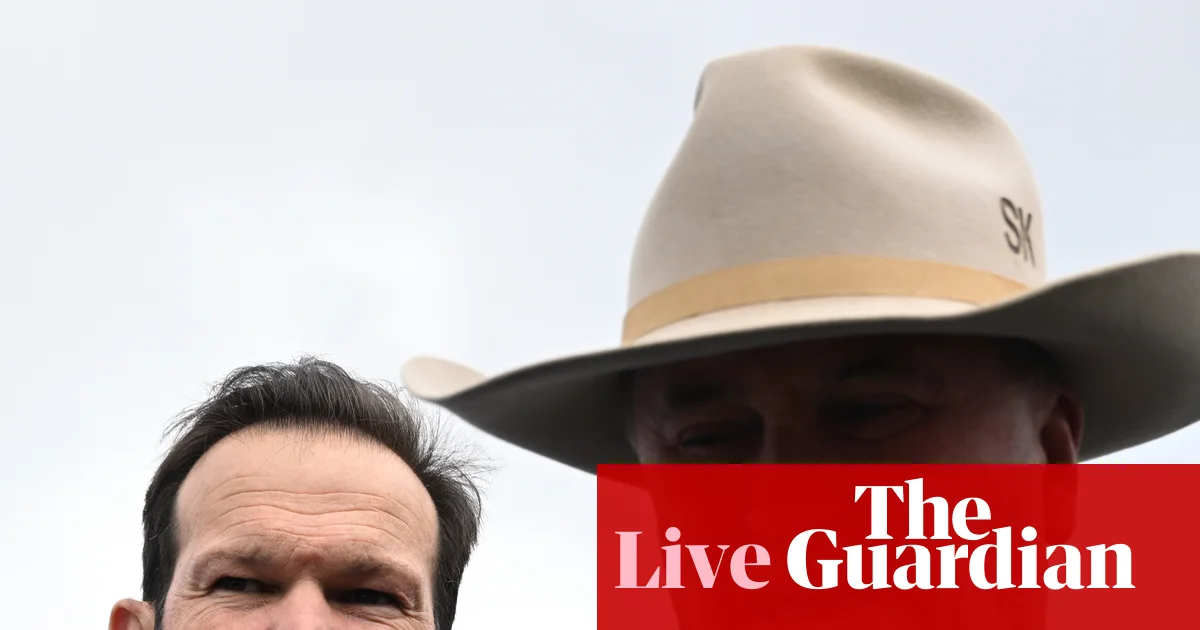
The Nationals leader, Matt Canavan, has welcomed the introduction of a controversial anti-abortion bill – described by experts as unnecessary, hurtful and misleading – to federal parliament.
Thanks for sticking around, see you tomorrow morning!

Sarah Basford Canales
Working holiday visa cuts still ‘need to be considered’ as opposition prepares migration policy
The shadow home affairs minister, Jonno Duniam, says working holiday visas need to be considered as part of the opposition’s policy to cap net overseas migration levels to “well below 200,000”.
Speaking on News24 earlier this afternoon, the Tasmanian senator, who is expected to announce the immigration policy before he retires in a few months, said the public would “know a number” and how the Coalition arrived at the number once it was finalised.
Duniam’s upper house colleague, Andrew Bragg, caused some consternation within the party last week when he said the net overseas migration (Nom) target should be set at 180,000 a year to prevent a housing shortfall in the coming years. Bragg said it could be achieved through “modest reductions” in visas for international students, working holidaymakers, and some unskilled workers.
The Nationals leader, Matt Canavan, quickly ruled out the junior Coalition partner’s support for working holiday visas and Bragg was counselled by the opposition leader, Angus Taylor, for going off script on a policy area he’s not leading.
But Duniam’s comments today suggest the opposition cannot pre-emptively rule out visa categories before the main work is done.
They only account for I think it’s something like 18,000 of the overall Nom. So to that extent, yes, [working holidaymakers] need to be considered. We need to be more targeted and work more closely with industry … I think the point I’m making here is that working holidaymakers, the surge in seasonal workforce we have – for both ag, horticulture, and hospitality – is necessary. And if we attack one section of or any visa subclass, then of course we’re going to have weighted outcomes there that are going to cause more issues than we already have.
Gina Rinehart owns A$1.5bn of SpaceX shares, company reveals

Luca Ittimani
Gina Rinehart’s company has revealed it holds 8m shares in Elon Musk’s SpaceX.
Rinehart’s Hancock Prospecting first announced its stake after the company listed on share markets back in June but declined to confirm how much it had bought.
US share market filings have now confirmed the company had 8m shares as of 30 June. At the time, those were worth US$1.37bn (A$1.93bn). Today, those would be worth US$1.12bn (A$1.57bn).
Hancock has previously responded to questions on whether it has sold or held onto its SpaceX shares with a statement describing Musk, the founder, as “an exceptional and brilliant person” with a “proven ability to use science for the betterment of mankind”.
Hancock’s American holdings rose from US$3.3bn in March to US$5.7bn, the filings show. SpaceX is its single largest holding.
It held or increased its position in all of its investments over the period. The company bought more shares in defence companies Lockheed Martin, Northrop Grumman and L3 Harris, software company CrowdStrike, media giant Fox Corp and Trump Media, the owner of the US president’s Truth Social platform.
Hancock also took on new investments, buying US$260m worth of S&P 500-linked exchange traded funds and taking stakes in a US rare earths developer and two gas producers.
Complainant C’s cross-examination begins in Alan Jones trial

Amanda Meade
Back in the Alan Jones trial, his defence barrister Gabrielle Bashir SC has begun cross-examining complainant C, a young man who worked for the broadcaster as a driver.
Bashir’s questions centred on C’s relationship with 2GB broadcaster Ray Hadley.
C accepted that Hadley helped him get a job at 2GB when he was 18 and paid his salary for three months – before he was employed to work for Jones as a driver.
Bashir asked C about his “Donkey” nickname with Jones.
Bashir asked in court: “It was you who first suggested the name Donkey?”
C replied: “Yes.”
Bashir asked: “You understood Donkey was a way to describe a man with a large penis?”
“Yes,” complainant C replied.
Bashir asked: “And that name and discussion of donkey became banter?
It was locker room chat?”
C said in court: “Yes.”
The trial before judge Glenn Walsh continues. Jones has pleaded not guilty to 22 charges of indecent assault and sexual touching.
Canavan and Joyce attend anti-abortion rally and back controversial bill

Tory Shepherd
The Nationals leader, Matt Canavan, has welcomed the introduction of a controversial anti-abortion bill – described by experts as unnecessary, hurtful and misleading – to federal parliament.
It’s the third time the “born alive” legislation has been introduced, despite its premise being debunked.
The issue of abortion has a history of causing ructions within the Coalition, and likely lost them seats at the 2024 Queensland state election.
The former opposition leader Peter Dutton then tried to quash it as an issue before the 2025 election.
The “born alive” bill was originally introduced by then LNP MP George Christensen in 2021, and reintroduced by Canavan and the Liberal senator Alex Antic in 2022.
The LNP MP Llew O’Brien brought it back in this morning. Debate was adjourned.
Canavan joined O’Brien, Antic and One Nation’s Barnaby Joyce and Malcolm Roberts at an anti-abortion rally outside Parliament House. He told Guardian Australia that some people think “it’s OK that babies can be born alive” after an abortion.
Canavan said:
I welcome debate on this because it is a matter of life and death. I am proudly pro-life.

Krishani Dhanji
Thank you for following along on the blog with me today!
I’ll leave you with the brilliant Achol Arok for the rest of the day’s news and see you here bright and early tomorrow.
Tl;dr here’s what happened in question time
-
Dan Tehan was booted from QT after telling Chris Bowen to “cut the crap” and reveal how much taxpayer money has been spent on the capacity investment scheme. Milton Dick said Tehan had disrespected him and the House.
-
The Coalition mainly focused on housing – on how many first home buyers were now in negative equity, and calling for transparency around the capacity investment scheme.
-
Dick early on in the piece had to cut off the housing minister, Clare O’Neil, after she ignored his warning to answer the question put to her by the opposition and kept attacking the Coalition.
-
The veterans’ affairs minister, Matt Keogh, was asked to explain why he refused to meet with veterans who had travelled to parliament house with concerns about access to allied health services, while some of those veterans watched on.
-
And the independent MP Sophie Scamps asked Mark Butler how the government would ensure individuals being taken off the NDIS would still be supported.
Question time ends
After a final dixer to the prime minister, Anthony Albanese calls time on QT.
Steggall asks for modelling on cuts to skilled migration
Independent MP Zali Steggall asks the treasurer what modelling his department has done on potential damage from cuts to skilled migration and holiday workers, and “which sectors or essential services would need to be scaled back due to worker shortages?”
Jim Chalmers starts by talking about the “essential contribution” migrants in Australia have made.
On the question of modelling, he says Treasury, the Productivity Commission, the OECD, Reserve Bank and others have done work on the issue and found “over time that migrants are more likely than not to make a big contribution to our economy – often they provide a big part of the dynamism and the innovation in our economy.”
He then goes into a full-scale attack on the opposition:
We have unfortunately heard, in recent times in particular, that there are some in our community, and especially in our politics sitting over there, whose primary purpose when it comes to thinking about dealing with migration in this country is to try and divide the community. And we reject that irresponsible approach. The approach that they take in talking down our economy and dividing our community is bad for our economy and it is bad for our society as well.
Minister is asked about cap on veterans’ allied health serices
Nationals MP Michael McCormack is next and asks the minister for veterans’ affairs why he’s refused to meet veterans in Canberra who are concerned about a $5,000 cap on veterans’ allied health services.
The minister, Matt Keogh, says the government has committed $177m in funding to increase the fees for allied health workers treating veterans, and removed the burden on veterans being forced to get a new referral every 12 sessions.
McCormack soon makes a point of order because Keogh hasn’t said why he’s refused to meet the group of veterans who have travelled to the capitol. Milton Dick tells Keogh to answer the question.
While Keogh continues, members of the opposition shout “shame” louder and louder.
We’re in the process of putting together a discussion paper that will be released for broad consultation with the veteran community … As they were informed last week by my office, I was unable to meet with them today but, as I have continually said and engaged with many ex–service organisations, we wish to engage with them and the practitioners in allied health services.
McCormack tries to table the letter of refusal from Keogh but he’s not granted leave (which means that the government refuses the request).
‘A lot of work’ to do on disability foundational supports, Butler says
How will the government ensure that no NDIS participant is exited from the scheme until appropriate foundation supports are fully funded and operational, asks independent MP Sophie Scamps.
The health minister, Mark Butler, says states and territories are working towards having adequate supports in place via Thriving Kids, for children under nine, and foundational supports.
On the former, he says he’s happy with the progress he’s seeing, but on the latter, acknowledges there’s still a lot of work to do.
He also promises that no one will “fall between two stools without proper supports”.
Thriving Kids is well under way. I’ve seen implementation plans, I think, by all state governments with the exception of Queensland. We’re very satisfied with progress being made there. They will start to ramp up from 1 October, with the expectation that they will be fully rolled out from 1 January 2028,
Foundational support systems will have to be built for them as well. Kids over the age of nine and adults who might not end up being on the NDIS as a result of that new test being introduced. And there’s a lot of work for state governments and the commonwealth to do there. We’re committed to doing that work.
Take three: Coalition continues questions on capacity investment scheme
Liberal MP Garth Hamilton picks up where Dan Tehan left off – but with some much safer language.
He asks “will the minister just tell Australians how much Labor’s secret capacity investment scheme is costing taxpayers?”
It’s the third question pushing for some details on the capacity investment scheme.
Chris Bowen still won’t answer the question and give us a figure. He says broadly:
The capacity investment scheme was treated in the budget in a very similar way – in fact, identical way – to previous government programs of a similar nature. Including programs that were administered by the then–minister for energy, including underwriting new internally generation investments, including Snowy Hydro 2.0.
The opposition tries to make a point of order on relevance, but Bowen sits down, indicating he’s ended his answer.
‘Cut the crap’: Dan Tehan gets booted from the chamber
The manager of opposition business, Dan Tehan, asks Chris Bowen: “Would you just cut the crap and tell Australians how much your Capacity Investment Scheme is costing taxpayers?”
That doesn’t go down well with the speaker, Milton Dick, who says that “language is beneath the dignity of this house”.
Independent MP Zali Steggall says he should get kicked out immediately.
Dick gives Tehan another go, warning him to use better language, which Tehan ignores.
My question is to the minister for climate change and energy: Will the minister just cut the faecal matter and tell Australians how much Labor’s Capacity Investment Scheme is costing taxpayers?
There’s a collective groan and some shouting from the government benches.
And Dick tells Tehan he’s completely disrespected the speaker and to get out. Dick then skips the question entirely.
‘Appreciate the notice the opposition gave on the front page of The Australian today’: Bowen
Nationals MP Llew O’Brien is next and asks the climate change minister, Chris Bowen, how much the government has given to foreign investors under the capacity investment scheme which underwrites major renewables projects.
He cites a story in The Australian that revealed private companies had about $40bn in social licence commitments under the CIS.
Bowen dryly thanks the opposition for the heads-up on the question with the story on The Australian newspaper’s front page this morning.
I particularly appreciate the notice the opposition gave on the front page of The Australian today, which says “The Coalition on Monday will launch a parliamentary attack under the … scheme.” I thought it was Christmas, but there you go. You learn something new every day.
I guess, given it’s the first time the opposition’s asked me a question since April, it’s a big deal. You have to flag it on the front page of the national broadsheet.
He then doesn’t answer the question anyway, claiming that deals under the CIS are commercial in confidence:
When you are operating an auction, what you are doing is calling on people to put forward bids. And if you reveal the outcome of those bids, you are undermining the position of the taxpayer.
Labor pledges new ‘opt-out register’ for gambling ads

Josh Butler
Breaking into question time with some breaking news. The Labor government has pledged a new single-service opt-out register for gambling ads – a similar idea to the Do Not Call register for spam calls – as part of its amendments to its wagering ad bill.
Communications minister Anika Wells has also confirmed Labor will clamp down on inducements and inducement advertising, as well as limiting some commissions for gambling employees.
Wells has today introduced a third gambling bill into the parliament. The existing legislation will be advanced tomorrow, but this new bill sets out a few of the government amendments to their own plan.
The bill’s explanatory memorandum says the government’s plans include “restricting the use of inducements by licensed interactive wagering service providers”, plans to prohibit “inducement-based direct marketing and social media advertising to certain customers, restricts attempts to obtain consent to receive such marketing, prohibits certain commission-based referral arrangements”.
A major change is a new “Wagering Advertising Opt-out Register”. We’re seeking information about how this would work, but the government says it would “provide a single mechanism through which individuals may opt out of receiving wagering advertising from online content service providers”.
Wells said in a speech that the register would “provide Australians with a ‘one-stop shop’ to opt out of seeing wagering advertising on online platforms.”
The Australian Communications and Media Authority will be responsible for implementing and enforcing these reforms, including monitoring compliance with the new restrictions and establishing and administering the Opt-out Register.
This Bill enables the ACMA to recover the costs of those activities through a levy imposed on licensed interactive wagering service providers. It is appropriate that the wagering industry, rather than taxpayers, bears the costs of regulating these activities.
‘It’s not rocket science’: Coalition and Labor spar on housing
Why has the number of first home buyers dropped by 6% this calendar year, asks shadow treasurer Tim Wilson.
The latest Australian Bureau of Statistics release shows that in the last quarter, new owner occupier first home buyer loan commitments for homes fell 2.9%.
Clare O’Neil says:
There have been more first home buyers each and every year under our government than there have ever been under any other government in Australian history.
She then tries on a bit of a “compare and contrast” which the opposition immediately tries to shut down, saying it was a very tight question.
Milton Dick rules that O’Neil can do a bit of a compare and contrast but it has to be relevant to the question.
O’Neil continues, and decides to stay positive and not criticise the Coalition.
We all read the newspapers on the Sunday morning. For the first time in my life, they are peppered with article after article about first home buyers around the country who are going to auctions and winning.
It’s not rocket science. It’s a very simple reason that they’re winning auctions, Speaker, for the first time in 25 years – first home buyers are standing on a level playing field.
Coalition launches question time on first home buyers and negative equity
Liberal frontbencher Aaron Violi has the first question today, and asks the housing minister how many people who have used the 5% first home deposit scheme are in negative equity in her electorate of Hotham in Melbourne.
Clare O’Neil chooses not to answer the question asked, and takes a jab at the opposition, saying it’s “fascinating” that they’ve asked this question with the “young leaders of our country gathered here in the gallery”.
She’s referring to the youth parliament program taking place today, with 150 senior school students attending QT today.
The Coalition quickly jumps in to say she’s not being relevant, and Milton Dick agrees, telling O’Neil to stop talking about the opposition.
O’Neil continues, talking about “homeownership rates for young people falling through the floor” and while that’s not untrue, she’s still not answering the question, which makes Dick pretty annoyed.
He cuts her off with a stern warning:
The minister will conclude her answer. She’s not being relevant to the question. We’ll move to the next question. Ministers also have to follow the standing orders.