
Photo-Illustration: by The Cut; Photos: Getty Images; Courtesy of Balenciaga and Jean Paul Gaultier
In July 2021, Demna held the first couture show in the salons at 10 Avenue Georges V since its founder, Cristobal Balenciaga, closed the house in 1968 — he thought for good — and retired to Spain. The moment was incredibly exciting. A great contemporary designer with a vision was about to marry his singular silhouette and language with that of a mid-century master in the Paris couture, someone who never spoke publicly to the press. At Demna’s urging, the brand — part of Kering — had spent a small fortune to restore the salons to their hushed, creamy intimacy.
Demna had a purpose in wanting to do couture. He thought it could be modern and relevant. You could have the most perfect-looking trouser suit in a new cut, but also a T-shirt and a hoodie done with equal care. In the silence of those rooms that day, he disturbed everyone’s peace — and changed minds.
Nothing like that happened on Wednesday at Pier Paolo Piccioli’s debut for Balenciaga couture.
Held in the garden of a grand public building, in scorching heat, it was all pomp and pomposity, and no purpose. Piccioli essentially reprised the volumes, drama, and colors he was known for as Valentino’s creative director, with Balenciaga attachments — a severe line here, a balloon skirt there. Nearly all the looks swept the ground, making them seem less a dream, as Piccioli claimed, than an obstacle to ordinary movement. He said he wanted to embrace Cristobal’s principles, but do they matter if the results look out of touch with reality? Besides, the best way to handle a founder’s principles is to either ditch them altogether or approach them from an angle — as Demna did, and Nicolas Ghesquière did before him.


Balenciaga. Courtesy of Balenciaga.
Balenciaga. Courtesy of Balenciaga.
Reverential fashion is a bore. The audience is beyond that, although I was a little surprised to hear many people swooning over the shapes as we left the garden. What were they seeing? An image? Or an actual woman? In the context of this show, the difference was vast and nearly a disturbing void. Demna led his audience somewhere. He continually surprised us with the possibilities of fashion, of an original, shattering silhouette. And that’s not the case with Piccioli. He was never the right person for Balenciaga. His first two ready-to-wear collections were largely a synthesis of other designers’ work. And now he has produced a very pretty, very worked bunch of fancy clothes that leave you feeling cold in the noonday sun.


Balenciaga. Courtesy of Balenciaga.
Balenciaga. Courtesy of Balenciaga.
I kept thinking of the purpose of couture as I watched Duran Lantink’s debut later in the day for Jean Paul Gaultier, in the founder’s elegant maison, now a perfect Swedish sauna. I think I lost a couple of pounds. I really like Lantink’s imagination and ambition. The shapes in his last ready-to-wear collection, which included allusions to stud cowboys, were enthralling, with a hard-to-define sexiness.
And I liked a lot of his couture collection, especially the sharp Gaultier-style tailoring with Duranian distortions and, as well, the amount of regular clothes, like sculptural denim jackets (Gaultier had jeans in his first couture show, in 1997), and recycled motorcycle leathers with peddle-pushers. More brilliant still was a kind of Mad Max vest in molded oxblood leather. “I wanted to explore the combination of technology with handcraft,” Lantink told me. “Can I find romance there? Or is it impossible?”


From left: Photo: Courtesy of Jean Paul GaultierPhoto: Courtesy of Jean Paul Gaultier
From top: Photo: Courtesy of Jean Paul GaultierPhoto: Courtesy of Jean Paul Gaultier
The implicit tension of that question gave the collection a certain edge. Marie Antoinette and the 18th century, plus the French Revolution, loomed in the background, and came out strongly in the closing look, a court dress reduced to its rigid panniers, with sprays of oxblood tulle gushing out at the sides, the model’s legs exposed. To me, the almost antagonistic shape was post-Galliano, who also drew on the 18th century. And we are again living in an age when people want to eat the filthy rich, and I sensed that maybe Lantink was unconsciously touching on that with his almost violent shapes. Other dresses, with rounded and extended fronts or backs vomiting tulle, made me think of drain pipes or the industrial façade of the Centre Pompidou in Paris.


From left: Photo: Courtesy of Jean Paul GaultierPhoto: Courtesy of Jean Paul Gaultier
From top: Photo: Courtesy of Jean Paul GaultierPhoto: Courtesy of Jean Paul Gaultier
Still, as much as I liked a lot of what he was attempting to do with his very first couture collection, I kept wondering why he was doing it. What does couture mean to him? I must admit I didn’t feel anything watching the show, and I didn’t have that delighted sense of wonder when you see something strange and new — as I did in his March ready-to-wear. I think that question of why is something he has to explore.
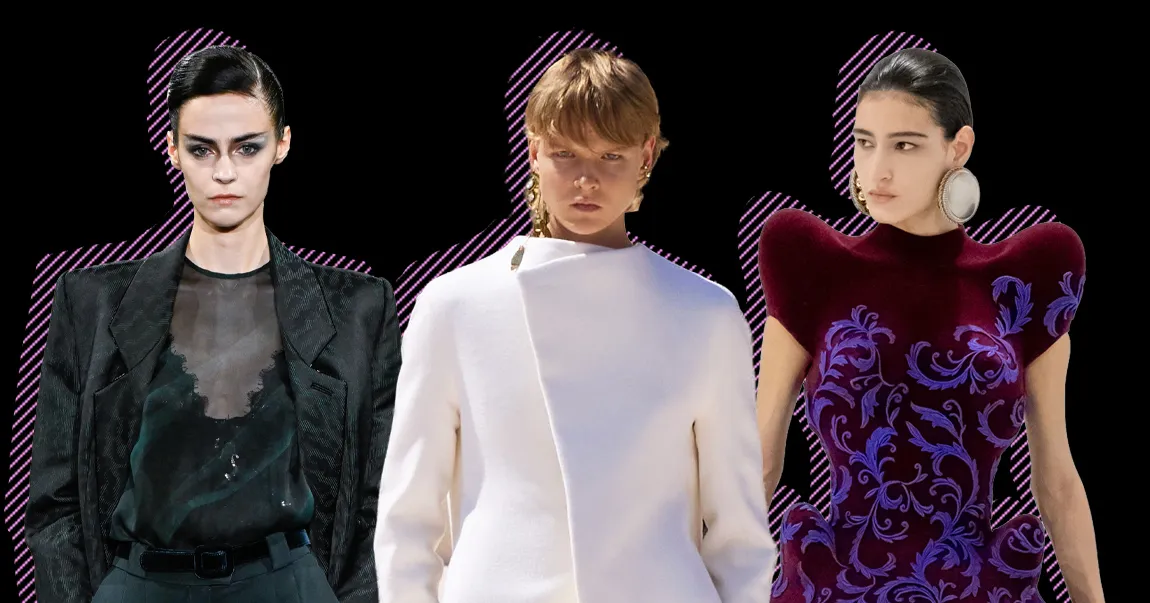
Silvana Armani, who is overseeing Giorgio Armani, struck a lean, sharp look at Armani Privé, confining herself to smoky hues of blue, mauve, and purple, with plenty of tailoring, lacy feminine bits, and a predictable number of tasteful strapless gowns. But everything was a little uptight, in an apparent effort to be more “modern” — a default position when you don’t have a real vision. I missed fluid Armani, and the Armani who wasn’t overly conscious of what his audience thought it wanted from him.


Armani Privé From left: Photo: Dominique Maitre/WWD via Getty ImagesPhoto: Estrop/Getty Images
Armani Privé From top: Photo: Dominique Maitre/WWD via Getty ImagesPhoto: Estrop/Getty Images