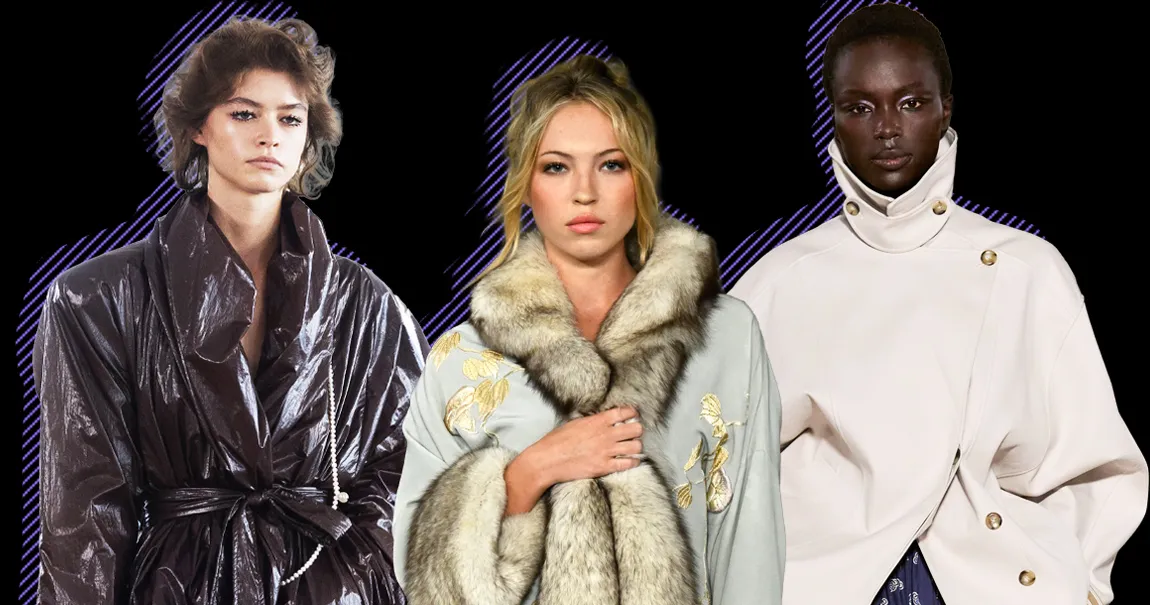

Photo-Illustration: by The Cut; Photos: Courtesy of Magda Butrym, Shutterstock, Courtesy of Altuzarra
Connor Ives, a young New Yorker who set up his fashion house in London, and who had a great show there last season, brought his act to Manhattan, taking over the famous Pool Room of the former Four Seasons. The last time I was there was for Marc Jacobs’s wedding in 2019. Magda Butrym, a Polish designer with a celebrity following, also joined the weekend mix. Demi Moore turned up for her show at a loft in Chelsea that cooked like a greenhouse.
For some reason, Butrym’s clothes reminded me of Donna Karan’s original “five easy pieces.” She had the glamorous belted coat, a bodysuit (hers with a delicate blouse attached to the jersey bottoms), a pencil skirt, and various fitted jackets or suits. Is that five pieces? The style was overtly feminine, but unlike Karan’s visionary collections, I couldn’t see a real concept or an urgent expression of how a woman might want to look.


Magda Butrym From left: Photo: Courtesy of Magda ButrymPhoto: Courtesy of Magda Butrym
Magda Butrym From top: Photo: Courtesy of Magda ButrymPhoto: Courtesy of Magda Butrym
It’s not news that a lot of young women want some mixture of sex and romance in their clothes, and they don’t necessarily want what the more prestigious luxury brands are selling. An executive of Moda Operandi told me that Ives’s fall collection has been one of the retailer’s best sellers. I wasn’t blown away by his show on the wall-to-wall of the Pool Room. It was obvious that Ives was going for a lighthearted parody of the hungry party girl, starved to near perfection (in Tom Wolfe’s words) in her tiny, pretty clothes with makeup and a hairdo that transforms her into a doll or perhaps a pet fox.
Still, I can see the instant appeal of a sleek dress in red silk embellished with flowers, the silliness of a minidress that is essentially a bustier, and his hot take on a matador’s costume. Ives’s looseness, and his ability to connect with a fresh wave of socialites and “It” girls, gives him an edge in the marketplace, as the Moda Operandi executive knows. But I did miss the throwaway — British? — humor of his previous show. On Saturday, he gave us a taste, I suppose, with a polo shirt worn over an embellished wrap-around micro-mini.


Conner Ives From left: Photo: ShutterstockPhoto: Shutterstock
Conner Ives From top: Photo: ShutterstockPhoto: Shutterstock

Photo: Conner Ives
Khaite’s Catherine Holstein also went sexy-romantic with full skirts, flouncy tops with bits of fabric stuck to them, and lingerie elements. Holstein may have been sailing with the fashion wind or just following her own fancy — fair enough — but I don’t believe the results. We’ve seen romance from lots of designers over the years, and the best have a sense of irony, wit, or daring that saves them (and the audience) from the shallows. Not Holstein.


From left: Photo: Courtesy of KhaitePhoto: Courtesy of Khaite
From top: Photo: Courtesy of KhaitePhoto: Courtesy of Khaite
By contrast, Joseph Altuzarra had a great idea and explored it in some depth. His inspiration was Casa Susanna, a retreat in the Catskills in the 1960s for men who wanted to cross-dress (as it was called then) and the wives who often accompanied them. Casa Susanna has been the subject of a book, a documentary film, and a recent exhibition at the Met based on photographs taken over the years of the camp’s guests.
What I liked about the collection was Altuzarra managed to find a lot to say about gender roles, the constant to and fro between feminine and masculine styles, nostalgia, and a sense of hidden lives. That last notion came across in a black wool dress that peeled back to reveal a lingerie-inspired layer. There was a nice tension between, say, a sleek, 1960s-style pencil skirt and a cropped cardigan that looked almost louche. Men’s collars were lopped off shirts and added to women’s jackets but left undone — for texture, probably, but also to convey the sense that the process of assuming the identity or style of another gender is awkward or never fully completed.


From left: Photo: Daniele Schiavello / Gorunway.com / Courtesy of AltuzarraPhoto: Daniele Schiavello / Gorunway.com / Courtesy of Altuzarra
From top: Photo: Daniele Schiavello / Gorunway.com / Courtesy of AltuzarraPhoto: Daniele Schiavello / Gorunway.com / Courtesy of Altuzarra
And if you didn’t know the story behind the clothes, it wouldn’t matter. They made sense on their own. I particularly loved Altuzarra’s clever use of madras — for sleeveless silk dresses. I always think of madras as such a Wasp fabric out of a Cheever novel. Also strong were pleated silk shifts with embedded lingerie elements. My only gripe with the collection was some of the trapeze-shaped jackets didn’t quite work. They were meant to suggest men’s trousers that had been inverted with the belt loops at the hem of the jacket. But the effect just looked forced and heavy.


From left: Photo: Daniele Schiavello / Gorunway.com / Courtesy of AltuzarraPhoto: Daniele Schiavello / Gorunway.com / Courtesy of Altuzarra
From top: Photo: Daniele Schiavello / Gorunway.com / Courtesy of AltuzarraPhoto: Daniele Schiavello / Gorunway.com / Courtesy of Altuzarra

Photo: Daniele Schiavello / Gorunway.com / Courtesy of Altuzarra