
Sign up for the Slatest to get the most insightful analysis, criticism, and advice out there, delivered to your inbox daily.
The primary impulse I have after listening to Charli XCX’s new album is not to debate whether it’s the proper, or perhaps properly improper, follow-up to the pop singer’s 2024 season-and-color-and-lexicography-defining hit record Brat. It’s to be in an arena, shouting along to David Cronenberg intoning, “They are dead, they are gone, no one lasts forever,” as he does over and over at the end of the final track of Music, Fashion, Film.
It’s a sample from a conversation Charli XCX had with the 83-year-old Canadian body-horror auteur last year about a health crisis in which he collapsed on the sidewalk. She asks what went through his mind in that moment: Did he think about his art? Of course not, he says. He thought about people, about life. Art is not about immortality—if it lives on beyond its makers, they’ll never know, and they are much better off that way. “Hear me assuring you that oblivion is freedom,” he insists. “They are dead, they are gone, no one lasts forever.”
He is looped repeating and repeating the phrase until you think your head might explode, as in Cronenberg’s movie Scanners. But as it goes on, it instead starts to become oddly musical, even kind of catchy. This is thanks to the “speech-to-song illusion,” a scientifically observed syndrome: If you repeat a passage of human speech again and again, the rise and fall of the person’s voice will begin to seem like a melody, until it can sound as if the person is actually singing. There’s a long history of musicians taking advantage of this effect, such as the late Scott Johnson in his 1982 composition “John Somebody,” or Charles Spearin of Broken Social Scene, who set his interviews with his Toronto neighbors to music on his 2009 album The Happiness Project.
On MFF, Cronenberg’s at first morbid-sounding quote becomes more comforting as the cadences of the words no one lasts forever coil round and round, swaddling your ears, buoyed by bleeping and blooping harmonies from producers A.G. Cook and Finn Keane. A little longer and it becomes galvanizing, a proclamation of faith, the central litany of a whole new afterlife-free church—“They are dead, they are gone, no one lasts forever.” Take me to that revival meeting for those never to be revived!
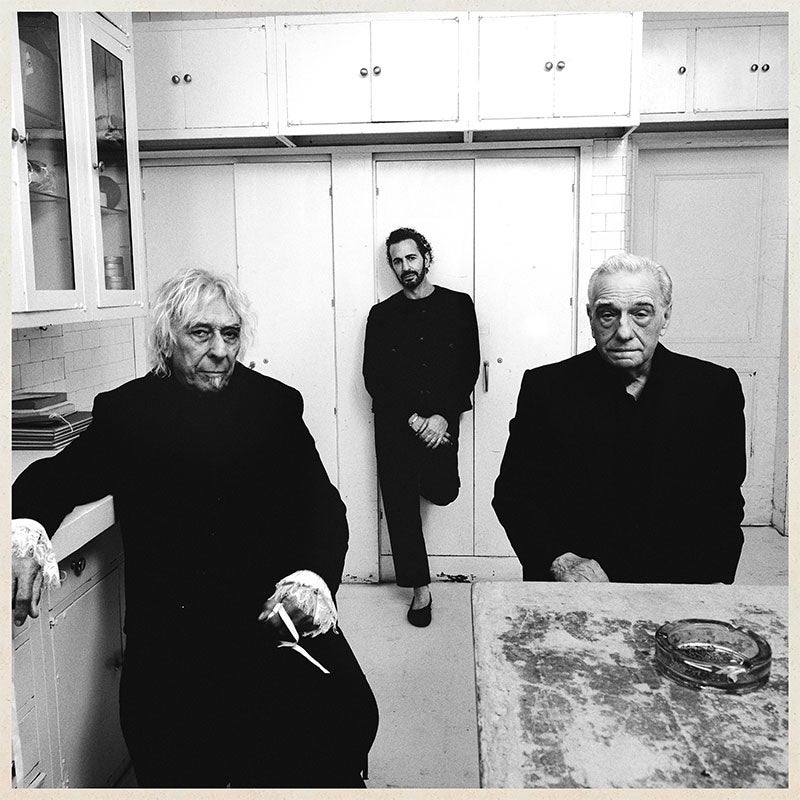
Cronenberg’s cameo as the only “guest feature” on this album is even more unexpected than that of Velvet Underground co-founder and veteran art-rocker John Cale on XCX’s previous project, the soundtrack to Emerald Fennell’s Wuthering Heights film, released in February. Cale also appears in the black-and-white photo on the cover of Music, Fashion, Film, representing the first of the titular arts, along with Marc Jacobs for fashion (XCX has worked with him on campaigns before), and, weirdly, for film, rather than Cronenberg, Martin Scorsese, who as far as I know has no previous link to her. Some might ask why they all have to be older white guys, but that’s the flex, that XCX (not pictured) is asserting herself as their peer, as the inheritor or sum total of such an established artistic trinity.
The larger mystery, though, is why an alternative-pop icon in her supposed peak period would want to end her new album on such an apparently doom-laden note. Caryn Ganz, in her Rolling Stone review, counted 27 repetitions of Cronenberg’s killer line, tying it to the ominous significance of that number in popular-music lore. But Charli has outpaced that particular curse already, as in a week she’ll be “turning 34,” as she sings somewhat ruefully in “Camera.” Was there something about changing from cult artist to culture dominator midway through her career that got her preoccupied with death? Should listeners be concerned?
No, what she’s found in Cronenberg’s thoughts on artistic transience is more a counterweight to the temptations of what she calls, earlier in the track, “the crushing highs and lows of ego.” The repeating loop also sets the director’s words as a kind of mantra. In this way, Music, Fashion, Film is a kind of very noisy meditation album, a spiritual quest to escape that self-importance. “Don’t fucking choke on your ego when you see me coming,” she sings on the compelling “Persona,” a “You’re So Vain”–like poison-pen track, except that it’s so clearly directed as much at herself as at anyone else (a move that undercuts the whole notion of the pop diss track, the object of so much gossip around Brat). On “Camera,” she sings about how she craves performing on film because of a kind of violent dispossession that is “the only way to feel like I’m not actually me.”
In search of those depths, XCX still proceeds, in her own patented style, by way of the superficial. She’s driven to probe and undermine her relationship to the hedonistic markers of sexy-crazy-cool that have been integral to her music since she emerged as an It Girl of the U.K. underground scene as a teenager a decade and a half ago. In case you doubt how much the limits of ego and fame have been on her mind since she came out of the Brat album cycle, see the long, tortuous essay she published on her Substack in December about the contradictions of cool becoming commercial. Also her more recent muddled musings about “anti-marketing.” Then there was her starring role in The Moment, an attempted satire of the Brat phenom that premiered at Sundance this winter and, like so much would-be anti-marketing, inevitably succumbs to being just marketing by other means.
Here, she carries on those interrogations in songs like “SS26,” in which she sings, referring in part to her Indian background on her mother’s side, “Think my politics could work as a press strategy / And my heritage could give me quite the USP [unique selling point] … Yeah, we’re walking on a runway that goes straight to hell.” With the title initialism standing for the current fashion season, XCX connects pop culture with the sociopolitical zeitgeist as she seldom has before, including perhaps the fact that the same time of year has now become the annual climate change–fueled wildfire season: “Spring–summer ’26 / The world is gonna end, no hope for any of it.”
MFF is more effective as critique than any of her tweets, Substack entries, and mockumentaries. It lasts only a half hour, neither takes itself too seriously nor insists too hard on its jokes, and reminds both herself and us that whatever all the other trappings and traps, most of all she’s just always had a fucking great time making music with her friends. It’s too soon to say for sure, but personally, I might even prefer the result to its celebrated fluorescent-chartreuse forerunner.
“Brat be damned” was definitely the dare of the first single “Rock Music,” which came out in May and prompted abundant and overblown pearl-clutching from dance-pop devotees over its chorus, “I think the dance floor is dead / So now we’re making rock music.” Even Madonna, with an album of her own to pump up, felt compelled to pipe in. XCX was simply being cheeky, of course, declaring that she didn’t want to repeat herself and doing it by blaspheming the tenets of the scene that birthed her, which in her early years held it as a truth self-evident that rock was the world’s boringest music. Though, given all her stylistic turns, of course she’s flirted with the genre before, notably on 2014’s Sucker.
The rock-cliché send-ups are right there in the lyrics: “Wow, I’m really banging my head / I’m really hurting my neck / The nerve damage is real.” Much more so, they’re in the sound. When she sings the words rock music, Cook and Keane transform them into something more like “ro-#o-%o-$o-!ck music,” a digitally elongated cyber-distortion of the phrase, much as they do with anything resembling a guitar riff here. But it’s too bad all the humorless backlash led XCX and Co. to take back the provocation as much as they did, because the rock influence really exists on MFF, in a very 2026 way.
One of the breaks that this record makes with Brat’s style is that it isn’t based on the kinds of programmed beats, MIDI riffs, and studio plug-ins that determined that sound. Instead, on a lot of tracks, Cook and Keane laid down the structures with live instruments—among them guitars, drum kits, and synthesizers—before messing with them with a lot of more futuristic tools (including some A.I.-based ones, if you want something else to fret about). “We were running around the studio with as many things plugged in as possible, just doing the worst sounds, trying to find the ugliest things,” they’ve said of producing “No One Lasts Forever.”
So there is a kind of back-to-analog aspect at the core of this album, though only in a way that intersects with electronics and experimental noise—not the usual domain of chart music, but the genre slurry in which a lot of music by younger artists dog-paddles now. See, for instance, Underscores (April Harper Grey), who will be opening for XCX on tour this fall, and whose recent album U is an even richer exercise in grinding genre into mulch. The drawling speak-singing of a lot of XCX’s vocals—not nearly as auto-tuned as usual—recalls recent U.K. postpunk bands like Wet Leg and Dry Cleaning, and MFF shares some territory too with the neo-indie-sleaze wave of the past few years, though arguably XCX had been there first. And remember that she’s married, as of last year (as addressed here in “I’m Afraid”), to drummer George Daniel of the 1975, a group that has been transposing old rock gestures into new pop ones for years on end.
There’s rock ’n’ roll attitude to the quick ’n’ dirty concision of these songs, most of them under three minutes and willing to be mistaken for demos. Lyrically, many seem willing to get in, yelp out an idea, and get out. The track “Yeah,” for instance, mainly reiterates the words I don’t wanna over and over until XCX calls “Wait!” and announces, “Now I wanna feel it, yeah yeah.” Switch the pronouns to you and repeat. On paper, this may sound thin, but the ever-changing textures and tempos turn it into a minidrama about the unreliability of desire, of sexual or creative impulses that can shift in an instant and upend whatever we thought we knew. The title is maybe the most foundational of rock words (the verbal comet that brought Beatlemania on its tail), and its repeated use of wanna reminds me of the Ramones’ talismanic use of that informal compound verb (“I Wanna Be Sedated,” “I Wanna Be Your Boyfriend,” “I Wanna Live,” etc.), as well as Kim Gordon’s refrain in Sonic Youth’s “Kool Thing” (“I don’t wanna / I don’t think so”).
In interviews, XCX has said that she had been planning to take a break from music—she does have scads of film roles to do—until she was overcome with a sudden urge, which might partly explain the brevity. But I think there’s a more deliberate choice here not to give the public what it wants, post-Brat, to play harder to get. But that doesn’t mean it’s as paltry or tossed-off as it might initially seem. Rather than developing these songs by means of traditional craft, with more complete narratives and arrangements that progress in harmonic complexity, the labor here is in the microscopic details, the way that Cook and Keane are constantly mutating the timbres and textures of sounds from second to second.
One of my favorite tracks, “Card Declined,” is on one level a commonplace critique of consumerism: “Let’s go shopping / I’ll buy a handbag … I’ll buy some jewelry, a personality.” It grows sadder: “A mahjong sofa / A new apartment … A whole new life / Card declined.” But what draws out the emotion is the way the music evolves. An electric guitar riff redolent of early synth-punk such as the Normal’s “Warm Leatherette” becomes more and more processed, till it sounds like a CD skipping (if you remember that sound), then develops a further stutter, then a bass level, a high harmony, and a sustained hornlike synth accompaniment. Then it begins stopping and surging like a stalled engine, with XCX’s vocals otherwise seeming abandoned to a cappella. Eventually, that sound palette is replaced by a chamber-rock wash, like a distant echo of the Cale-era Velvet Underground, and the whole song repeats itself with XCX singing up an octave. Then that stalls, and finally stops dead, until the track switches into a completely different, pop-rock section that’s a miniature version of a song that was originally the B-side to “Rock Music”—proclaiming “I keep on thinking ’bout you every single day and night” to 1960s-style organ flourishes, but only for about 40 seconds. All that in 3:28.
These microdynamics are redoubled in the way sounds shift from track to track, making the album much better heard as a whole than song by song. If you weren’t hooked by the advance singles, try listening to it instead as an extended 30-minute suite. That makes me less impatient with the weaker songs, like “2007” (I can’t decide if it’s actual or mock nostalgic) and her sweet but overearnest tribute to collaborator Cook, “Magic Metal Montana”—if MFF really were a rock album, the latter would be the schlocky power ballad. This subordination of the individual units to the whole is a sort of model of the kind of enlightened perspective XCX is striving toward, one might almost say.
Almost, that is, if one weren’t worried about choking on one’s ego. Nothing lasts forever, life’s but a walking shadow, tomorrow and tomorrow and tomorrow and so on, but Music, Fashion, Film does make a fair go of its half hour’s strut upon the stage, even if it’s actually a catwalk to hell.