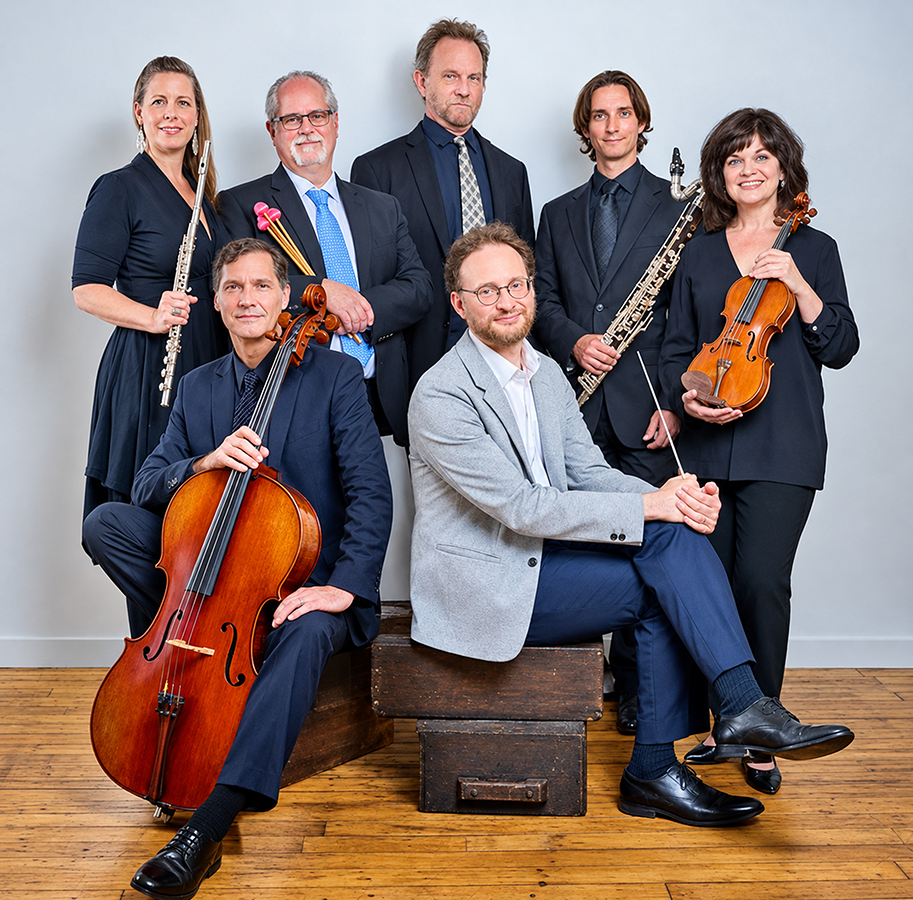
“The Fire Within” opened Collage New Music’s 54th season this past Sunday. Its core Pierrot ensemble of Sarah Brady (flute), Alexis Lanz (clarinet), Catherine French (violin), Jan Muller-Szeraws (cello), Craig McNutt (percussion), and Christopher Oldfather (piano) joined Artistic Director and conductor Eric Nathan in a program of all living and extremely contemporary composers, many of whom were in attendance at Longy’s Pickman Hall.
Spell, a clarinet, cello, and percussion trio with tape by the founder of National Sawdust in NYC Paola Prestini, seamlessly melded into the tape part, particularly Muller-Szeraws who blended his cello with the sounds to the point where they were nearly indistinguishable from one another. McNutt added to the atmosphere on the vibraphone while Lanz, breaking through the texture, brought of long lines across the ensemble. When given the chance to blend together in each instrument’s respective higher register, Lanz and Muller-Szeraws delivered on their duet, two performers very accustomed to one another. Nathan’s conducting, while relatively spare for this piece, pulled the sound out of the trio effectively. Right as the piece began to feel long in the tooth, Prestini rightfully trailed it off, casting the thought into the ether incomplete but finished.
 Katherine Balch’s musica spolia, reflective of vines growing around Rome during her time in the city for the Rome Prize, followed with the core ensemble fully represented. Oldfather and McNutt drove the opening with sharp attacks cast out into the sextet and picked up by the other instruments in an angular and spindly work effectively representing the free-flowing plants growing their way up architecture. Short effects exploded into larger, held notes from both Brady and French, French especially being able to straddle the line between support and attack well here. Later on, Oldfather seemed to reach repeatedly into the piano; were there preparations inside the instrument? From the audience perspective on Pickman’s floor, it was hard to tell, but the timbres and playing style certainly suggested it, playing into McNutt’s percussion effectively while, once again, making an instrument straddle multiple roles. Nathan had much more activity in this piece, needing to control far more and doing so with nice flexibility.
This reviewer had the pleasure of reviewing Niloufar Nourbakhsh’s Aid for Sex several years ago during the Tanglewood Festival of Contemporary Music (see HERE). Years later, the work still rings true and maintains a strong identity. Sharp and punchy material, march-like in quality and lead by Lanz with strength on the clarinet, it stood out this afternoon for its intensity. Moments emerged where a haunting and hanging repeated C-note line emerged from French with deftness and a chilling effect, but mostly the work felt relentless in its energy. Oldfather had an extended piano solo that gave way to shared percussive material with McNutt, the pair easily trading material in their respective percussive instruments. Nathan here shined in a different way, controlling time well and achieving that marcato sound with relative ease.
JaRon Brown’s sewn from a quilted puzzle of colours, a Collage co-commission, closed the first half. Heavily disco-inspired drum kit patterns emerged right from the beginning, lead by McNutt who showed his expertise with a variety of styles of percussion. Escaping otherwise straight-forward popular styles, Brown opted to make the work highly polyphonic and contrapuntal, different melodies meshing and clashing with one another like a quilt or a puzzle (see it in the title?). Some notes amidst the relative chaos: Muller-Szeraws had several lyrical solos throughout that deserved mention, and Oldfather with McNutt taking a break from the drum kit on his glockenspiel broke the pulse and barrage of lines with a sweet duet. The only complaint? The ending left something to be desired, fading into a whimper rather than ending strong like the composition seemed to be implying throughout.
The second half opened its larger-scale music, starting with Jagged Dancing Lights by Ileana Perez Velazquez, one of two compositions from the Frank B. Epstein Commissioning Fund. Inspired by images of Cubans dancing in joy despite their rolling blackouts and lack of food, Vasquez wanted to express joy in darkness. Interlocking lines eventually gave way to more polyphonic writing, each instrument carrying itself similarly to the Brown with and against the other voices in the sextet. Muller-Szeraws helped eventually establish a rumba groove that dominated the ensemble, separating it from other dense pieces on the afternoon fare; Oldfather deftly held onto the groove and developed it both in active playing and in short pauses in his solo, showing his own breadth of stylistic playing abilities. Brady and French expertly imitated each other near the beginning before French emerged as a soloist, breaking through the core of the clarinet/cello/keyboard instrument accompaniment with ease, singing out over the groove like a jazz combo soloist. McNutt also had a fun moment playing a large composite percussion setup of bongos, tom-toms, and other assorted skins to flesh out the rumba. An effective if rather long piece, the second half opened well enough.
Joan Tower’s Into the Night (adapted from her cello concerto The New Day) closed the concert with its reflections on the final days of her husband’s life and the cherished moments of having each new day with him contrasted with the terror of the night not knowing if he would survive. Pandiatonic clusters painted colors at the beginning before Muller-Szeraws rang out a larger solo, indicative of the concerto past of the adapted work. Lanz imitated Muller-Szeraws quite well as the ensemble began to agitate, the nervousness of the night setting in. Oldfather slammed the lower register of the piano, full of dread and pathos, while Brady expounded on a nervous yet hopeful solo immediately after. Tower exploited the dichotomy of the welcome day and the intense nights, making a far more clearly structured form that the players and Nathan could expound upon, Nathan having to really work here to hold the ensemble together through many character changes. Brady, Lanz, and McNutt summed up the entire conceit of the work near the end with a dichotomy-in-miniature ending, contrasting the nervousness and relaxation within the short trio near the end before everything relaxed into a comforting end, holding onto the love Tower had for her husband.
Collage continues its season with this program on tour at Williams College before its November 15th second program, “Scenes from a Novel.” This venerable new music ensemble still is going strong fifty-four years later, sounding fresh as ever and actively commissioning new music to cultivate the landscape rather than simply reframe our immediate past. We as audiences should continue to support this admirable goal, especially with an ensemble as important to the new music scene in Boston as Collage.