Sign up for the Slatest to get the most insightful analysis, criticism, and advice out there, delivered to your inbox daily.
Pop radio station Z100, in my hometown of New York City, is America’s most listened-to contemporary-hits radio station, with a regular audience “cume” of more than 2 million listeners at any given time of day. When I get into a taxi or a Lyft, there’s a decent chance it’s what I will hear pumping from the driver’s sound system—a steady diet of Taylor, Bruno, and Sabrina. But all summer long, one thing I haven’t heard wafting from cabs or passing cars—or at the drugstore, or my local café—is the undisputed 2026 Song of the Summer. That’s because it isn’t playing on Z100 or, indeed, at most New York stations (save one adult-hits station). In Gotham, this song may as well not exist.
And yet, I have no doubt Ella Langley’s “Choosin’ Texas” is a legitimate, nationwide monster hit. I mention Z100’s omission of the song to contextualize why it not only is the Song of the Summer but is also marching toward an all-time record atop Billboard’s Hot 100. We have entered an era when, thanks to streaming and the migration of country listeners to Spotify, singles like Langley’s can command the pop charts regardless of whether the whole nation is consuming them. With lyrics about Tennessee, Abilene, and, right there in the title, Texas, “Choosin’ Texas” is the purest country song ever to spend months on top of the pops. Eat your heart out, Z100 programmers—Ella Langley doesn’t need my fellow coastal urbanites to make chart history.
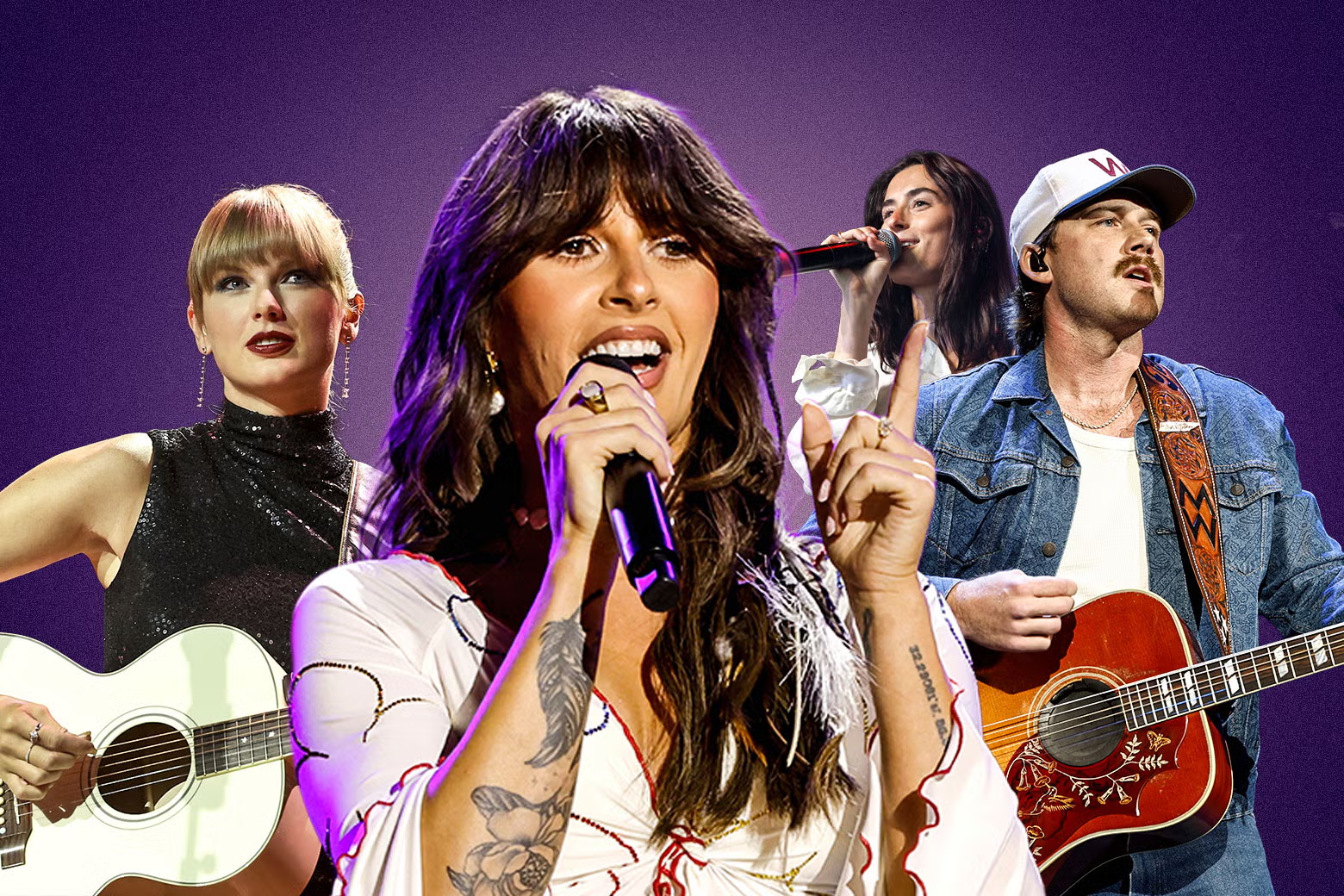
And I do mean history: “Choosin’ Texas” is now one week away from tying “Old Town Road” and “A Bar Song (Tipsy)” for the most weeks at No. 1 for a nonholiday hit. And unlike those two country–hip-hop hybrids, Langley’s smash is straight-up, unadulterated country music, delivered with a deep twang, steel guitar and mandolin, and a two-step roadhouse rhythm. When it first topped the chart in February, it looked like a happy accident. Six months later, “Choosin’ Texas” looks more like a movement—it’s dragging other country or country-ish records up the pop charts alongside it. For most of the summer, “Texas” has been sitting atop a Top Five that is more than half songs Billboard classifies as country; and for one week, for the first time ever, the Hot 100’s entire Top 5 was Nashville-adjacent. Not since the 1990s era of Garth Brooks, Alan Jackson, and Shania Twain has America more decidedly gone country.
As I wrote back in March, in the song’s second week on top, it was already surprising that something so purely twangy was dominating the pop charts. Though country music has been crossing over on the Hot 100 for several years now, generally the songs that have topped the big pop chart have featured subtle hip-hop elements, like the J-Kwon–interpolating “A Bar Song” or Morgan Wallen’s heavily syncopated “Last Night,” or been overt pop crossovers, like Luke Combs’ celebrated cover of Tracy Chapman’s “Fast Car” or Wallen’s duet with Post Malone “I Had Some Help,” or just been politically minded flukes, like the short-lived summer 2023 No. 1s by Jason Aldean and Oliver Anthony. (That was a crazy summer.)
But now, in 2026, here we are, with Langley taking Song of the Summer in a walk. Since June, it hasn’t been close: On Billboard’s official Summer Songs chart, “Choosin’ Texas” has been No. 1 every week of the season. And no other song stands a chance of stealing the title by Labor Day—not even Taylor Swift’s country-adjacent Toy Story 5 smash “I Knew It, I Knew You,” which will wind up in second place for summer ’26.
When it first went to No. 1 in the winter, I wouldn’t have guessed we’d still be talking about “Choosin’ Texas” in the summer. It’s a great song in any season, but it’s also a heartbreak song that takes place indoors, and I have long theorized that nightclub music tends to be winter music (even when that nightclub is a honky-tonk). In the song’s lyrics, Langley’s Tennessean protagonist is watching her Texan paramour slip away from her and nursing her broken heart at a bar, “drinking Jack all by myself.” When the original video dropped last fall, just before the holidays, it depicted a western-wear couple two-stepping on a spotlit dance floor while Langley sang the song in the foreground, sitting at a bar in long sleeves. For months, that humble clip was all Langley’s label Sawgod (an independent country label affiliated with major label Columbia) had to promote the single; in fact, it was still the only video when the song reached No. 1 in February. They called it a “lyric video” to indicate that it wasn’t an “official video,” but it has the bones of a plot.
Then, in the spring, after the song exploded and had been sitting at No. 1 for a while, Sawgod/Columbia set it up for summer by dropping a much fancier video (see above), featuring Langley enacting the song’s lyrics at the famed Stagecoach Ballroom, in Fort Worth. The supersized, seven-minute clip features dramatic dialogue, truck scenes, and club scenes and is chockablock with cameos by country stars, including Miranda Lambert, who co-wrote the song with Langley. Everybody in the clip is in tank tops and sleeveless vests, plus there are a few bare midriffs. Langley’s indoor lament was transformed into a warm-weather bop, and the song kept on at No. 1 through the spring and into the summer.
Now in its 18th week at No. 1 on the Hot 100, “Choosin’ Texas” has punched (and two-stepped) far above its weight class. Not only is Langley’s smash one week away from tying Shaboozey and my beloved “Old Town Road” by Lil Nas X for the all-time nonholiday record. If Langley holds on to No. 1 another four weeks—doable, possibly even inevitable—it would tie the latest all-time record holder, Mariah Carey’s holiday staple “All I Want for Christmas Is You.” (That would be a short-lived win, as Carey’s Christmas chestnut will almost certainly pile on another three to five weeks at No. 1 this coming December. But still!)
How has “Choosin’ Texas” pulled this off? In a word, consistency: It’s never set any data records in any of the metrics that factor into the Hot 100, but its steady week-in, week-out consumption is rock-solid. Its radio airplay has gradually spread from country stations to pop stations, particularly the ones that target older demographics. (The Z100s of the world, which target teenagers as well as adults, have been warier.) On the all-genre Radio Songs chart, “Texas” has climbed as high as No. 4; more notably, it also cracked the top five on Billboard’s Adult Pop Airplay chart, which isolates spins on that city-friendly contemporary-hits format. On the sales side, “Texas” has been selling a high-four-figure number of dollar downloads each week—again, not an amazing stat, but cumulatively stellar. And most important, its streams on Spotify et al. have been amazingly consistent, averaging 25 million a week, give or take—not a blockbuster streaming number, but big enough that in any week when there’s no new competition for the No. 1 spot, Langley’s hit floats back to the top.
In fact, “Texas” has climbed in and out of No. 1 half a dozen times since February, a record that, Billboard says, is an all-timer. Its run in the penthouse has been interrupted by eight different songs—two Taylor Swift hits, a return week by Bruno Mars, a Super Bowl–fueled No. 1 by Bad Bunny, and lead singles from new LPs by BTS, Olivia Rodrigo, Drake, and Ariana Grande. Long story short, for half the year, “Choosin’ Texas” has become the Hot 100’s default hit.
This would seem like a one-off fluke if Langley’s hit weren’t joined in the Hot 100 winner’s circle by other country crossovers. At various points this summer, sitting right alongside “Choosin’ Texas” in the Top Five have been some combination of these: Langley’s own follow-up hit, the perky, clap-along bop “Be Her,” got as high as No. 2 in May. (Frankly, “Be Her” sounded to me and a lot of pop pundits like Langley’s bid for a summer hit, but her “Texas” won’t get out of the way.) Swift’s aforementioned “I Knew It, I Knew You” interrupted Langley’s No. 1 run for a fortnight in June and has been knocking around the Top 5 ever since. Another Langley follow-up, “I Can’t Love You Anymore,” is a duet with fellow country megastar Wallen that reached No. 4 in July. Then, in August, Wallen’s own new single “Been by Now,” a preview of his next album (God’s country help us), debuted and peaked at No. 2 behind Langley. And finally, the truly left-field hit “Boston” by newcomer (and alleged nepo baby) Stella Lefty put a vibey, Gen Z spin on the trend.
Mind you, some of these pop hits are “country” in scare quotes. The Swift and Lefty singles, for example—Z100 is power-rotating both, an indicator that they don’t sound all that countrified. Swift’s smash has been hyped as her return to country but, as I said in my column, is closer to mellow Californian pop crossed with a bit of New Orleans soul. Lefty’s hit is not only named “Boston,” for crying out loud; it’s basically a stomp-and-clap reimagining of Noah Kahan’s 2022 hit “Stick Season” (not a secret—Kahan received writing credit). Nobody ever called Kahan’s neo-folk ditty country music. And as for the Wallen hits, they’re his typical synth-infused adult-contempo schlock with his Tennessee accent on top. Still … all of these giant hits are, in fact, getting played on country radio right now, and their pop-chart overlap is uncanny. In the previously mentioned early-August week when country locked down the Hot 100’s Top 5, Langley’s “Texas” sat atop the hits by Wallen, Swift, Langley–Wallen, and Lefty, all in a row.
So, real talk: Has country music permanently colonized the pop charts? Are we witnessing a faddish reboot of the early-’80s Urban Cowboy boom or the ’90s Garth-and-Shania “hot country” phenomenon? Or is 21st-century country now a more permanent part of pop’s multigenre coalition, alongside R&B, hip‑hop, EDM, reggaetón, and K-pop? Clearly, we’ve been trending this way for a few years now—since at least 2023–24, when Wallen began breaking at Top 40 radio, when pop acts from Beyoncé to Post Malone to Sabrina Carpenter added twangy elements to their hits, and when Shaboozey’s success at both country and pop radio showed that Lil Nas X had battled Nashville’s gatekeepers not in vain.
Fundamentally, I see country’s 2020s boom as a confluence of cultural cycle and improved data. The fact is, country typically goes pop at least once a decade—think back to the ’70s wave of Glen Campbell, John Denver, and pre-Grease Olivia Newton-John, or the ’00s crossovers by Carrie Underwood, Taylor v1.0, and Miley Cyrus, or the ’10s bro-country boomlet headed up by Luke Bryan, Florida Georgia Line, and Sam Hunt. Some of these crossovers were bigger than others—if you lived in a big city in the 2010s, you could get through your day encountering little to no bro country—but, bottom line, we were due for another crossover wave this decade, and this one is just bigger than normal, comparable to the country-pop booms of the early ’80s or mid-’90s. That’s the cyclical part.
What may be more permanent is how streaming has changed the data calculus and leveled the playing field, such that country songs I may never hear on Z100 New York can, these days, become national pop hits. For a century now, country music has been a parallel universe of hitmaking that didn’t always register on the national pop charts—for data reasons more than popularity reasons. In the middle of the country—it’s tempting to say “red states,” but it’s just as true in Virginia, Colorado, New Mexico … heck, even upstate New York—country music is pop, the default music that surrounds everyone. In decades past, the audience for a Hank Williams, Loretta Lynn, or George Strait song might be nearly as populous as that for an Elvis Presley, Barbra Streisand, or Billy Joel song from the same respective period. (Just two years ago, a Strait concert at Texas A&M University’s football stadium set a record for the single largest ticketed audience in American history. A year later, Strait was beaten by a Zach Bryan show in Michigan.)
But until recently, the Hot 100 and other all-genre pop charts didn’t reflect that reality, either because the data going into the country charts wasn’t included in those pop charts, or because country fans (even more than pop fans) were congregating on the radio, which measures audience but only to a point. Even after Billboard added radio and sales data from all genres to the Hot 100 near the end of the 20th century, and added streaming services like Spotify in 2012, country music still looked smaller than it actually was, because country fans were much slower to take to streaming.
But ever since country listeners migrated en masse to streaming services around the turn of the 2020s, not only has that changed, but it seems that country fans latch on to the big artists and their biggest hits even more tenaciously than pop fans. The way Langley’s “Texas” has sat at or near the top of the Hot 100 this year is reminiscent of what happened in 2023 with Wallen’s “Last Night,” which spent 16 weeks atop the Hot 100, outlasting other interrupting pop hits from the likes of Olivia Rodrigo and SZA. “Last Night” was that year’s default hit and wound up as both Song of the Summer and the top hit of the whole year.
So while pop crossover helps when it comes to the genre’s chart performance, it isn’t necessary. All by itself, country die-hards’ loyalty on streaming stacks the deck in country’s favor on the all-genre pop charts. That’s different from country radio, for which programmers believe in letting songs have only a brief turn on top—the industry operates like a de facto oligopoly, with the Country Airplay top slot turning over every two to four weeks. That’s not how streaming works for country music. Now that younger country listeners have migrated to Spotify and Apple Music just like all pop fans, they tend to be faithful to one big hit for months at a time.
For 2026, that one big hit is Ella Langley’s “Choosin’ Texas,” an exceptional song with coattails long enough to drag other country-flavored hits along with it. It’s solidly in the tradition of country’s great story-songs, and it’s relatable to wide swaths of Americans—those who get to hear it, anyway. Assuming it takes the all-time Hot 100 non-Christmas crown away from Lil Nas X and Shaboozey, it will be a victory for a woman in a genre that doesn’t often give women a fair shake. Surely all of us can raise a tumbler of Jack to that.