By GARRY RAYNO, InDepthNH.org
“Laws are like sausages, it is better not to see them being made,” is a phrase attributed to Prussian Chancellor Otto Von Bismarck but is more likely from American Poet John Godfrey Saxe.
Most people never know the ingredients that coalesce to become legislation, the back-room deals, “you vote for my bill, I will vote for yours,” the compromises hammered out in late night conversations, the stroking, the threatening and the money that may not change hands, but fuels future campaigns.
They also don’t see the impact outside organizations and lobbying firms — often familiar names — have. They exist to or are paid to protect someone’s interests even if it conflicts with the state’s best interest.
The groups with money to pass around for campaigns, free trips and to exotic places with a conference for lawmakers, and the all important free food and drink, often have more influence on the final product than the state’s million plus residents.
Some are more upstanding than others, and some do little but promote a national ideological agenda that has little to do with most residents’ priorities like housing, health care costs, food and energy prices, and protecting the state’s resources, which are what retain or attract people to the state.
The legislation that is most successful helps people or rectifies a problem, and almost always brings stakeholders to the table, and is bipartisan. Everyone has a little piece of the pie, but no one has a particularly large one.
That kind of legislation is rare these days although it used to be more frequent in the old days, a decade or more ago.
However, both sides of the aisle along with industry representatives, business groups, waste disposal companies, local governments and environmentalists have endorsed a paint recycling effort operated by a non-profit set up by paint manufacturers.
The program is funded by a surcharge on the price of paint to cover the cost of collecting and transporting the unused paint from local hardware stores that volunteer to join the program or from municipal hazardous waste collection sites and recycling what is collected.
Under the proposed program operated by the nonprofit PaintCare, there would be less hazardous paint waste in landfill leachate to pollute aquifers or open water, no more missing the hazardous waste collection day, you might have a little more room in your basement to store something besides old paint dating back to the turn or the last century, and it would be free to those who drop off the toxic unused liquid often turned solid.
The assessment would be on the paint so those who do not buy paint do not pay for its disposal, as they do now with municipal hazardous waste collections.
House Bill 451, sponsored by Rep. Karen Ebel, D-New London, with both Republican and Democratic co-sponsors, sailed through the House on a voice vote, as it did two years ago, but stalled in the Senate last session, when the Senate Ways and Means Committee recommended it be re-referred to the committee.
The program which is already in Vermont, Maine, Rhode Island and Connecticut, and eight other states and counting needs legislation for a waiver to antitrust laws because the manufacturers are “colluding” to develop and run what they call the paint stewardship program.
Advocates for the program note it will save cities and towns and property taxpayers money because half the waste collected during hazardous waste collection days is unused paint.
The Product Stewardship Institute in Boston estimates the savings for New Hampshire municipalities would be between $1 million to $1.3 million annually.
The bill had the backing of the Business and Industry Association, the National Waste Recycling Association, Waste Management, Casella, the NH Municipal Association, Conservation Law Foundation, Aubuchon Hardware, and a consortium of statewide environmental groups including the Society for the Protection of NH Forests, The Nature Conservancy and the Audubon Society.
Ebel said, “This was constructed from the bottom up,” noting no one spoke in opposition to the bill at the public hearings.
The Business and Industry Association included the bill in its annual scorecard as a positive for lawmakers.
But so did the Libertarian Americans for Prosperity, a Koch Foundation affiliate, but as a negative in its annual rating of lawmakers.
An AFP press release was issued calling the assessment for the recycling program the “Paint Tax,” although a tax requires the money go to a governmental entity which a manufacturing association is not. And the assessment is not a user fee like the state collects for various government services like auto registrations or professional licenses.
The only governmental involvement in the bill is the Department of Environmental Services which would have to approve the program’s specifics as they do for many other services that impact the environment.
Americans for Prosperity is the organization that promised contributions to the campaigns of lawmakers who would say “Taxation is Theft” at the House Well and many Republican members did.
No tax is a good tax as far as the Americans for Prosperity is concerned as is the case with another organization that checked into the debate, Americans for Tax Reform led by Grover Norquist, who also never saw a tax that shouldn’t be repealed or reformed.
This attempt to demonize the bill occurred leading up to the Senate vote earlier this month, although it passed 13-11, as five Republicans joined the Democrats to send the bill to the governor.
The drum beat continued against the paint tax, a common strategy that is more often than not successful in New Hampshire, despite the fact the assessment can never be a tax because government is not collecting it.
But who cares as long as you drive up the negatives and rattle the saber loudly enough to get attention for the next campaign even though you are not being honest.
The Union Leader also checked in with an editorial against the bill again calling it a paint tax, much like the same folks called the premium for the paid family and medical leave bill an income tax when it was an insurance premium like many people pay to their employer for their health insurance.
Gov. Kelly Ayotte was the state’s attorney general and also served in the US Senate and has to know an assessment collected by a manufacturers’ nonprofit is not a tax but speaking to the NH Journal earlier this month she said, “I have a pretty simple principle: No sales tax — not now, not ever,” Ayotte said. “I think that this bill looks like a sales tax. It acts like a sales tax on paint. If you walk like a duck, you quack like a duck, you are a duck.
“So from my perspective, I don’t think the duck’s going to make it.”
That’s fine but the state has all kinds of sales taxes, the rooms and meals tax, the tobacco tax, the communications tax, the beer tax, real estate transfer tax, prepared food tax you pay in grocery stores for pre-made sandwiches, the insurance tax, the securities tax, the tax on video slot machine earnings, and the profits from the sales of liquor and lottery tickets.
If you want to talk about raising taxes, the governor and lawmakers did that for people who now have to pay to the state a portion of their Medicaid premium and more for their co-pays, not to mention all the increases in fees from auto registrations to burial at the state Veterans’ Cemetery.
The bill was enrolled Jan. 7 so it is just a matter of time before it reaches the governor’s desk.
“It is disappointing and disheartening,” Ebel said, noting the vast support from across the political spectrum and from businesses, environmentalists, paint manufacturers and local retailers.
“If (the governor) vetoes this bill, she stands in the way of business,” Ebel said. “The paint manufacturers want this.”
Garry Rayno may be reached at garry.rayno@yahoo.com.
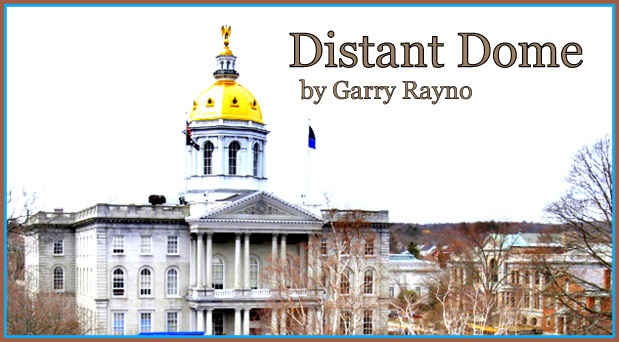
Distant Dome by veteran journalist Garry Rayno explores a broader perspective on the State House and state happenings for InDepthNH.org. Over his three-decade career, Rayno covered the NH State House for the New Hampshire Union Leader and Foster’s Daily Democrat. During his career, his coverage spanned the news spectrum, from local planning, school and select boards, to national issues such as electric industry deregulation and Presidential primaries. Rayno lives with his wife Carolyn in New London.