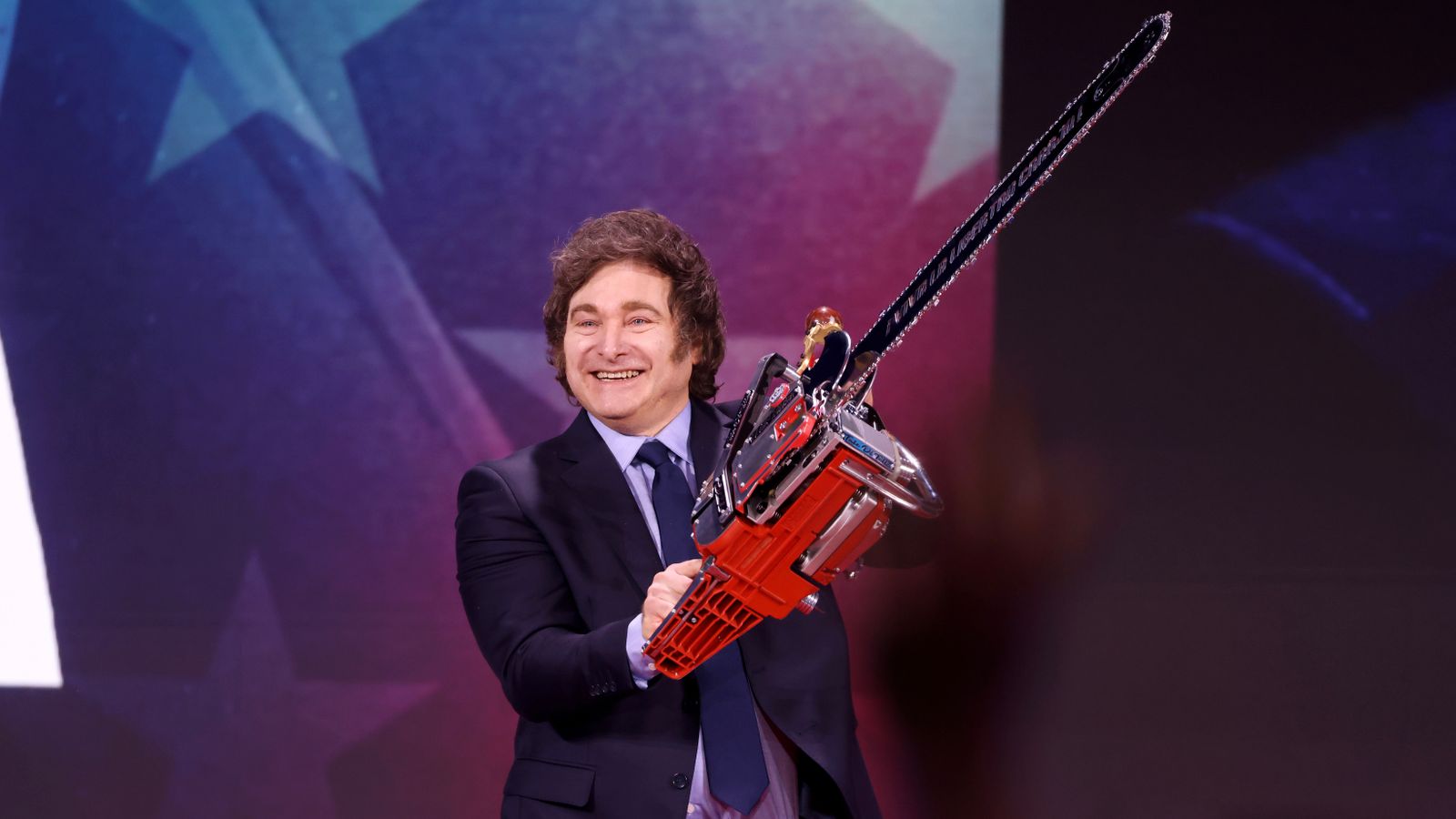
On February 14, 2025, at 7:01 p.m., Argentina’s fascist President Javier Milei used his X account to promote $LIBRA, a cryptocurrency launched 23 minutes earlier. The launch attracted massive investment, rapidly driving its market capitalization to about $4.5 billion. Just three hours later, the asset had lost 89 percent of its value. Fifty thousand buyers collectively lost about $251 million, while the nine founding wallets collected $87 million. Five hours after posting it, the president deleted his tweet.
Defend his conduct, Milei stated in an interview that he had promoted the cryptocurrency “as a citizen, tweeting from his personal account, and not as president.” The effort was evident: to present the case as the isolated deviation of an adventurous political neophyte.
Eighteen months later, the government itself refuted this version. In official statements, it admitted to having diverted more than 1 trillion pesos from a public fund created to finance road works—the SisVial—into financial investments: exactly what $LIBRA had done in secret. Far from being an aberration, the crypto scandal was the first crack through which the flagrantly criminal mode of operation of the entire government became visible.
The diversion of Integrated Road System (SisVial) funds
On August 9, 2026, writing for La Nación, Hugo Alconada Mon reported that “for two and a half years, the government of Javier Milei collected more than 1.5 trillion pesos in the trust fund created to finance road works, but allocated only a quarter of that amount to that purpose. At the end of last May, it held more than 1 trillion pesos in financial investments, such as fixed-term deposits and government bonds” (our translation, as with all other quotations from Spanish).
The SisVial is a trust fund that captures part of the fuel tax, with a legally exclusive purpose: road construction and maintenance. It was created in 2001 at the insistence of the World Bank, precisely to prevent this revenue from being diverted to other ends. It is exactly this safeguard, designed by international finance capital itself, that the Milei government now uses as a vehicle for the diversion.
The figures, reconstructed by La Nación from accounting balance sheets and official documents, confirm and detail this distortion: of the 1.5 trillion pesos collected in two-and-a-half years, only a quarter was spent on works—an underspending rate of 73.8 percent. A former director of the bank BICE described the logic as that of a “mesa de dinero” (trading desk): public works at a standstill, resources directed toward speculation.
Meanwhile, between 65 and 70 percent of Argentina’s national highways are in fair or poor condition, and public works have been practically paralyzed for two and a half years. The governor of Santa Fe described his province’s roads as “no longer having potholes, but craters.” It is not a lack of money: it is a decision about where to put the money—for every peso spent on asphalt, 77 pesos went into financial investments. “Behind the numbers there are people who die on the roads,” an economist consulted by La Nación summarized.
Given this, the confession of Argentina’s current government spokesman, Adrián Ravier, is the purest formulation of the government’s policy. Asked about the destination of the money, he admitted that “part of these taxes goes to Vialidad (the national roads agency) and the other part is administered by the Ministry of Economy as part of the efforts to achieve fiscal balance.” Asked how much went to road maintenance, he refused to answer: “What I cannot say right now is how much of what is collected is being allocated to road maintenance.”
Ravier took the post in June 2026, replacing Manuel Adorni—who held the job alongside serving as Milei’s chief of cabinet. He resigned from both posts that month as a result of his involvement in the $LIBRA crypto-asset scandal.
If in the SisVial case the plunder passed through the ordinary apparatus of the state, in $LIBRA it ran through the personal channel of the president and his family network. Even so, it is the concentrated, personalized and internationalized version of the same operation: extracting value without producing anything, using the state as a vehicle—except that here the victim is not those who die on the roads for lack of maintenance, but those who lost their savings buying a crypto asset endorsed by the president himself.
The fraud was engineered by two companies: KIP Network Inc., based in Panama, which signed the project’s institutional website, and Kelsier Ventures, run by the American Hayden Davis, which supplied the financial capacity. The link between the two was made by the Argentine operator Mauricio Novelli—who had known Milei for years and, according to a La Nación investigation, had been paying the then-congressman a monthly salary as an “influencer” since 2021. It was Novelli who brokered both the October 2024 meeting between Milei and Julian Peh, of KIP, and the January 30, 2025, meeting between Milei and Davis at the Casa Rosada—off the official agenda, made possible by Karina Milei, the president’s sister and secretary general of the Presidency.
The model was not born in Argentina. A month earlier, on the eve of Trump’s inauguration, the same group had already launched the memecoin $MELANIA following the script it would repeat with $LIBRA: endorsement by a political figure, acquisition of more than 90 percent of the supply by insider wallets before the public, artificial appreciation and coordinated dumping. The class action Hurlock v. Kelsier Labs, filed by injured buyers in the US District Court for the Southern District of New York, identifies at least 15 memecoins manipulated by the same infrastructure.
Adorni’s resignation connects the two cases. A forensic examination of Novelli’s cellphone revealed links between the operator, Karina Milei and adviser Santiago Caputo, as well as a $5 million agreement for the presidential promotion of the cryptocurrency. The investigation into the illicit enrichment of Adorni—who amended his asset declaration claiming $513,000 in bitcoins “forgotten on a flash drive”—followed the trail of the victims’ money to undeclared digital wallets controlled by him and his wife. Adorni’s fall changed nothing structurally; it confirmed that the crypto scandal was not peripheral, but touched the center of the government.
Milei’s economic “miracle”: Plunder disguised as growth
The propaganda touting the Argentine economic “miracle” under Milei does not withstand scrutiny of the government’s own official numbers. Argentina’s second-quarter 2026 GDP data were recently released and point to a contraction of 0.6 percent compared with the first three months of the year. Worse still, growth in the first quarter stood at only 0.7 percent.
The decline was widespread across the components of domestic demand: private consumption plunged 2.4 percent from the previous quarter, public consumption fell 2.3 percent, and gross fixed capital formation—the measure of investment—dropped 0.8 percent. Only exports grew (2.5 percent), while imports decreased 3.5 percent, artificially cushioning the contraction of GDP.
The composition of this residual growth is even more revealing than its magnitude. In the year-over-year comparison, mining grew 16.4 percent and agriculture and livestock 6.9 percent—capital-intensive sectors oriented toward commodity exports. Manufacturing, meanwhile, fell 2.1 percent, construction advanced only 0.2 percent and commerce stagnated. Non-primary activities, which account for about 85 percent of GDP, remain depressed.
Yet the most dramatic figure is that of investment. Gross fixed capital formation plunged 11.1 percent year over year, the fifth consecutive quarterly decline. It is 3 percent below the level of the fourth quarter of 2023 and 14 percent below the third quarter of that year, at levels similar to those at the official close of the COVID-19 pandemic. As economist Lorenzo Sigaut Gravina of the consultancy Equilibra was forced to admit, it is paradoxical that under a pro-market administration marked by deregulation, what has fallen the most is investment.
The same pattern of statistical illusion appears in the fiscal accounts. The “zero deficit” celebrated by the markets is the result of cuts to the social budget and flagrantly criminal mechanisms, such as the diversion of funds earmarked for roads into financial speculation.
Rising unemployment, informality and household subsistence debt are the social face of this “miracle.” Unemployment rose from 7.5 percent to 7.9 percent in the first half of 2026, the highest since 2021. Informality also rose significantly to 45 percent. While subway fares increased by 2,000 percent and basic services by 850 percent, wages were adjusted by an average of 300 percent.
One in three Argentine families—more than 20 million people—has active debts; 6 million are in arrears and 3.5 million have debts classified as unrecoverable. The nature of this indebtedness is laid bare by the fact that approximately 90 percent of credit card arrears originate from purchases at supermarkets and on food.
The priority of repression and the crisis of the state itself
On August 31, 2026, the government published in the Boletín Oficial a package of wage adjustments for the armed forces and the federal security forces, with cumulative increases of about 32 percent over the year for the military, and raises of 10 to 35 percent for the security forces, depending on function.
The decrees also extend to civilian public employees—and it is precisely this extension that reveals the depth of the crisis: the government is forced to restore the wages of the state apparatus itself because the deterioration it produced is corroding the state from within. The military had accumulated a 28 percent loss relative to inflation since 2023, and in June the Ministry of Defense had to relax its exclusive-dedication rules, allowing military personnel and federal agents to seek jobs in the private sector. An Army corporal received a base salary of $566—less than half of what a typical family needed to avoid falling into poverty.
The priority, however, is unmistakable. The government that “has no money” for roads, health and education—diverting the funds earmarked for these areas into financial speculation—finds tens of billions of pesos every month to restore the repressive and military apparatus. Among the beneficiaries are the personnel assigned to the F-16 Peace Condor Program, which includes exchanges with Air Forces Southern (AFSOUTH), a component of the US Southern Command.
This is the logical development of the class character of the bourgeois state: its fascistization is the form required to impose mounting capitalist attacks on the working class and to repress the social response they provoke. Milei’s alignment with the preparations for war by American imperialism against China completes the picture.
The same plunder, on a continental scale
The same pattern of plunder that Milei’s Argentina illustrates in detail is repeated, on a continental scale, under Washington’s orchestration. The Trump government presents its coalition of fascistic governments in Latin America—the so-called “Shield of the Americas,” which the WSWS has characterized as Operation Condor 2.0—as a “fight against narcoterrorism.” But the very political apparatus that sustains this imperialist offensive on the continent is completely mired in criminal scandals.
The WSWS has documented how this apparatus operates, through the Argentine operator Fernando Cerimedo, who directed operations to install or sustain far-right governments in several countries of the region, including Argentina. Arrested in Bolivia in August on charges of ordering the botched murder attempt against his ex-partner, Cerimedo is also under investigation for illicit enrichment and for providing protection to drug-trafficking-linked flights—the same crime that serves as the pretext for Washington’s imperialist violence.
The connection with $LIBRA is not tangential: it was Cerimedo’s wife who leaked the recordings that exposed a bribery scheme run by Karina Milei, the same sister of the president who arranged the meeting between Milei and the cryptocurrency operators. The personal enrichment through access to the state, which $LIBRA revealed on a national scale, is replicated as the method of operation of the entire network that sustains the power of Milei and his regional peers—who take the blatant criminality of the Trump government itself as their model.
This rot is neither accident nor exception: it is the form that imperialist domination takes when capitalism, in terminal crisis, has nothing left to offer but plunder, repression and barbarism.
The buildup of the military and the installation of far-right swindlers aligned with Trump are meant to enforce the ruling elite’s attacks on the labor and social rights of the working class.
In February, Argentina’s union bureaucracy was compelled to call a general strike against Milei’s labor counter-reform, while decreeing a stay-at-home stoppage without mobilization. Workers filled the streets of Buenos Aires and other cities anyway, to be met with gas, rubber bullets and mass arrests. The pensioners have marched on Congress every Wednesday for more than two years, at the cost of hundreds of injuries—among them the photographer Pablo Grillo, whose skull was fractured by a police gas canister.
The road fund, the disability agency and $LIBRA are not merely the scandals of one corrupt administration, to be settled in the courts or by the Peronist opposition whose betrayals opened Milei’s road to power. They are how capitalist rule now functions internationally.