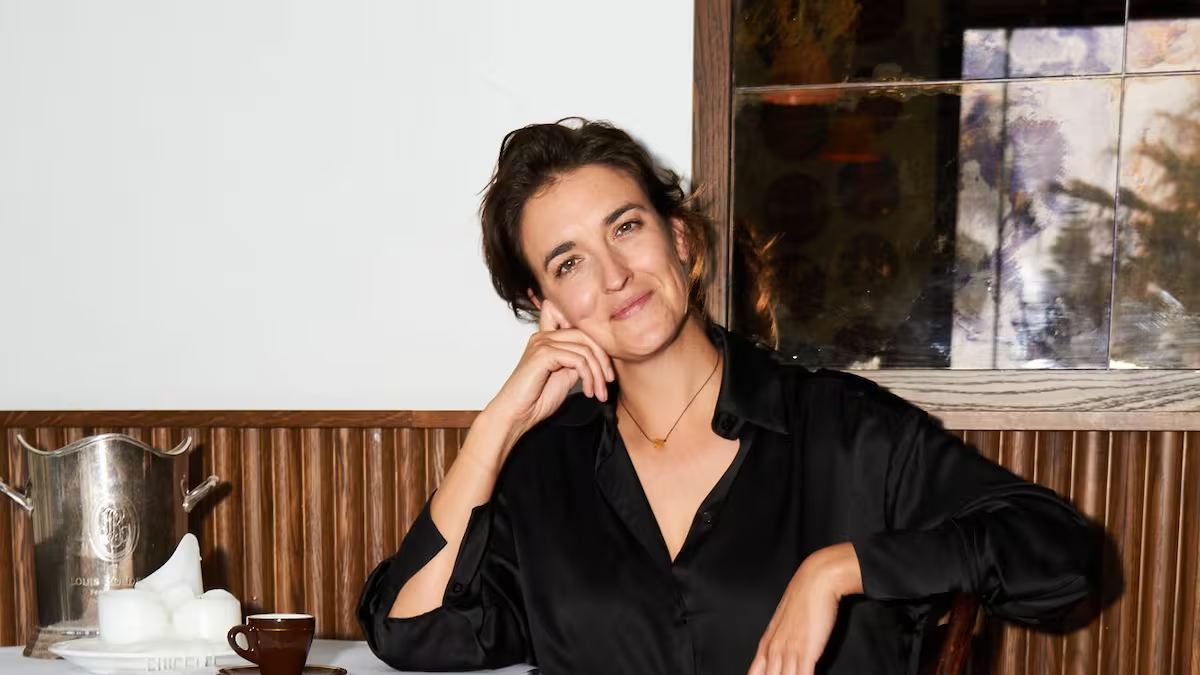
“I was in this space and just thinking how witchy it felt,” she explains, describing the meadow of dye plants and circle of stools the staff described as their “weaving circle”. In the shed were cauldrons and vials of powder, hanging herbs and an old wooden broom; a collection of symbols synonymous with witches accumulated not from a fascination with witchcraft but a dedication to environmental and social sensitivity.
“It wasn’t my own epiphany, but what I discovered was that there was a body of anthropological writing by Sylvia Federici and others around this idea that women’s work kind of informed the iconography of witches,” Tonti says.
A central claim of Good Witch, inspired by Federici, is that the witch hunts were never really about magic, but disenchanting the world so it could be dominated, economically and socially. As a result, women were stripped of their economic and social power.
“The economy as we know it has been built on the back of that,” Tonti says.
The other claim is that the fashion industry’s two great sins, the exploitation of women’s labour and pillaging of the natural world, aren’t separate problems, but share a root that can be tracked to the witch hunts of early modern Europe.

While historical accounts differ, roughly 100,000 people were tried for witchcraft across the era Tonti covers (1450–1750), and about half were executed, eight in 10 of them women.
Both men and women in agrarian societies relied on the land, so why were women disproportionately targeted in the attempt to dominate it?
There are many reasons, Tonti says, but most can be boiled down to the way natural and social forces located women’s power and wisdom in the natural world, more so than men’s.
“Women have this sense of how we care for each other and are responsible for providing that care to children and to other members of the community,” Tonti said. “They were the ones that needed to be oppressed for structures to change.”
What is a witch?
Today, the symbols associated with a witch are so deeply embedded in pop culture that the word conjures little beyond pointed hats and black cats, cauldrons and broomsticks. In 1690s Salem, however, a witch looked nothing like Elphaba in Wicked or the Sanderson sisters in Hocus Pocus. “For the most part, the witch in Salem was a neighbour, a mother, a servant, a friend,” Tonti writes in the book.

So, after spending years travelling across Salem (US), Pendle (England) and North Berwick (Scotland) investigating witches, how does Tonti define them today?
After laying down the caveat that there are countless interpretations and present-day spiritual groups with their own definitions, Tonti says she consistently noticed one common denominator.
“A witch is a powerful woman,” she says. “That, historically, has gotten you into trouble, that gets you into trouble now.”
This is one reason why a book about the 17th-century witch trials is relevant today. “The far right playbook hasn’t changed,” she says, referencing the approach King James and his witch-hunters used in the 1590s–1600s: “women belong in the home, exploit the environment at all costs, effective propaganda, and scapegoat an imagined enemy.” Certain elements have been modernised or substituted, but the intention stays the same.
The other is the desire to re-enchant the world, something Tonti believes arises during times of uncertainty.
“People are looking for something outside themselves, you know, for comfort, for solace, for moments of self-reflection,” she says. “The witch hunts themselves are politically grounded in something very relevant today, but witches and the idea of these other things, the rise of witch talk and tarot and all of that stuff, really reflects people having an innate sense that there is something bigger and we’re missing it.”
While this could look like New Age spirituality, religion or even the wellness industry’s invocation of “the universe”, for Tonti, “that magic is very simply the power of the natural world”.
Today, the state of our natural environment and treatment of labour workers is far from ideal, yet Tonti has seedlings of hope.
“We’ve been indoctrinated to believe that the systems that we’re functioning in are fair and are pretty good,” she says. “Now we’re kind of getting to the point where it’s like, well, the economy doesn’t work for everybody,” she said, adding that she thinks things will get worse before they get better.
“The hope is in the fact that we can come back to each other and the hope is still in the natural world.”

- Good Witch by Lucianne Tonti (Simon and Schuster) is out on July 28. RRP $41.99.