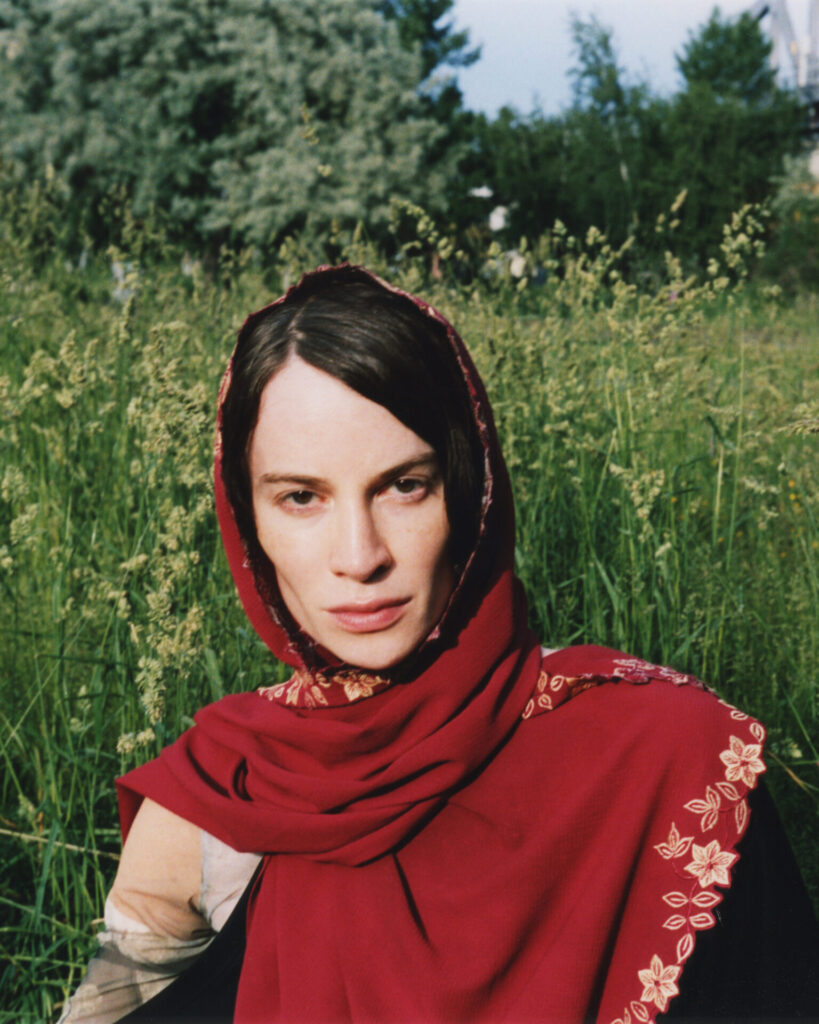
Alif Hilal, formerly known as Lyra Pramuk, takes us through the dizzying mixture of influences that fed into last year’s album Hymnal and a new rework called Hymnal (Resung), from rave to blues via devotional music, minimalism, folk song and more (the results are compiled into a playlist exclusively for tQ Subscriber Plus tier members)
Music journalists love to tell you they know all the influences that has gone into a new album, but a lot of the time the artists responsible themselves are left baffled by these comparisons. We thought, why not go straight to the source?
Alif Hilal (fka Lyra Pramuk) is a composer and vocalist who uses electronic processing to stretch, contort and reimagine acoustic sources – often built from her own voice. On Hymnal (Resung), she invites artists such as Djrum, Laurel Halo, John Tejada and Dumama to rework tracks from her mesmerising second studio album. Ostensibly a remix album, the record is far looser and more striking than that might suggest, with an emphasis on reinvention through collectivity. In this piece, she explores her approach to musical references and cultural research via a guest playlist, and gives her perspective on what reworks offer artists and listeners.
I always work with references, so it was very organic to put together this playlist. It’s a lot easier for me to conceptualise the project if I understand the world it sits in. Even if you try to copy other work, it never works. When I make references, it’s often poetic, somatic and textural, rather than form-inspiring. The spirit, the materiality, the vibe, and the life are what I’m looking for. I could listen to five seconds and say ‘I want that.’
Hymnal was very personal, just as Fountain was personal. I was researching my own spirituality. A big part of the conceptual inspiration was Sufi Islamic rituals, and the devotional prayers, chants and induced trance states that happen in Sufi Islamic practice.
I converted to Islam last year. I just announced that I’m changing my name. That’s a process that will unfurl. But this record was a personal way for me to create a space that would challenge me to understand my own faith in a deeper way.
I’ve had a pluralist interest in spirituality for a long time. It was always connected with music, trance and rave. A lot of the references, whether they are classical minimalism, or dance music, or country, have this devotional feel to them. And I love when the dance floor feels like a church.
At the same time, I was looking at a modular continuum between New York minimalism, classical and blues and American house music as a form of folk music, trying to understand where all those traditions cross together. The record has a minimal palette of just voice and strings, used to assemble a world that would somehow be a homage to the musical research I was inspired to delve into.
On blues and gospel music, I’m from a part of Pennsylvania where it’s very working class. That is the sound of people around. These are working songs. I was also mining that part of where I grew up and thinking about the spirit of that place, understanding how it had shaped me.
Blues vocalisation is interesting because something like 30% of enslaved Africans who became African American were Muslim in West Africa. There’s this idea that a lot of blues was coming from Islamic chants, which is another cross section. I grew up on the whole great tradition of African American music. It is my natural connection with music, and when I naturally vocalise. There’s blues in there.
It wasn’t until I moved to Berlin that I got into raving. I was having this deep, embodied relationship, but I never had the library.
In the last few years, I’ve started DJing more, but I feel like a baby with dance music. That’s also sweet, because I’m really naïve and open to everything. I just saw Terrence Dixon play in Berlin a month ago, and that was really life changing.
I was also listening to a lot of Steve Reich when I had the idea for Hymnal. Steve Reich is one of my favourite composers, whose work I became close to when I was studying at music conservatory. It always connected with me as a young person, that transcendentalism and aliveness. I feel I’m in a lineage with him in some way, like I’m a sibling, or a child, or something.
The piece by Alan Pierson with Ossia is an ensemble that started at my music conservatory, Eastman School of Music. Ossia was a student-created contemporary music ensemble, and I worked with them 15 years after this recording. This is a heritage record from the programme. It is one of my desert island recordings. I’ve seen this piece performed live three times, and it is a part of my soul and will be a part of my musical consciousness until I die. Tehillim is a set of sacred hymns in the Torah, so it’s a devotional, sacred Jewish piece. It’s literally liturgical.
Homogenic by Bjork is an obvious influence. I first heard that record when I was 14. In rural Pennsylvania, there’s a lot of Appalachian folk music, fiddles, stuff like that. But I was also listening to hip hop and making techno in Fruity Loops with my brother. When I heard Homogenic, it felt authentic to me in terms of what music should be. It’s this perfect cross of the kind of the reality I was living.
In addition to that intellectual musical research, if I feel that music is more than just a product – it is spiritual and I’m channelling something in my work – what am I channelling? A lot that came up for me was this connection with the earth and nature, and feeling my own body grounded in this temporal reality. As a trans artist, it takes time to feel bodied. I got to a place where I was privileged enough to feel bodied and say, ‘what is it that I’m connected with here?’
Now, making Resung, I love the recontextualisation and the dialogue of this personal work. It’s also devotional to invite people to work with your music. I feel open to the outcome. If you put both Resung and Delta together, that’s 18 artists who have made tracks of my music. Having only two albums out, I’m tickled by it.
I feel curious when the work comes on my desk. Giving people my trust, it seems it inspires a lot of freedom, like they’re able to show up within my work in a way where they’re honoring their own choices.
I was surprised with Laurel Halo and John Tejada’s rework of ‘Meridian’. It’s a beautifully old-school banger. But really, I was surprised by all of them. Dumama, she’s working a lot with grief and processing grief collectively in her musical practice. What she did with ‘Swallow’, I feel so touched by what she was offering.
It’s a spiritual thing for me, to not be too egotistical about my own voice. That is also folk, having this openness that people can gather around the work like a fireplace.
Alif Hilal’s new album Hymnal (Resung), featuring reworks of material from last year’s Hymnal by Tarta Relena, Laurel Halo, Djrum and more, is out now via 7K.
The full tracklist for her Quietus Guest Playlist is below, and available on Spotify, Apple Music, Tidal, Deezer and Qobuz by clicking the ‘Subscriber Plus Exclusive Playlist’ button at the start of this article. On streaming services, one or two tracks may be unavailable depending on your chosen platform.
Terry Riley – ‘Performance Two – Part 1’
Alan Pierson, Ossia – ‘Tehillim: I. Psalm 19: 2 – 5’
Henry Flynt – ‘You Are My Everlovin’’