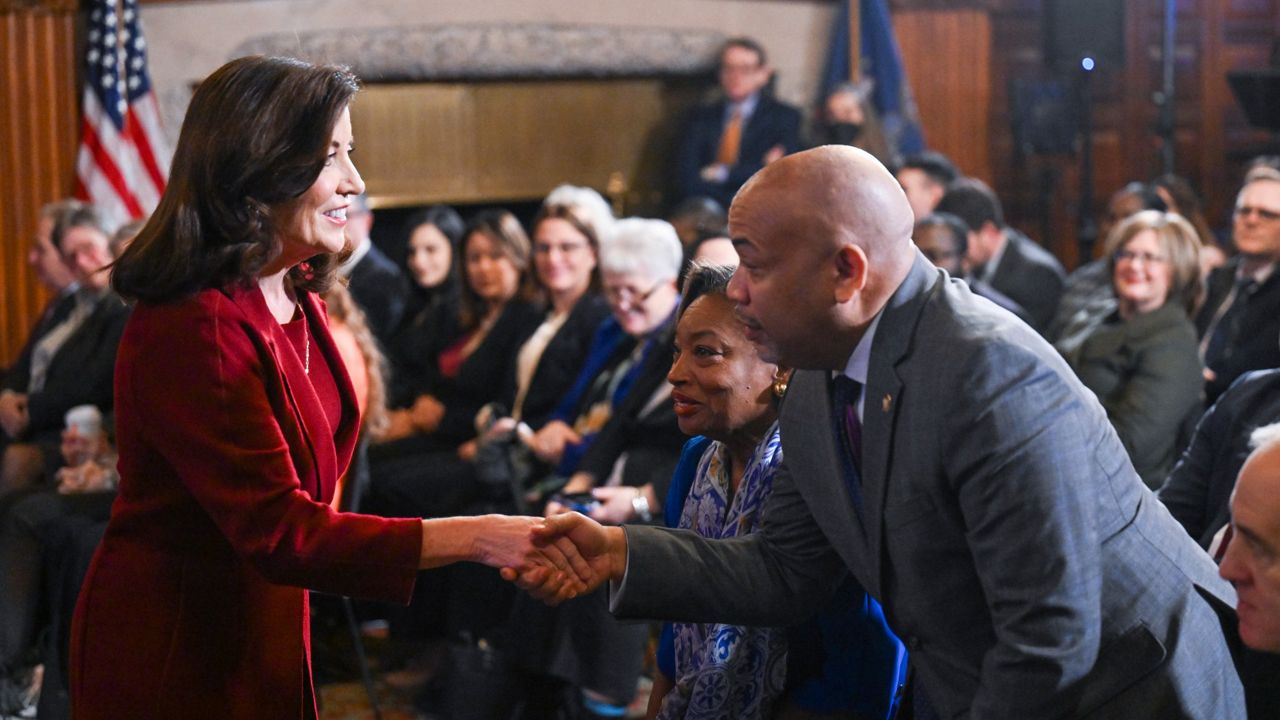
At a Wednesday afternoon news conference in Albany, state Assembly Speaker Carl Heastie was clearly frustrated as New York’s state’s budget process lagged, 22 days late and within striking distance of surpassing last year’s spending plan in tardiness, which was the latest in 15 years.
“There is something wrong with this process, and you all don’t write about it,” he said.
Heastie accused reporters of failing to adequately report what is behind the late budget: New York’s executive budget process in which the governor is in the driver’s seat and the legislature is left to sift through a budget proposal laden with policy changes, which governors see as one of their few avenues to make real change in state law.
“You all write about it happening; I don’t think you write about what it really means,” he said of the state’s budget process. “A governor’s budget quite possibly takes up 80% of a session, but in a few days, we’re going to be in May.
“I have to try to pass all of the priority bills the members want in a month,” Heastie said, adding that money can’t be discussed until those policy proposals are settled.
This year, session ends earlier than usual on June 4, so lawmakers can hit the road for campaign season. The extension the Assembly put in place last year to buy time until June 17 — after the budget process dragged through May 8 — is not an option.
Heastie has been clear that he isn’t frustrated with Governor Kathy Hochul specifically, but the overall process, describing negotiations as “friendly” and acknowledging that Hochul is merely using a “tool in her toolkit.”
Hochul has fought back against charges that she has used the process overzealously, pointing out for weeks that most of her proposals have been up for review by the legislature since January, though that isn’t the case with her pitch to change the state’s climate law, and this year she began meeting even earlier than usual this year to begin laying the groundwork — though that isn’t the case with her pitch to change the state’s climate law.
“I’ve been hoping it would be done since April 1, but I also am not walking back from my belief in the priorities that New Yorkers deserve to have — the majority of them focused on affordability,” she said Monday. “I am not walking back from my commitment to do whatever I can in my power, with the Legislature, to keep the people of New York from having the highest auto insurance premiums in America. We shouldn’t accept that, and people before me should have questioned why we’re putting up with this. I’ll be that person. I am that person, and I’m not stopping until we get real relief in that space.”
The irony in Heastie’s frustration is that even if good government groups and others in Albany agree that the process has become wildly unbalanced and Hochul clearly uses it to her advantage, it’s the Legislature’s remaining power in the negotiation that actually takes up a good deal of the time. Saying yes to a plan or proposed tweak may move things along, but Heastie, Stewart-Cousins and their members have lines in the sand and simply rubber stamping the executive budget isn’t an option.
Both sides have nuclear options, but that’s a story for another day and at least for now, another year.
Three weeks in, the state budget is at the phase where information disseminated to members of the Legislature by Heastie and Senate Majority Leader Andrea Stewart-Cousins following three-way meetings with Hochul can either make or break progress.
If the governor’s concessions or updates are well received by members during the majority’s closed-door conferences, the gears turn faster. If the members give the latest update a shoulder shrug or a thumbs down, the gears turn slower — maybe even in reverse.
Despite several meetings between Hochul and legislative leaders this week and conferences for both houses, the gears don’t appear to have moved as quickly as some would have liked.
On the governor’s proposals around auto insurance, Hochul appears to be willing to move on what is known as joint and several liability. Her initial proposal sought to change this standard for defendants who are less than 50% at fault, so those defendants are held responsible only for the damage they caused.
Heastie confirmed that the conversation had moved in that direction.
“We were always concerned,” he said. “You have a person who may have 25/50 auto insurance coverage, they hit a bus full of people and if the bus is nowhere at fault and there is 50 people on the bus and they all get injured, they’re all looking at the 25/50 person. It’s really about people who get hurt in accidents — do they have the ability to get pain and suffering? So it is a conversation that is on the table.”
Heastie said the governor appeared more steadfast on the issue of comparative negligence, or reducing the ability to seek damages based on the percentage a person contributed to the accident.
“In this world and in this life, you don’t say give me two things I want for two things I want, sometimes you have to make concessions. But I still have that concern that if I’m the 51 person, I’m going to try to litigate to get me not to be the 51 person,” he said.
Hochul has dug in on a complex array of reforms around litigation and fraud that she has insisted for months will lower New York’s high car insurance rates, amid sustained attacks from lawmakers and the state’s trial lawyers, who have demanded proof.
“My expectation and the only motivation I have in pursuing this is to see premiums decline,” she told reporters Tuesday. “What we expect will happen is that we start removing some of the unique aspects of New York, which is liability laws that end up with enormous jackpot payouts in court that you don’t see in other cases. I mean, that’s a huge driver. Plus, the laws on fraud need to be tightened up. I want stricter penalties. I want more aggressive enforcement.”
The deliberations around changing the state’s 2019 climate law, which was intended to provide a framework for New York to reduce emissions by 85% by 2050, are a similar back-and-forth of pitches from the governor’s office and digestion by lawmakers.
To a chorus of objections from environmental advocates, Hochul has insisted the law must be changed to stop utility rates from climbing even higher, thanks to a combination of a lawsuit filed over overdue regulations and factors like disinvestment in renewables by the Trump administration and the COVID-19 pandemic. She wants to adjust timelines and the methodology by which the state calculates emissions.
It has long been reported that lawmakers were more comfortable giving the governor wiggle room on the timeline rather than the emissions methodology, but that doesn’t mean they are ready to rubber-stamp the governor’s preferred end date of 2030.
Amid pressure to walk the date back, Hochul has provided options to state lawmakers that include a path to compromise by requiring regulations be released by 2029, but Assembly Environmental Conservation Committee Chair Deborah Glick told Spectrum News 1 that the options don’t cut it.
“The suggestions from the governor were inadequate. These aren’t minor tweaks, these are serious changes. The science is telling us we have a shortened horizon, not a lengthened one,” she said. “A big piece of the sticking point is when are we actually going to see regs? We know there is a process after we get regs, and that takes time. There is public comment and people dig into the regs, so if you are already late on the regs, pushing them out another four or five years is not helpful.”
Glick said at one point it had been floated that if the governor agreed to move the date up, the Legislature would have to vote on regulations themselves, which she called “peculiar.”
Heastie said it’s all part of the back and forth.
“Sometimes when you try to resolve something you put ideas out there, it doesn’t necessarily mean it’s the final or the only, but at some point you have to figure a path out,” he said. “There was a discussion of two possible options, but I don’t think those are the final discussions.”
In the upper chamber, Deputy Senate Majority Leader Mike Gianaris seemed overall optimistic Wednesday that some sort of resolution is imminent.
“I think we’re recognizing how far the governor is willing to go on some of these things. We have some hard lines, she has some hard lines and hopefully we’ll push through those things in the next few days,” he said. “It’s an ongoing conversation, but you can just feel that the outstanding issues are narrowing. I think we’re on the path.”
Hochul has stressed that her environmental credentials have not wavered, but that she is merely responding to changing times.
“If this law is not changed, as I’m trying to do with this Legislature right now, the cost of gasoline will go up an extra $2.23 per gallon on top of the increases you’re already seeing. I don’t think families can stand that. I think that is asking too much. I think we have to say no. We have to put our families first,” she said last month.
Gianaris said the debate over an immigrant protection package was closest to being wrapped up, despite a blowup over Hochul’s desire to allow information sharing with ICE in cases of probable cause related to certain crimes while otherwise limiting information sharing, along with the governor’s push to relax environmental quality review laws in some cases to spur housing development.
“I think we’re getting there on all of it. It’s just a matter of time,” he said.