
An audience member takes a photo of Gov. Gavin Newsom at a meet-and-greet. Newsom’s ballot measure committee received donations from well more than 20,000 Bay Area residents, about half of them from non-employed people, in 2025.
If you believe money controls politics, then you might reasonably suspect that retirees call the shots.
In this election cycle, it’s mostly Bay Area tech and finance professionals who’ve made headlines for writing big checks to their favorite political causes. But a large and growing portion of the region’s residents who are donating to state and federal campaigns aren’t in either industry. In fact, a Chronicle analysis shows, many of them have no job at all.
Fully a quarter of Bay Area donors who gave to a California state political committee from January through mid-October this year said they were retired. Another 16% said they were otherwise not employed, a broad designation that includes retirees, unemployed workers and homemakers.
Article continues below this ad
The combined 41% was more than double the 17% share those donors comprised as recently as 2024. And non-employed people make up an even bigger percentage of Bay Area donors when it comes to federal elections: roughly half through September this year, a share that’s crept up from about 30% a decade ago. (The analysis only covered identified donors; committees are not required to identify donors who give less than $100, or $200 for federal committees, to a single recipient).
While it’s unclear how much of the non-employed group are retirees, experts have pointed out that older voters tend to be more politically engaged, and retirees — especially in wealthier regions such as the Bay Area — may have both the will and the means to donate.
Some groups, such as the Democratic-aligned ActBlue and the Republican-affiliated WinRed, have drawn criticism in recent years for aggressively pursuing donations from older voters, including those with dementia, by sending streams of text messages and emails asking for money. The Chronicle’s analysis excluded donations to these “intermediary” committees that primarily act as processing platforms for political parties.
Article continues below this ad
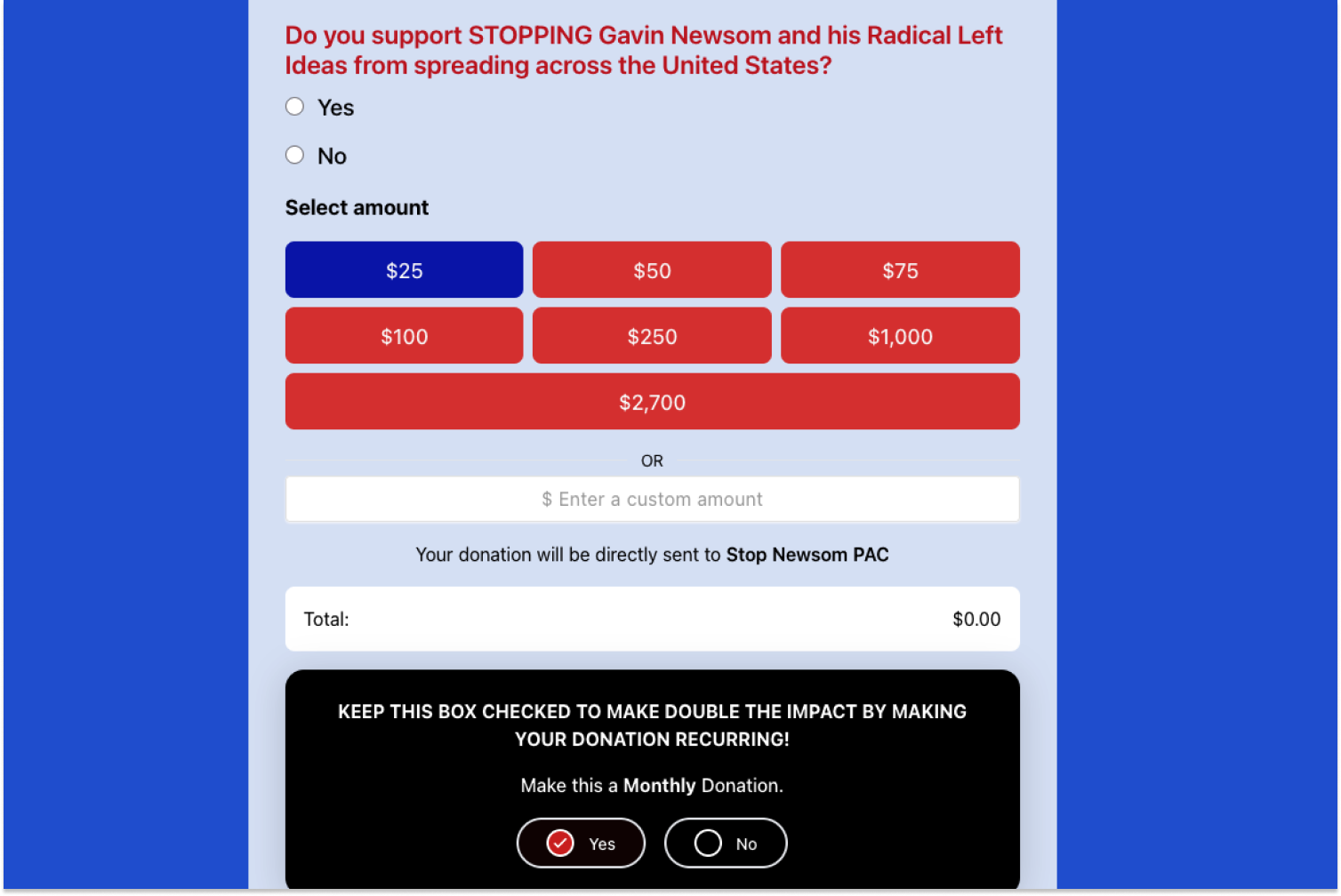
Other committees have received similar critiques for their fundraising tactics, including pre-checking a box on the donation form that signs up the donor to a contribution each month. While many campaigns have backed off from the automatic opt-in — which California banned for local and state elections in 2022 — some have continued to use it. Equality PAC, a federal committee that supports LGBTQ candidates, defaults donors to monthly giving, as does the relatively small “Stop Newsom PAC.”

This screenshot of Stop Newsom PAC’s donation page shows the box agreeing to monthly recurring donations is pre-checked.

This screenshot of ActBlue’s donation page for Equality PAC shows the box agreeing to monthly recurring donations is pre-checked.
But how committees solicit donations is just one half of the equation. The other is that these non-working donors evidently have causes they support enough to give their credit card info to. What are they?
To some extent, their preferences stand out for their partisanship. Research and voter registration data show that older donors tend to be more conservative than their younger peers — regardless of party. That bears out in some of the data: A whopping 85% of the Bay Area residents who gave to the Howard Jarvis Taxpayers Association’s “Protect Prop 13” committee in the past decades were not employed. The committee frequently backs anti-tax measures, including this year’s Proposition 43, which would require two-thirds of voters to approve new local taxes.
Article continues below this ad
In the Bay Area, in fact, contributors who have given to conservative candidates are overwhelmingly non-employed. About 70% of the donors who gave to Republican and California gubernatorial candidate Steve Hilton had no job.
But many of the Bay Area’s non-employed donors have also supported liberal causes. Gov. Gavin Newsom’s ballot measure committee received donations from well more than 20,000 residents, about half of them from non-employed people, amid his statewide redistricting effort last year. That flurry of contributions appears to be partially responsible for the rise of nonworking Bay Area donors in state elections in 2025.
Nonworker donors are also faithful contributors to prominent liberals outside of California. For example, 52% of Bay Area donors to Democratic Texas Senate hopeful James Talarico don’t work.
Article continues below this ad
Conversely, the state and local politicians who disproportionately draw funds from donors who still work are often those who advocate a change from the status quo, both on the left and otherwise. Just 20% of donors to the 2020 state Senate campaign of Jackie Fielder, who now represents San Francisco’s 9th District on the Board of Supervisors, indicated they weren’t employed. That share was even smaller among donors to the 2016 campaign of state Sen. Scott Wiener, a more moderate “abundance”-aligned politician.
On the federal level, Bay Area donors to 2020 presidential candidates Sen. Bernie Sanders and Andrew Yang were also largely workers.
Unsurprisingly, the committees that receive the fewest or no donations from non-employed people are those that directly represent corporate workers, such as those formed by Chevron or Google.