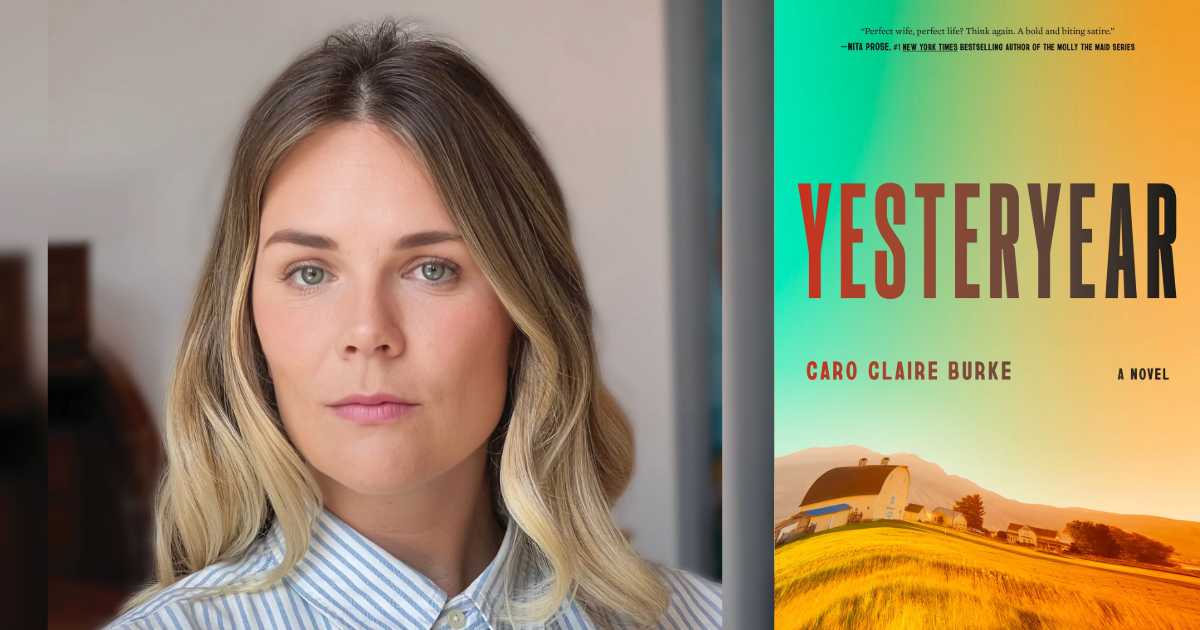
Caro Claire Burke is the author of Yesteryear, a Winter/Spring 2026 Indies Introduce selection. 
Annastasia Williams of The Bottom in Knoxville, Tennessee, served on the panel that selected Burke’s book for Indies Introduce.
“In a time where influencers are more prominent now than ever, you will love this novel that goes behind the scenes of a tradwife named Natalie that finds herself thrust from her Instagramable life into an alternate timeline (pun intended) where she does not fully recognize her family or any aspect of her farmlife. Her carefully curated life is uprooted very suddenly and you will #lol at Natalie’s plight. This debut novel has a lot of heart, humor, and social commentary and I expect it to be big,” said Williams.
Burke sat down with Williams to discuss her debut title. This is a transcript of their discussion. You can listen to the interview on the ABA podcast, BookED.
Annastasia Williams: Hello everyone. My name is Annastasia Williams. I’m from The Bottom in Knoxville, Tennessee, and I’m here today to speak with Caro Claire Burke, debut author of the book Yesteryear.
Caro received her Master’s in Fine Arts from the Bennington Writing Seminars. She’s the co-host of Diabolical Lies, a politics and culture podcast, and Yesteryear is her first novel.
Hi, Caro. Thank you so much for being here and for recording the podcast with us.
Caro Claire Burke: Thank you for having me. It’s a pleasure.
AW: As part of the Indies Introduce adult panel, we read a lot of manuscripts, and Yesteryear was definitely one of my favorites. I loved getting into the inner world of Natalie Heller Mills, how she thinks is so different from how she acts on the outside. I’m thrilled to be able to talk to you about this book today, and I’m so honored that you were able to join us.
CCB: Thank you. Yeah, I’ve spent a lot of time alone with Natalie over the last two years, so it’s very fun to be able to talk about her with other people.
AW: This book is about tradwife culture, and we see it everywhere, this concept of getting back to traditional values and women’s place in the family. This book, I think, offers a really interesting critique on that culture and that phenomenon. Why do you think tradwife culture is so fascinating to people in our society, and what inspired you to write this particular story?
CCB: I think that the discourse around tradwives, both in social media and offline, sits at the intersection of every conversation that we have about womanhood. Whether it’s about how we treat mothers in society, the decisions that someone has to make about starting a family versus committing to their career, or what it means to have different power dynamics in your marriage or even with your children, all of those conversations are endlessly fascinating to humans, and always have been. The tradwife discourse is really just the latest iteration that allows us to explore it from so many angles, and that was such a pleasure to do in Yesteryear.
AW: Let’s talk a little bit more about Natalie. Natalie Heller Mills is complex to say the least. She’s obsessed with this concept of perfection. There’s even a line in the book that says, “I’m Natalie Heller Mills and I’m perfect.” She expects perfection, not only from herself, but from everyone around her — her kids, her husband, her family. However, readers get to know what’s going on in Natalie’s mind, and we see that it’s not perfect.
What was it like writing a character like Natalie and exploring where this perfectionism can lead?
CCB: It was just fun. Being a writer, so much of creating a character can often feel difficult, and worthwhile in that way, but you can really feel like you’re walking through the dark. Natalie was just like a lightning bolt. I immediately knew who she was. It was really exciting to put her in increasingly challenging circumstances, because she is always operating with this crackling energy. She has this moral framework for how the world should work, and if people don’t operate under it, it’s baffling to her and it’s infuriating.
She’s a joy of a character to work with. There’s always going to be something interesting. She’s always going to misunderstand a comment, and she somehow still maintains a relatability.
AW: There’s a ridiculousness to Natalie, but there’s — I also related to her, and I really enjoyed kind of the path that you took this character on.
CCB: Thank you. I also relate to Natalie in so many ways. She is acidic and bigoted and neglectful of children — she has all these terrible qualities — but she is also ambitious, and she wants so much from the world. That is a quality that I admire in everyone, but that I always admire in women. Women who want to remake the world in their image, even when it’s not an image that I agree with, I have a grudging respect for.
AW: There are a lot of family dynamics explored in this book, also, especially relationships between Natalie and her husband, Caleb, Natalie and her children, and Natalie and her mother and sister.
How do the traditional values that Natalie holds impact her relationship to herself, to the people around her, and to God who she has so much faith in?
CCB: Natalie’s understanding of family is very hierarchy based. It’s kind of a pyramid. It’s very commonly found in Christian fundamentalist religion, and I’m sure many other fundamentalist religions, where the man is the one who answers to God, the wife answers to the man, and the children answer to the wife. There’s a very clear hierarchy in place, and there’s a coldness to that hierarchy. There’s no confusion to it. Natalie ingrains that hierarchical coldness with the way that she builds her family.
But the irony, of course, is that she also behaves very often like the patriarch. She is the one who tries to be in control of her family. She has a very hard time letting go of that control, and she is constantly grappling with how to be a “good Christian woman,” but also how to keep the world as she wants it. Her relationships are very transactional. It’s all very business-like, how she perceives the way the world should be and trying to attain a sort of order.
AW: I found her operating very similarly to Caleb’s dad, who is this politician. There is that kind of transactional nature in their relationship and how they are manipulating Caleb even throughout the book.
CCB: Yeah, absolutely. Doug is the more traditional patriarch in the novel. And there are a number of sections throughout the novel — this is not a spoiler — where Natalie really grapples with the idea that she feels like she should have been born a man.
She has a very, very traditional understanding of gender, of people being either women or men, and having very specific traits assigned to both. And she recognizes that the fundamentalist belief of what women are is not really how she feels about herself, so she feels like maybe she was born into the wrong body. She admires someone like her father-in-law, who wields power comfortably, and who is able to do that without essentially being punished for it.
AW: I also thought her relationship with God. She refers to that personal relationship with the Lord often. There’s even a section of the book where she says that when she was a girl, she thought about the Lord in the way other girls thought about their crushes. Can you talk a little bit more about that and how she sees her religion and her faith?
CCB: Natalie has a very warped relationship with sexuality and with pleasure, generally speaking. She has, again, a very transactional relationship with spirituality, but also maybe the most intimate relationship in her life.
I think she respects the Lord, whoever that is in her understanding, she has a respect and a deference to him that she doesn’t have to anyone else. So, I really enjoyed playing with this idea of Natalie believing that the only right way to feel pleasure is to basically be in communion with the Lord. That creates a lot of mixed wires throughout her life, where if she feels good about something, then clearly she’s being good with the Lord. If she feels bad, then she has caused him pain. And her relationship to sexual pleasure is very intertwined with that.
AW: Another group of people that I found interesting, and who Natalie kind of claims as her enemy, are the angry women. Can you tell us a little bit more about the angry women and why Natalie sees them as such adversaries?
CCB: The angry women are essentially Natalie’s followers, or at least a significant sect of them. They’re the followers online who are the most active, the most outspoken. Natalie sometimes wonders who they are. I think she believes them to be secular, liberal women, but she often perceives them as a symbiotic relationship, where they are the ones who are often most outraged by her behavior, but they are also, ironically, the ones who bolster her career. They’re the ones who are giving her engagement. They are the ones who are often buying her products, and it’s a symbiotic relationship like the little fish that will eat along a shark’s belly.
I liked the balance of skewering both hyperbolic versions of femininity, you have liberal, lean-in feminism, and then you have very conservative, proud wife, empowered-by-not-having-a-job feminism. Both of those versions are kind of skewered pretty heavily by Natalie in this book.
AW: Natalie becomes a social media influencer that blows up kind of overnight, and as I was reading the book, I thought, in some ways social media becomes Natalie’s God. It really influences her decision making, and she gets a lot of affirmation from the internet. But the fun twist in this book, is that you strip all that away from her and slap her into the 1800s.
What was writing for that time period like, and what kind of research did you do for that aspect of the book, and how, how did that impact how you were playing with this character?
CCB: It was really interesting. I had so much fun with that timeline. I think the biggest decision I had to make, which impacted the research that I did, was how built out I wanted this world to be. Is it a town? How many people are there? Then I came to the conclusion that I wanted this to be very claustrophobic.
That informed everything, because that’s a pretty big narrative challenge. How do you keep her on her property, and keep yourself entertained as you’re writing a relatively long book? So that was where I kind of focused my attention. What would it be like to be doing laundry? What does it feel like to be making dinner? What do the dinners actually look like? What are they doing at night?
I wanted to cultivate this reality of what it was like to live back then, but also focus on the events that I think would be the most affronting to a modern woman, and a lot of that is drudgery and boredom. She can’t believe the frequency with which she has to do these tasks. She can’t believe the simplicity of the conversation she has with her children, who, living the way homesteader children would — they’re not talking about much, they go to sleep early. Those narrative decisions drove what I wanted to focus on in that world.
AW: I think about her time in the 1800s with that different family, different lifestyle, and then her life on the Yesteryear Ranch that she’s curated for herself and her family. There’s almost a similar level of claustrophobia, she encapsulates herself in that world in modern day, and then struggles with that same sense of being stuck when she’s in the 1800s.
CCB: A layered theme, in this novel, is surveillance and performance. Natalie always feels like someone is watching. The earliest version of that is that the Lord is watching. God is always watching you. Then it’s other women that are watching you, and then it’s people online that are watching you.
So this sense of surveillance and paranoia follows her through both timelines, and you do get a sense of claustrophobia. I imagine even if she were traveling around the world, she would probably feel constantly claustrophobic, just by nature of how she views the world.
AW: I also just felt a sense of exhaustion. Her life must be so exhausting, to be performing all the time for everybody. That was even interesting to read through Natalie’s point of view.
CCB: Yeah. That is one of the elements that I really empathized with when I was writing the novel. Natalie is such a workhorse, she really is constantly striving to fix the problems in her life, and to get everything done, and to make herself into something that she feels like is “Correct.” There is an exhaustion that follows with that, and that was something that I related to, and that made me feel really sad for her.
She can behave in such detestable ways that, at least for me when I was writing her, it was important to have those moments of humanity.
AW: I think that speaks to how nuanced Natalie Hiller Mills is, and I know that booksellers and the people that come to our bookstores are really going to connect with this book in a lot of ways.
What do you, as the author, hope that people come away with after they read your book?
CCB: I’ve had a number of conversations, both when I was selling the book and in the lead up to the book coming, and something that has really made me happy about this novel is that it kind of operates like a Rorschach test. It really depends on what your ideology is, where you grew up, what your relationship is to parenting, and what your relationship is to social media.
It’s a novel that inspires you to talk to someone not just about the book, but about your own life. For example, I might be talking to a publishing editor, and five minutes into the conversation, we’re suddenly talking about their experience breastfeeding while going back to work. That has been so exciting as a writer. So this might be a cliche, but I think every person will come away with a different thing that they want to talk most about, but I do think that the novel inspires conversation. I think people want to figure out who Natalie is with someone else. Maybe that comes from how claustrophobic the novel is. Natalie really is alone, so I think there’s this instinct to talk with other people about what happened to kind of break that seal. I always love when a book can do that.
AW: Yeah, I run a couple book clubs at The Bottom, and I know this book is going to be amazing for a club experience. It’s going to get everybody talking.
Thank you again, Caro, for sitting down with me to share more about your process and about the book. We so enjoyed it, and I know it’s going to do really well in bookstores.
CCB: Thank you. It’s such an honor for you to be reading my book and spending time evangelizing it. I don’t take it for granted, and I’m so grateful for the work that you do in connecting readers to books.
Yesteryear by Caro Claire Burke (Knopf, 9780593804216, HC, Fiction, $30.00, On Sale: 04/07/26)
You can learn more about this author at caroclaireburke.com.
ABA member stores are invited to use this interview or any others in our series of Q&As with Indies Introduce debut authors in newsletters and social media and in online and in-store promotions. Please let us know if you do.