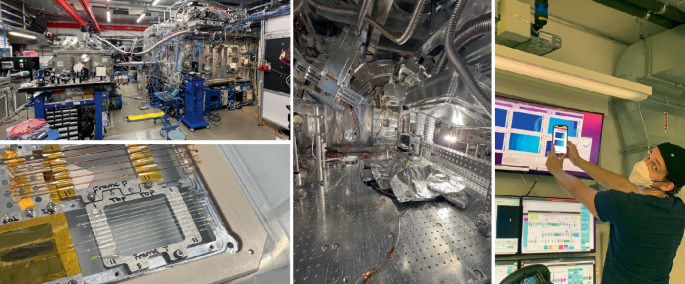
Understanding how atomic structures evolve during chemical processes is central to many problems in chemistry, from materials formation to catalysis and solution chemistry. Yet, most structural probes capture time-averaged states, rather than instantaneous ones. Even when performed in situ, conventional total scattering and pair distribution function (PDF) analysis, which transform scattering data into real-space maps of interatomic distances that probe local atomic structure, integrate over seconds to minutes, thereby averaging out short-lived intermediates and transient rearrangements that often govern reaction pathways.
Achieving meaningful ultra-fast PDFs, however, requires more than fast X-ray pulses. High data quality depends on careful optimization of instrument geometry, background subtraction, detector corrections, and data reduction workflows. Critically, measurements must extend to sufficiently high momentum transfer (Qmax), which ultimately determines the real-space resolution of the PDF. Many early ultra-fast studies were limited by low Qmax, resulting in a loss of chemically distinct structural information, effectively blurring the local chemistry.