This story is part of Image’s September Image Makers issue, your guide to this city that refuses to be any one thing.

Japanese designers are turning heads in L.A. Their clothes can be spotted on store staff, at art and fashion events, or even on the streets, where a passing look can stop you in your tracks. A splash of chrome against an elegant eggshell-blue dress. Layers upon layers of Comme des Garçons. A colorful pair of neatly pleated Issey Miyake pants. Whatever the detail may be, it’s a look that demands attention the moment it steps outside.
Inspired by “Happy Victims” by Kyoichi Tsuzuki, a book that documents devoted collectors and the brands that fill their lives, Keyla Marquez, fashion director at large for Image, began to wonder how many people in L.A. had Japanese designer collections of their own, tucked away in their closets. Her interest in Japanese fashion comes down to what she calls “the ethos that it carries” — a sense of uniqueness and an appreciation for imperfection.
We spoke with four creatives who are reimagining what it means to not only collect Japanese fashion in L.A., but to truly embody its unique spirit. Emilia Yin, art dealer and founder of contemporary art gallery Make Room, approaches her Issey Miyake collection much like she does her art, gravitating to an array of colors and flowing forms that reflect her personal eye. Toreno Winn, stylist, photographer and creative director, is drawn to the experimental qualities of CDG, Junya Watanabe and Sacai, with playful proportions and unexpected silhouettes defining his collection. Fiel, vice president of brand and creative at the AI-native startup Newton, loves reinventions of utilitarian clothing, favoring functional pieces in deep greens and blacks. Meanwhile, actor and artist RiRia has a lifelong devotion to punk fashion, curating a Hysteric Glamour wardrobe bursting with color, energy and attitude.
Each of these artists’ closets is a source of self-expression. Their collections are more than garments and pieces of fabric; they are reflections of the people who seek them out, restore them and make them their own.
Emilia Yin: ‘One can understand the world without limitation’

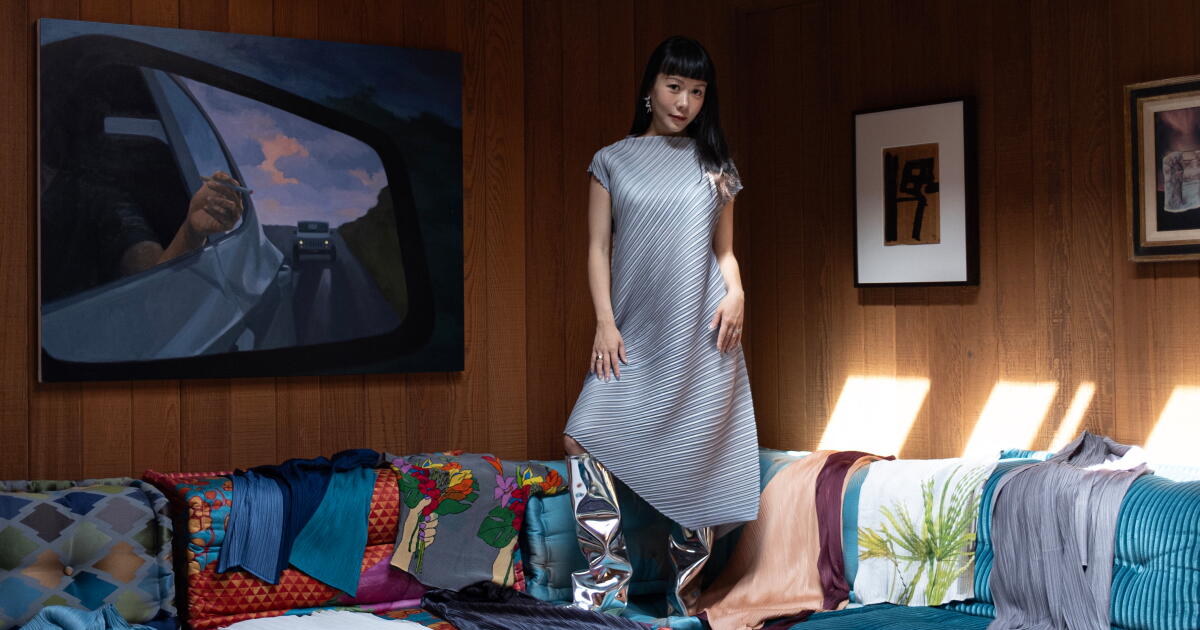
Yin wears Issey Miyake dress, A.W.A.K.E. Mode boots and Dries Van Noten earrings.
Japanese fashion opens up a very diverse and unlimited way to rethink fashion and design. I grew up in Hong Kong, and Japanese fashion has always been a big influence. My family loved traveling to Japan, and I think that really helped open us up to new ways of understanding people and how different cultures can coexist within one space.
When I traveled to New York, I got my very first Issey Miyake jacket from the MoMA Design Store and at the time I didn’t know much about the brand. I was fascinated by the design and by the way the fabric was pleated. Fast forward to summer when I went back to Hong Kong, I found out my parents had also been buying Issey Miyake, so it was interesting to see these subliminal connections. We would shop in the Issey Miyake stores in Japan, and it became a way for us to express and share love with each other. The dress I’m wearing now is a dress my father bought for me before I opened my gallery, and I wore it on opening night. There are memories associated with each piece.


How I shop for pieces is very similar to how I collect and buy art. It’s a mixture of intuition, understanding and research. With Issey Miyake, the pieces are very innovative in their fabric and design, and there’s a technical design and pattern behind it. When I look at a piece, I know if it has the soul of the designer who created it. I enjoy looking at archive pieces and learning the history to understand what inspired these designers. My dream collection consists of the most unique archive pieces of each designer I collect.
I have a 6-month-old daughter and I’m looking forward to growing my collection through her eyes. I appreciate people with obsessions towards their craft and believe having a passion and love for what you do is one of the most beautiful things a human can have and I would encourage anyone to seek it.
Fiel: ‘I have such a deep appreciation for anyone who makes things’

Jet, left, wears Junya Watanabe AD2013 top and Future Collective shorts. Fiel, right, wears Sacai jacket, Uniqlo pants, Jil Sander shoes, Bottega Veneta glasses and Grainne Morton jewelry.
I had a roommate in college who collected Margiela and Morgane Le Fay. She had Japanese fashion magazines around, and I didn’t grow up with any of that stuff, so that was my first exposure. I started collecting magazines such as the Visionaire and from there started buying clothes.
There was a store behind my first office building that got all of the clothes they couldn’t sell from Barneys, and I would find bins of Margiela for $15. Comme des Garçons ended up becoming the thing I really loved. For me, it’s about the concept and craft. Recently, I’ve been interested in the reinventions of utilitarian clothing, such as bomber jackets. I have a lot of black in my collection, but recently I’ve been wearing other colors like military green.
The Sacai jacket I have on now was my grail for a long time. I buy things that are off season. People get tired of it and then they sell it. I buy things straight from Japan because the resale market there is really incredible. When I received this jacket, it was filthy and under $200, but I just washed it carefully. I love taking something that’s been neglected and restoring it and then using it so it’s not just forgotten. I’m always paying attention to the craft of everything — how things are made and the people who are behind them.


I enjoy the ideas and the silhouettes of Japanese fashion. There’s a certain philosophy to dressing the body in Japan where the clothing obscures the body. This jacket does that too, it’s like a big cocoon. It makes me feel happy. Jackets make me feel like I have a little shell and each one is a different flavor of shell depending on what the jacket is. I like turning into a different shape.
I’m working on my own creative evolution and vision. I look at the creatives I admire and you can see they have language in their work. It’s so thrilling to me how someone like Junya Watanabe comes up with his designs or how Sacai turns utilitarian clothing into something you wouldn’t expect.
RiRia: ‘I’m kind of like a prism. I take the light and I turn into a whole rainbow’

RiRia wears X-Girl dress, Kenzo X H&M pants and arm sleeve, Junya Watanabe jacket, fur collar, pins and necklace handmade by RiRia, Jwyed wallet chain, Gyaromi/Kimamaya key chain and vintage Japanese gloves.
I first moved to L.A. from Japan 14 years ago. The first store I stepped into was a Japanese art store in Little Tokyo. They had this Super Lovers piece that I only saw in magazines. I started collecting Japanese pieces because I wanted people to know where I was from. I went to a high school in downtown L.A. where there were no Asian kids, and one way for me to express myself was through my clothes. I like to say I was made in Tokyo but a product of L.A.
I love to incorporate crystals and rhinestones as an element to my fashion. I bedazzle pieces I collect and I like how it reflects the color and turns into a rainbow. That also reflects my personality. I grew up as a classical flute player but I was also into punk fashion. For performances I would put little chains on my gown and wear bedazzled badges. I feel when you have a really strong core, however you present yourself isn’t going to change who you are. I have my classical musician roots at my core, but my punk, rebellious exterior adds a cherry on top.


Japanese fashion collector, RiRia, photographed for Image Magazine’s September 2026 Image Makers issue.
(Dana Boulos / For The Times)
My favorite brand to collect is Hysteric Glamour. It was too basic for me in Japan since everyone wore it, but in L.A. it became something more rare. I learned to appreciate Japanese fashion more after moving here. All the Hysteric Glamour pieces I collect have stories to them. I look for originality and rarity when collecting. I’m really picky with what I wear, so when I style it’s influenced by Harajuku and Ura-Harajuku style. For me fashion is unpredictable, so how I feel on a certain day influences how I dress. Today I wanted to be a little punk and colorful with a neon twist.
I feel my collection speaks to my authenticity. I never collect one specific brand or designer because I select clothes based on how a piece makes me feel in the moment. I’m hoping people see that all the colors and shapes and how bedazzled I am is a reflection of my identity.
Toreno Winn: ‘I like to say I’m a Japanese Swiss Army knife. I don’t stick to any one aesthetic’

Winn wears Comme des Garçons Homme Plus top, bottoms and hat, Noir Kei Ninomiya shoes and Takahiro Miyashita TheSoloist jewelry.
My relationship with Japanese fashion started when I fell into a deep rabbit hole with Yohji Yamamoto. I bought a pair of Y3 sneakers in either 2009 or 2010. It was during the time I was collecting footwear and I was drawn to unique footwear, especially Adidas, and at the time they were doing a collaboration with Yohji. I have a huge Yohji collection, but what I mostly collect now is Comme des Garçons, Sacai, Junya Watanabe and Doublet.
I’ve developed different ways of collecting my pieces, especially through community. I have connections in Paris, Belgium and Japan, and I actually lived in Asia for some time and enrolled in a few classes. I learned sashiko stitching and footwear design and created some really cool footwear. I feel Japanese fashion in L.A. has gotten more popular and I think fashion is just a universal language we all speak — that’s how I’ve built relationships with people.


I feel my style has matured and grown over the years. It’s rooted in quality, intentionality, fabric and well-constructed garments. I’m versatile and my style is a summation of all the eras in my life.
I take a lot of inspiration from film and anime. They have some of the coolest colors and silhouettes and they come to life through animation. I try to do that by creating a character in my personal style. My three big inspirations are Rei Kawakubo, Yohji Yamamoto and Issey Miyake.
Figuring out my identity has been super helpful in showing myself to others without having to say a word, and I think that comes from my level of intentionality and how I dress. Disruption is fun. Through my work as a stylist and my personal style, I want people walking down the street or scrolling on social media to stop and think. No matter what the opinion is, I want people to form one because then there’s a reference point of “I don’t like that” or “I absolutely love that” and defining what that line is for each person is a beautiful thing.


Featured Collectors Fiel, RiRia, Toreno Winn and Emilia Yin
Creative Direction Keyla Marquez
Photography Dana Boulos
Videography Quincy Bowie
Creative Assistant Matzi
Locations Collectors’ homes in Newport Beach, Culver City and Sawtelle, Wild West Social House