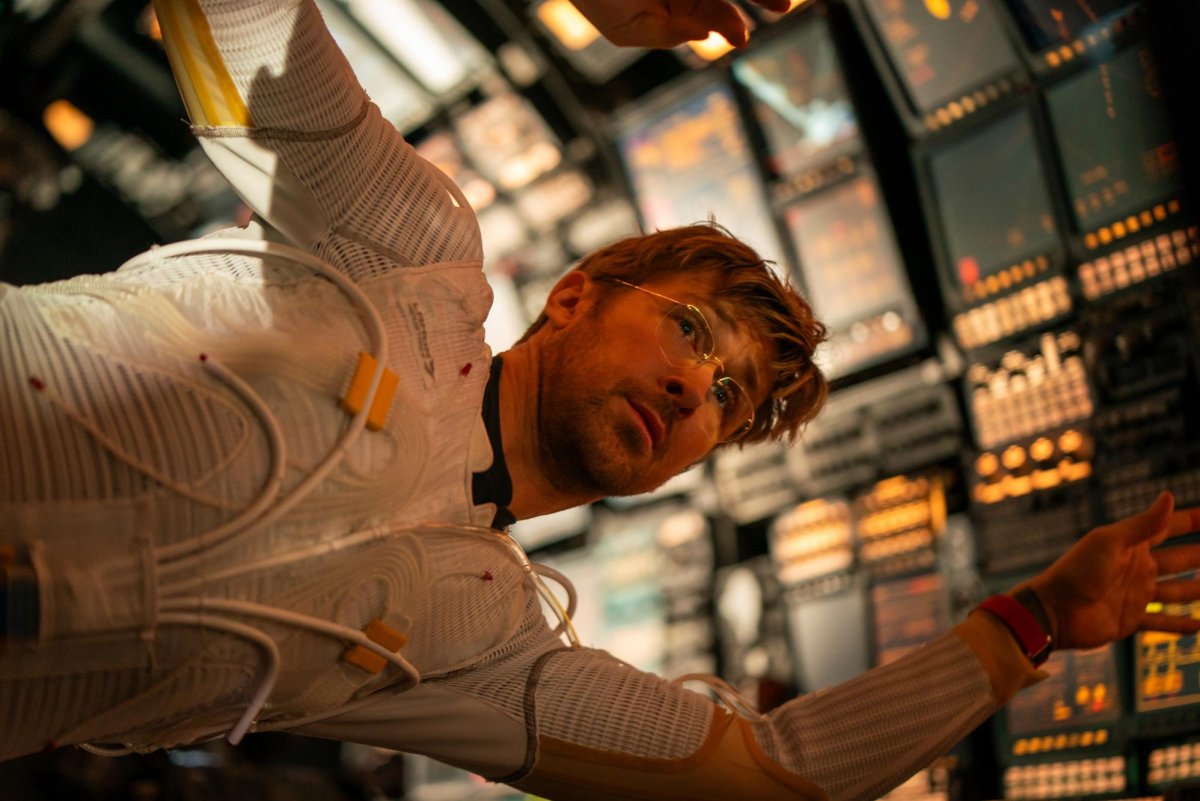
1 of 5 | Ryland Grace (Ryan Gosling) is alone on the ship in “Project Hail Mary,” in theaters March 20. Photo courtesy of Amazon MGM Studios
LOS ANGELES, March 10 (UPI) — Project Hail Mary, in theaters March 20, is a celebration of real-life science. Through science-fiction, it shows how fun, humorous and rewarding learning can be.
Ryland Grace (Ryan Gosling) awakens on a space ship. He sees that the other two astronauts who were with him died during the trip.
Flashbacks show how international scientist Eva Stratt (Sandra Huller) recruited schoolteacher Grace to help with a solar crisis because of a controversial paper he once published. Stratt’s team needs to reproduce energy particles from Venus to visit the one sun in the galaxy that has resisted the particles that are dimming the Earth’s and other suns.
They still can’t produce enough particles for a round trip. So the astronauts on Project Hail Mary will only be able to send their findings back to Earth via a probe.
Both on Earth and in space, the film captures the joy of conducting experiments. Grace and Stratt’s agent Carl (Lionel Boyce) get pumped up buying supplies. When it works and they discover the life cycle of the particles, it shows all of that work produced useful results.
In space, Grace encounters an alien on a similar mission. He has to figure out how to receive and decode the alien’s messages when they have different languages and physiology. Then, together they try to solve how they can save their respective suns.
Even when the film invents Astrophage particles and new elements on the distant sun, they follow logically from Earthbound science. Grace still practices the scientific method on fictional elements.
Learning need not be limited to apocalyptic scenarios. Even in everyday life, knowing something you didn’t know before adds to your life.
It feels like in the modern world of 2026, a lot of society, leaders included, deny knowledge to prevent change or growth. Hopefully, the demonstrations in Project Hail Mary ease that fear in viewers.
Even if it doesn’t change worldviews, Project Hail Mary is entertaining. Based on a book by Andy Weir, it reduces complicated scientific concepts to layman’s terms with the same humor the adaptation of Weir’s The Martian displayed.
Adapted by Drew Goddard and directed by Phil Lord and Christopher Miller, it also shares a sense of humor with the latter pair’s Lego, Spider-Verse and Jump Street movies.
Many of the punchlines are simply facial tics, of which Gosling and Hűller must have tried several variations to land on the perfect reaction shot. When Grace first encounters the alien ship, the simple motions of the ships create a humorous juxtaposition between large and small spacecrafts.
Grace gives the alien from Erid the name Rocky. They learn 250 mutual words, enough for Grace to build a translator device. It’s essentially Google Translate for Eridian.
250 is still enough words for jokes. In fact, the directness of the limited vocabulary makes Rocky even funnier.
That’s not to say the film is entirely flippant. Appropriate attention is paid to the souls lost on the voyage and in danger on Earth, and the relationship between Grace and Rocky is emotional.
All of the space scenes are in IMAX for IMAX screenings. Only the flashbacks are in regular widescreen.
Even then, the first and last transitions between past and present allow light to bleed from the widescreen frame into the screen above and below. That is one IMAX effect that hasn’t been done in other films.
The space exploration is messy and jerky. Grace is not in 2001, though he does reference Close Encounters of the Third Kind. Project Hail Mary is focused on the chaos of space, not the grace despite the hero’s name.
Project Hail Mary may seem awesome from the sheer grandeur of space presented in IMAX. However, it is its depiction of learning that truly inspires awe.
Fred Topel, who attended film school at Ithaca College, is a UPI entertainment writer based in Los Angeles. He has been a professional film critic since 1999, a Rotten Tomatoes critic since 2001, and a member of the Television Critics Association since 2012 and the Critics Choice Association since 2023. Read more of his work in Entertainment.