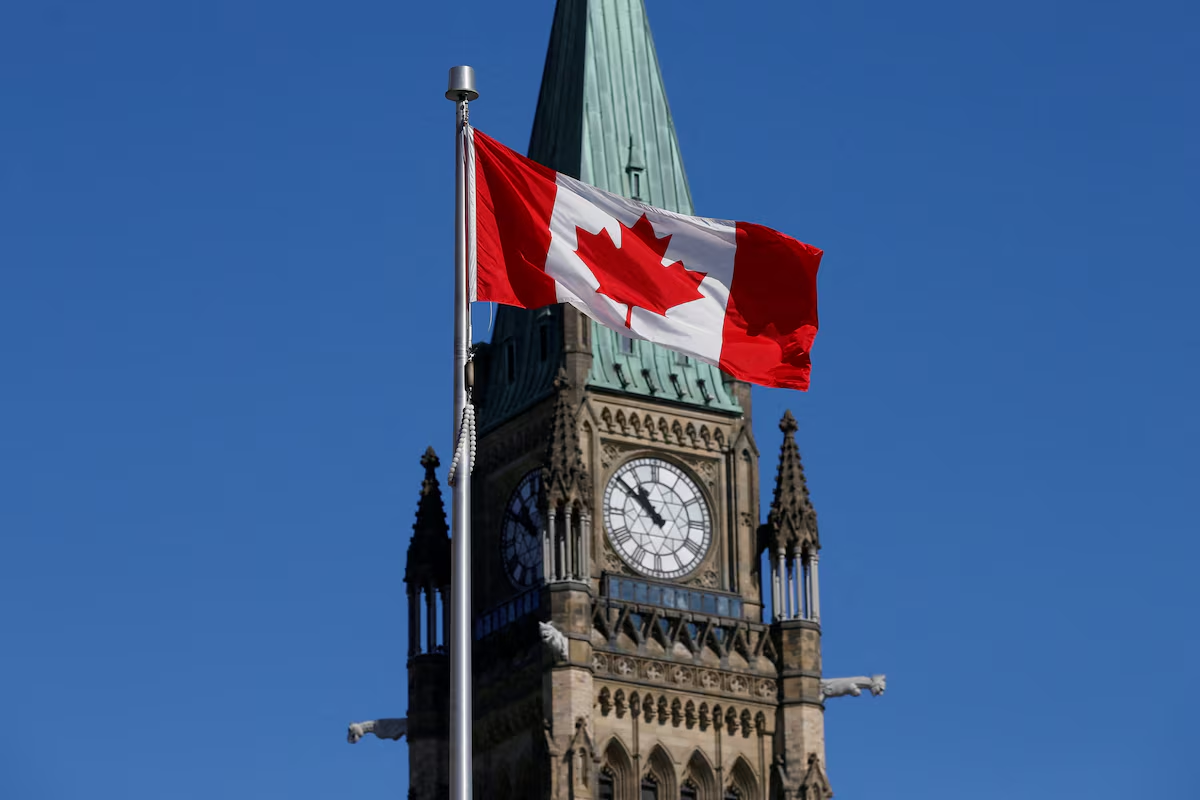
The Carney government does not need to rekindle a debate about establishing a single national securities regulator, writes Rita Trichur.Chris Wattie/Reuters
Canada may never have a true national securities regulator because of the dysfunctional nature of our federation.
Provincial turf wars persist — like pesky mosquitoes in July — despite the federal government’s desire to build a unified Canadian economy. That doesn’t mean Ottawa should give up entirely on realizing a national project that was recommended by a Royal Commission back in 1935.
Instead of rekindling a predictably fractious debate about establishing a single national securities regulator, the Carney government should squarely focus on managing systemic risks and strengthening criminal enforcement in Canada’s capital markets, according to a new report by the C.D. Howe Institute.
This proposal warms the cockles of my nerdy heart even if it stops short of recommending Ottawa resurrect plans for a co-operative capital markets regulatory system — an initiative the previous government foolishly scrapped five years ago. But I digress …
The report’s authors are Paul Bourque and Douglas Hyndman, both of whom have deep knowledge about capital markets.
Opinion: The flashing-red bond market is the thread that may unravel the entire world economy
As Mr. Bourque and Mr. Hyndman rightly point out, this is an opportune time for Ottawa to focus on systemic risk management and bolstering market enforcement as it seeks to fortify the Canadian economy against exogenous threats.
“U.S. tariffs and Middle East conflict have made it clear how vulnerable Canada’s economy is to disruption,” stated Mr. Bourque in a press release. “Completing the unfinished federal elements of capital markets reform would help build resiliency at a time when independence and competitiveness are critical.”
Added Mr. Hyndman: “Ottawa should follow through on the responsibilities previously recognized by the Supreme Court of Canada and finally complete this unfinished reform.”
Canada’s highest court affirmed in both 2011 and 2018 that Ottawa has the authority to collect data and monitor systemic risks in financial markets.
What exactly is systemic risk? Well, it’s the potential for an adverse event to trigger a domino effect in financial markets.
The report cites some historic examples.
The U.S. subprime mortgage crisis began in 2007 and morphed into the Great Financial Crisis of 2008-2009.
The contagion from those crises, along with the resulting panic in European debt markets, also caused Canada’s market for asset-backed commercial paper to freeze in 2007, leaving Canadian investors stuck with more than $30-billion worth of moribund notes. The resolution of that debt debacle took years.
There was also the 2023 regional banking crisis in the U.S., which spread to Europe. The fallout prompted Canada’s top banking regulator to start daily monitoring of domestic banks’ liquidity, The Globe and Mail reported at the time.
Make no mistake, this isn’t just an exercise in hindsight. It ought to be a contemporary concern.
In March, for instance, Bank of Canada Governor Tiff Macklem called for increased monitoring of private credit.
“Surveillance needs to be enhanced so we can monitor how risks evolve as this market grows,” he said at the time. “The issue is not private credit itself. It’s how private credit will behave under stress – and the risks it poses to the broader financial system.”
As the report’s authors aptly note, capital markets are becoming increasingly complex, and financial players are increasingly interconnected. That means systemic risk can swell but escape the notice of regulators.
Sure, some efforts have been made, including by provincial and federal regulators, to monitor financial system risk. But as the report argues, this patchwork approach makes Canada an outlier among industrialized countries.
What is still needed is a national approach backed by legislation, stringent standards and sufficient resources to collect data, the report said. Additionally, it stresses the need for a “single point of political accountability.”
Imagine that.
The report also urges Ottawa to exercise its authority to remedy our country’s poor track record on criminal enforcement by giving a federal agency a national mandate to investigate and prosecute securities offences.
“Canada’s criminal deterrent against capital markets fraud and abuse is universally regarded as weak,” states the report.
Scandals such as Bre-X and Quadriga illustrate this failure.
It is also unclear how U.S. President Donald Trump’s deregulation drive will affect that country’s capabilities to monitor and mitigate systemic risk in financial markets, the report said.
But the authors’ broader point is that Ottawa should fulfill its duty to monitor systemic risks and crack down on serious securities offences to bolster Canada’s economic resilience.
“The federal government is looking to make the economy stronger and less reliant on the United States,” states the report. “That includes retaining and attracting investment in Canada’s capital markets.”
Precisely.