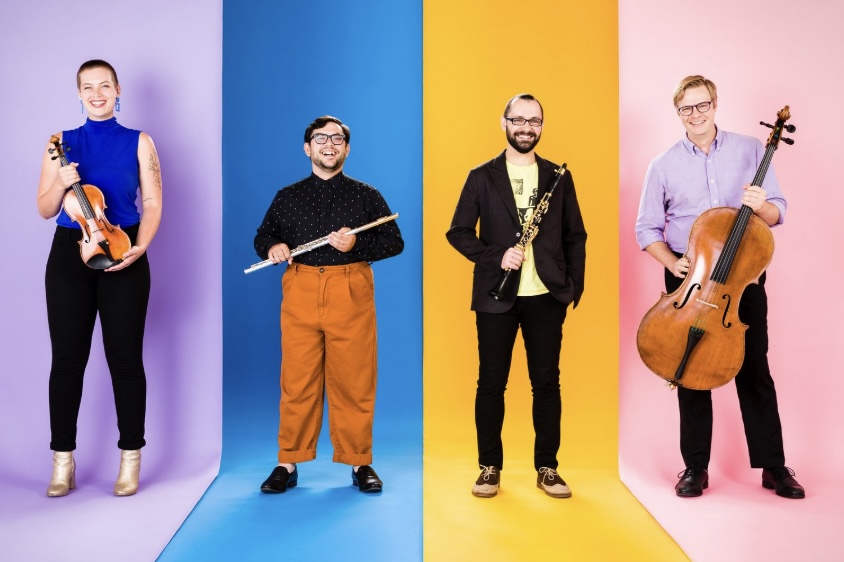
Lenox — Contemporary ensemble Hub New Music will perform at 7 p.m. on Friday, May 1, at Tanglewood’s Linde Center for Music and Learning, presenting a program of newly commissioned works that reflects its focus on contemporary composition and electroacoustic sound.
Hub New Music is a contemporary chamber ensemble founded in 2013 and based in the United States. The group features a distinctive instrumentation of flute, clarinet, violin, and cello and is dedicated to performing newly commissioned works written specifically for that combination. Known for its thoughtful programming and close work with living artists, the ensemble performs at major venues and festivals worldwide while also engaging in educational residencies that connect new audiences with contemporary classical music.
Friday’s program:
- Angélica Negrón — “Pedazos intermitentes de un lugar ya fragmentado”
- Daniel Wohl — “Mirage”
- Christopher Cerrone — “Barnes Dances”
- Daniel Wohl — “État”
Born in Paris and now based in Los Angeles, Daniel Wohl is a composer known for combining electronic sounds with traditional instruments in creative and unexpected ways. His work ranges from solo and chamber music to large orchestral pieces, as well as scores for film and television. Critics have praised his music as imaginative, original, and emotionally engaging.
Wohl’s music has been performed at major venues, including Carnegie Hall and the Hollywood Bowl, and by leading groups such as the Los Angeles Philharmonic and London Contemporary Orchestra. He has collaborated with a wide range of artists across genres, including Jóhann Jóhannsson and Son Lux.
In addition to concert music, Wohl composes for film and television, working with directors such as Luca Guadagnino and Patty Jenkins. His album “État,” released in 2019, reflects his interest in blending electronic and acoustic sound. He earned his doctorate from the Yale School of Music, where he studied with David Lang.
I interviewed Daniel Wohl last week via email. Our conversation has been edited for clarity and length.
What does it mean for you to present this work with Hub New Music at Tanglewood, a venue so closely associated with classical tradition?
There’s something compelling about presenting a work like this in a context that carries so much historical weight. Tanglewood has a strong lineage that includes both classical tradition and more experimental work, and I think this piece engages with that while also reframing it through contemporary electronic music.
Classical music has always drawn from the sounds and ideas of its time, whether from jazz, folk traditions, or other forms. I see this work as part of that continuum. It brings a different sonic language into the space, and that contrast can make both the tradition and the new work feel more immediate and alive. Working with Hub New Music is a big part of that, since they bring a level of precision and openness that allows that dialogue to happen naturally.
‘Mirage’ draws on UFO-inspired imagery. How does that concept translate into sound, and what should audiences listen for in a live performance?
The reference to UFO imagery isn’t meant to be literal, but more about evoking a certain atmosphere—something ambiguous, slightly disorienting, and hovering between the familiar and the unfamiliar. In the music, that comes through instabilities in pitch, timbre, and spatial perception. Sounds shift in ways that are hard to fully locate or resolve.
In a live performance, I’d encourage listeners to notice how things transform over time. Lines that seem stable begin to bend, and textures that feel grounded can start to float. There’s also an important spatial aspect, where sound doesn’t always behave in a predictable way. It’s less about following a clear narrative and more about staying inside that sense of uncertainty.
How did writing for Hub’s specific instrumentation—flute, clarinet, violin, and cello—shape the structure and sonic world of the piece?
This instrumentation is both flexible and very exposed. With only four instruments, every gesture is clearly heard, so there’s a need for precision in how material is shaped and developed.
I approached the ensemble as a kind of hybrid instrument, trying to blur the boundaries between the four players and create a single evolving sonic entity. Structurally, that led me toward continuity rather than contrast. Instead of clearly defined sections, the piece unfolds more gradually, with timbral changes playing as important a role as harmony or rhythm in shaping the form.
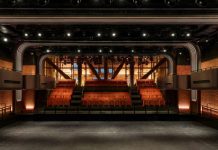
Your music blends electronics with acoustic instruments. In a space like the Linde Center’s Studio E, how do you approach balancing those elements so they feel fully integrated?
For me, integration with electronics starts in the writing. The electronics aren’t an added layer, but part of the same ecosystem as the acoustic instruments. I’m thinking about how a sound begins, how it evolves, and whether that evolution is carried by a performer or by the electronics.
The clarity of Studio E makes it possible to be very precise with that balance. The goal isn’t to hide the electronics or to feature them, but to blur the sense of where a sound is coming from. Ideally, you stop hearing a distinction between acoustic and electronic and just experience a single, continuous field.
For listeners encountering your work for the first time, what kind of experience do you hope they take away from this performance?
I’m not expecting the audience to visualize a narrative as they’re listening to it. What I hope is that they feel drawn into a different sense of time and perception, where things might not be immediately clear but still feel coherent.
If there’s a takeaway, it’s that sense of being slightly disoriented but still engaged. That feeling of not being entirely sure what you’re hearing.
* * *
The Linde Center for Music and Learning is located at 3 West Hawthorne Road in Lenox. Tickets and additional information are available here.