
QUEBEC CITY — The Quebec government has announced a series of measures to promote buying locally in response to the escalating trade war between Canada and the United States.
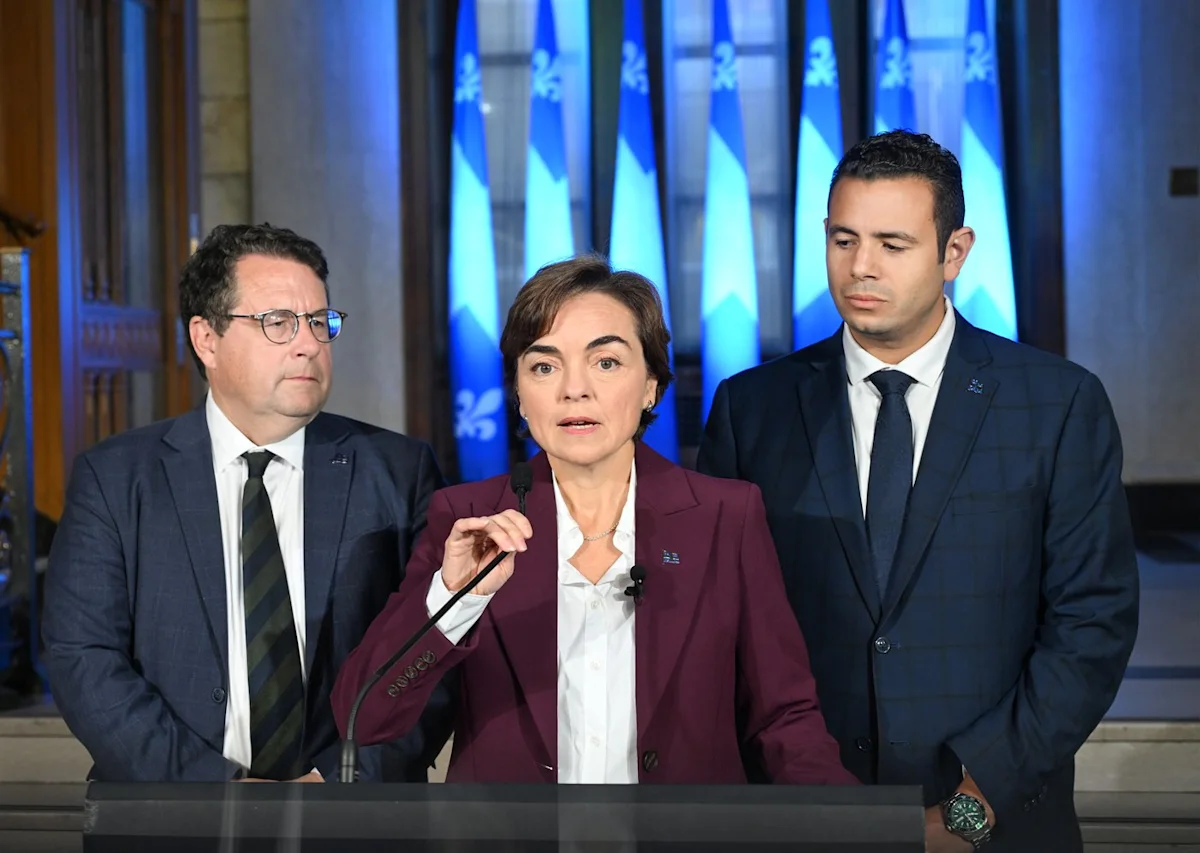
Premier Christine Fréchette says the measures will inject about $1.5 billion into the Quebec economy in the next four months.
“Quebec is facing a bully,” Fréchette said Tuesday, in reference to U.S. President Donald Trump.
“We have two choices when facing him. Either we bow down and end up on our knees, or we keep our heads high and stand tall.”
Fréchette’s cabinet met as she took a break from the provincial election campaign to return to her role as premier and address the latest in the trade war.
The ministers adopted an order-in-council requiring the government to take steps to favour local businesses when it comes to awarding contracts, such as reserving public bids for companies with a place of business in Quebec and Canada.
Those measures could also include requiring that goods be produced and processed in the province, and granting a 15 per cent preferential margin based on Quebec or Canadian value added.
Crown corporations will also be asked to develop a local buying strategy, and will be allowed to deviate from legislation that currently governs public sector contracts.
In the hard-hit furniture sector, the government will source exclusively from Quebec suppliers.
Fréchette said the measures she announced would impact about $1.5 billion in contracts.
In total, the Quebec government and public agencies awarded $26 billion in contracts in 2024-2025. The protectionist measures adopted by the government will exclude fewer than 10 per cent of bidding companies, she said.
“It isn’t a very high percentage — under 10 per cent — but the fact remains that these are companies for which it’s becoming harder to position themselves to win contracts,” she said.
She also urged municipalities, organizations and individuals to buy as many Quebec products as possible. “We need to be united,” she said.
Canada’s retaliatory tariffs kicked in on Monday after the breakdown of talks with the United States.
Trump responded on Tuesday by saying he was directing the federal agency that oversees government procurement to remove all Canadian-origin products from its “awards schedule.”
In a post on social media, Trump said “the Canadian Government, including Canadian Provinces, have banned American Small Businesses and Companies from selling into their Government Procurement Markets.”
He also claimed “that is not reciprocity, it is a Canadian Trade Scam.”