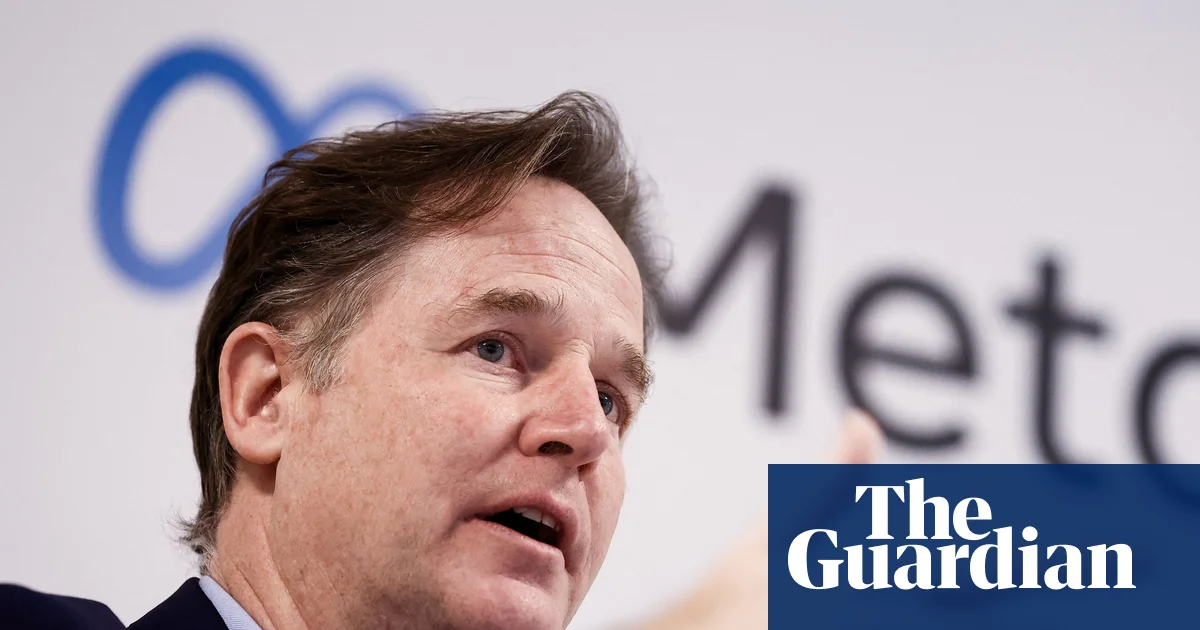
Silicon Valley companies including Meta have decided to embrace Maga politics, some for “rather more self-interested” reasons, the former UK deputy prime minister Nick Clegg has said.
Clegg, who spent nearly seven years at Meta as the head of global affairs, told The Rest is Money podcast that it felt like “a very good time for me to move on” when he left the company in March 2025, three months into the second Trump administration.
Executives who had previously shunned politics pivoted right; the products themselves “changed utterly: from being human-centric to being much more about content, often synthetic content, algorithmically recommended to you”, Clegg said.
He also called into question the UK’s contract with the US software company Palantir, expressing distaste for the US spyware firm’s ideology and saying there were legitimate concerns as to whether “Palantir is making itself too sticky” – inculcating dependency in its clients.
Palantir’s contracts with the UK have been a subject of mounting controversy in the past months. Last week, a report from parliament’s science, innovation and technology committee said Palantir was the “most concerning example of the public sector’s growing reliance on a small number of major technology providers”.
The committee urged the government to end its contract with Palantir in 2027, when it is permitted to do so by the contract’s break clause.
The day after that report, the former health secretary Wes Streeting described Palantir executives as “Blofeld villains” at an event at London’s SXSW conference but defended Palantir’s stewardship of UK health data and refused to say whether the contract should end.
A Palantir spokesperson said: “We’re proud that our software is helping to deliver better care, including an additional 110,000 operations to date, a 15% reduction in discharge delays and a 7% increase in the number of people finding out whether or not they have cancer within 28 days. As the former secretary of state said himself this is ‘absolutely critical to the future of the NHS and there aren’t many platforms and providers in the world who can do this’.”
Clegg suggested that with the rise of artificial intelligence, Palantir could be easily “disrupted or challenged” by AI-powered rivals and perhaps replaced by one of them.
While Palantir advertises its AI capabilities, its core offerings are software platforms that integrate data into business and government workflows. These now use AI, but Palantir has not built its own foundational AI models.
The chief executive of Palantir UK, Louis Mosley, told the Today programme last week: “The British state has used us in two departments that have since stopped using us and had no issues with transferring the data, the logic, the intellectual property that they developed in our software out of our software and into other vendors. So this notion that we are part of a vendor lock-in is false”.
Clegg’s stint at the heart of the US tech industry began in 2018, when he was hired as a lobbyist for Meta after his predecessor, Elliot Schrage, resigned over the Cambridge Analytica scandal. In his time at Meta, Clegg managed the fallout of that scandal and created a body to oversee Meta’s content moderation decisions.
He arrived at Meta shortly after the departure of Sarah Wynn-Williams, formerly Meta’s director of public policy, who went on to write the whistleblower account Careless People about her time in the company. In it, she describes episode after episode of blundering, myopic and “lethally careless” decision-making by Meta executives, including allegedly working with the Chinese Communist party on censorship, and alleges instances of sexual harassment by some of the company’s leadership.
Wynn-Williams appeared on stage at the Hay festival but was forced to sit in silence because of legal action against her by Meta, which secured an emergency legal order on the eve of publication preventing her from publicly discussing aspects of the book.
Meta did not respond to a request for comment. It has previously described Careless People as a “mix of out-of-date and previously reported claims about the company and false accusations about our executives”.