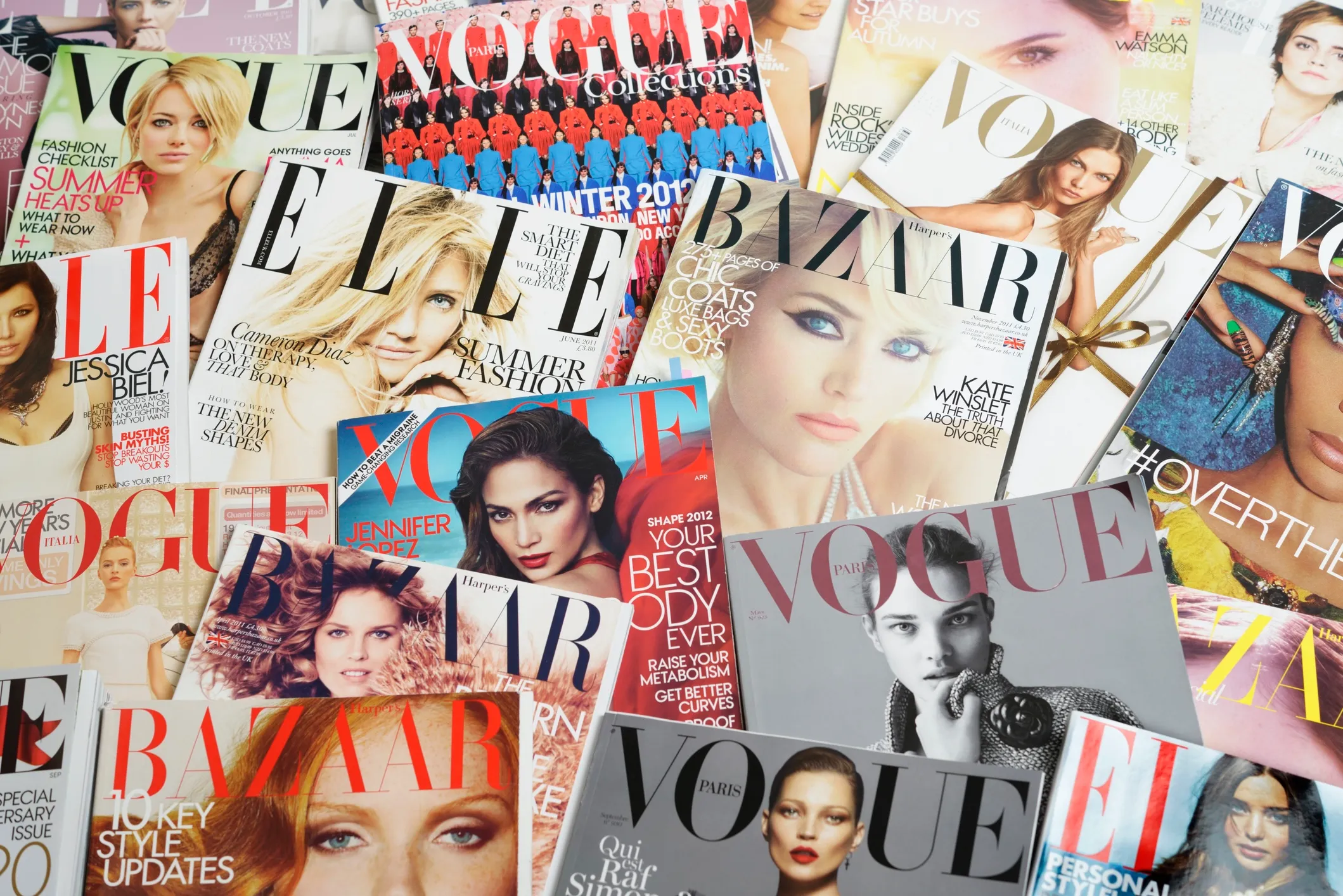
There is a moment in former Condé Nast maestro Nicholas Coleridge’s memoir The Glossy Years where he recounts losing his magazine virginity. Aged 16 and ill in bed at home he picked up a copy of Harpers & Queen belonging to his mother and in an instant was spellbound: the wit, the glamour, the ‘understated snobbery’. ‘That first couple of hours with a glossy changed my life,’ he wrote.
So I felt when Vogue was delivered to my school library each month: a sliver of high-end bliss among the daily-end drudgery. It was the start of a teenagehood marked by circles of shame in Heat and sticky ink on my thighs from reading Grazia on sweaty school coaches (temporary tattoos of gossip). The teenage years, endlessly horizontal, lent themselves to Tatler in a hammock, More on a sofa, Elle in bed. I was magazine binging long before I was ‘doom-scrolling’.
Print magazines being in their death throes is well documented – even the spirit-raising statistic that independent magazine sales in the UK rose by 14 per cent between 2021 and 2024 can’t counter that. But when the social media ban for under-16s was announced this month, it made me wonder: am I too optimistic to think that it might, in time, revive the joy of a magazine for teenagers? In a post-ban utopia where the scrolling stops or, at least, dies down to an illegal flick, might teens return to the addictive ‘sheen of the paper, gentle waft of fragrance from the advertiser’s scent strips [and] punning headlines’ that Coleridge fell in love with?
There are still popular junior magazines. The Week Junior (aimed at those aged eight to 14) marked a decade in existence last year and even the Schöffel-brigade’s bible The Field has launched a junior issue for gung-ho eight-to-16-year-olds who want to know how to catch a trout. But for anyone on the cusp of adulthood, it’s the grown-up glossies which are the paper gold.
It feels almost embarrassing to admit the randomness of some of the magazine content I worshipped. I remember a tiny feature on the sculptor Antony Gormley’s daughter Paloma – then a teenager herself – in a Noughties issue of Vogue which I re-read again and again. There was a coolness about her that was primal girl crush territory. There were also the more obvious magazine dopamine hits: anything about Sienna Miller; nuggets of gossip on the Olsen twins; the real-life love stories of The OC cast. Growing up in rural Somerset, I’d even find an H&M tiered maxi skirt in any kind of ‘What’s hot and what’s not’ feature exotic. But I’d also scrunch my eyes to read the tiny caption on a shoot with a £2,000 Alice Temperley dress that I would never ever buy.
The social media ban feels like a lifeline for this sort of print media
Then there were the Tatler Bystander pages – akin, I think, to Instagram on a Monday morning, snooping on a wedding that you haven’t been to. A kind of who’s who of glamour, a real life Rutshire, but without the risk of an accidental ‘like’. As the social climbing mother Molly Maxwell says in Jilly Cooper’s Rivals: ‘Oh I see you take the Tatler too; not for the articles really; but it’s such fun to see which of one’s chums are in this week.’
There were wholesome niches too (mine was Horse & Hound; my husband’s was Newcastle United’s Black & White magazine with its mega posters). And the illicit monthlies (Bliss etc), ideally read aloud to friends for full impact. After one Christmas holiday trip to London from the West Country, the vision of my friend being frogmarched back across Paddington station by her mother to return her copy of Bliss to W.H. Smith (coverline: ‘Snag a snog – Have your Chrimbo cake and eat it’) is etched in my memory. Partly humiliating, partly thrilling, Bliss from then on in was the most coveted title to get hold of, with its agony aunt tackling boys, bodies and sex.
It’s easy to rose-tint the devouring of women’s magazines. There was of course toxicity aplenty – the aforementioned circles of shame and cruelly unattainable beauty standards. But there was a simplicity and a slowness. It was without the cyber bullying and the digital validation and the eye-crossing scrolling. In many ways, the social media ban feels like a lifeline for this sort of print media – particularly when it comes to attracting new readers young enough not to have had a taste of TikTok et al yet. Teenage girls will still need to seek out media that sparks their imagination or fuels their ambition. So, step forward again the glossy, the bible of aspiration. (Best read lying down.)