
When Starbucks Korea promoted its series of reusable tumblers called “tanks” with a “Tank Day” campaign on May 18, 2026, it probably seemed like a fun marketing idea.
Instead, it spiraled into a public relations crisis.
Executives failed to account for the fact that May 18 also coincides with the anniversary of the South Korean military’s deadly suppression of the 1980 Gwangju Uprising, a mass, pro-democracy protest against the country’s military government. Authorities used armored vehicles and helicopters to suppress the uprising and make widespread arrests. The official death toll was around 200, but some scholars and activists argue the true number may have reached 2,000.
For this reason, Starbucks’ “Tank Day” promotion immediately incited protests, calls to boycott the coffee chain and wall-to-wall news coverage in South Korea. The company was compelled to apologize, pull the campaign and launch historical awareness training for all employees.
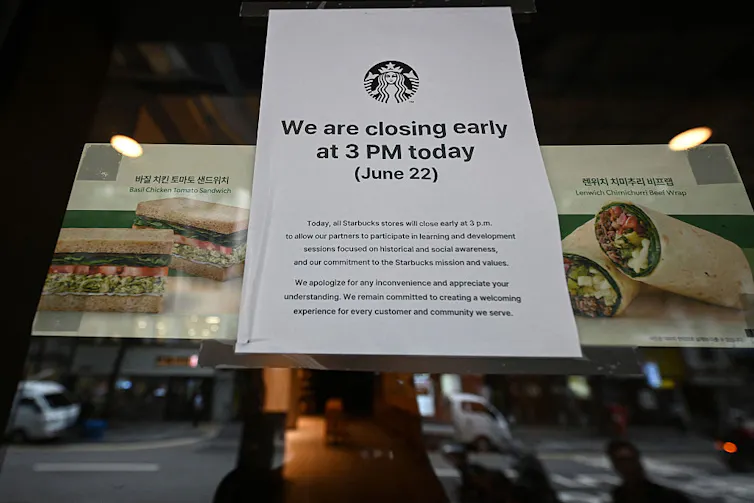
Jade Gao/AFP via Getty Images
As a linguist who studies language, meaning and culture, I am fascinated by these marketing mishaps, which highlight a long-standing challenge for global brands.
When people hear about marketing blunders abroad, they often assume the problem is a poor translation.
Sometimes it is. More often, though, the issue is tied to culture, which global brands ignore at their peril. That’s because a slogan’s or promotion’s meaning is influenced by history, social norms and local associations, all of which can dramatically alter how a message is received.
When words cross borders
Mercedes-Benz learned this lesson when it entered the Chinese market in the 1980s. The company initially used the name “Bensi,” which reportedly sounded similar in Mandarin to “rush to die” – an association that, for obvious reasons, isn’t ideal for an automaker. So the company later shifted gears and adopted the name “Benchi” instead, meaning “run quickly,” a more appropriate name.
Another example came in 2009, when HSBC’s global slogan, “Assume Nothing,” was reportedly interpreted in some markets as “Do Nothing,” forcing the bank to undertake a costly international rebranding campaign. Its replacement slogan, “The world’s private bank,” was designed to avoid the ambiguity.
Sometimes the problem is not translation at all, but meanings that shift between two dialects of the same language. A well-known example comes from the Swedish company Electrolux, which used the slogan “Nothing sucks like an Electrolux” for its U.K. advertising in the 1960s to promote its vacuum cleaners.
Intended to highlight powerful suction, the phrase was received quite differently in the U.S., where “sucks” had already caught on as slang for poor quality or disappointment.
Why meaning is slippery
Linguists have long known that meaning emerges from context. The same word can carry different associations in different places. A phrase that sounds clever in one country may sound confusing, offensive or absurd in another.
The Starbucks Korea controversy demonstrates this clearly. The problem was not a mistranslated slogan. Rather, a campaign built around an ordinary product name failed to account for how the phrase would resonate within a specific historical context. Consumers brought cultural knowledge to the campaign that marketers had apparently overlooked.
Research in intercultural communication shows that successful communication depends not only on linguistic accuracy but also on cultural competence. In other words, knowing what words mean is only part of the challenge.
It is equally important to understand what they mean to the people using them. This is why companies increasingly invest in “localization,” which involves working with local experts, native speakers and in-country marketing teams. In doing so, a company can better adapt the language, imagery and branding to fit the expectations, values and experiences of a particular audience before launching a campaign.
Translation is more than words
Recent advances in artificial intelligence and machine translation have made communication across languages easier than ever. Translation tools can convert text or speech in seconds, helping people communicate across linguistic barriers. Yet this technology has not eliminated the problem of cultural misunderstanding or marketing snafus.
Machine translation often struggles with humor, slang, irony and cultural references because these depend heavily on context. Human translators generally remain better than AI at recognizing subtle meanings and anticipating how audiences are likely to respond.
Even human translators can make mistakes when they lack cultural knowledge or sufficient fluency. The history of translation is full of cautionary tales, from literary blunders to famously mistranslated video games.
One of the most memorable examples comes from the 1990 Japanese game “Zero Wing,” whose English version included the phrase “All your base are belong to us,” instead of something along the lines of “All of your bases are now under our control.”
While the awkward translation became a popular internet meme, it also illustrates how poor translation can undermine understanding. Producing an accurate translation requires more than replacing one word with another. Conveying tone, humor and cultural meaning is harder still.
The real cost of getting it wrong
Marketing blunders are often amusing, and some of these examples have become business school case studies of what not to do.
But for companies, the consequences can be serious. They may face expensive rebranding efforts, damaged reputations and lost consumer trust.
In cases like Starbucks Korea, the issue extends beyond embarrassment because the campaign inadvertently touched on events that remain culturally and politically sensitive.
Corporations are investing heavily in market research, yet incidents like these continue to occur because communication is fundamentally human. Consumers do not passively receive messages; they interpret them through the lens of their own experiences, cultures and histories. That is why successful global marketing depends on more than translation. Even the world’s biggest brands can overlook that reality.