Movies can also serve as warnings or premonitions. You can draw a line between the plots of the bicentennial’s best picture nominees and the realities of today. To wit:
In 1976, the nominees were about distrust in the American government due to corruption; incels; television capitalism run amuck; a guy who sang about socialism and against fascism while trying to help the poor; and a promotional fighting event celebrating America’s bicentennial.
In the real world of 2026, fascism is in fashion, there’s a Democratic socialist mayor in New York City and similar candidates are winning primaries. Billionaires are buying up television stations and other media while all manner of questionable reality TV programs continue to be broadcast. Every other major YouTube channel and podcast seems to be run by some angry straight white dude blaming everyone but himself because he can’t get laid.
(As for that promotional fighting event celebrating an American anniversary, I direct your attention to what’s left of the White House lawn.)

The real world of 1976 wasn’t a bed of roses, either. The country was in the midst of an energy crisis and dealing with the aftermath of Vietnam and Watergate. Desegregation and racism were still major issues. And on the tech front, Apple and Microsoft were founded, which meant very little at the time but would have serious repercussions today.
A massive party honoring America was a welcome distraction in 1976. The bicentennial celebration seemed like a much bigger deal, and a much more united effort, than this year’s festivities. But then again, in 1976 I was an optimistic 6-year-old who got excited when I found a bicentennial quarter in my Mom’s change purse. And the New York City celebration was indeed impressive. I am neither 6 years old nor optimistic now, but that doesn’t change the realities of 2026.
Regardless of the bicentennial festivities, 1976 was still part of a decade where movies were daring enough to have unhappy endings. You weren’t guaranteed a good time at the movies, and audiences found that feature cathartic. The year’s box office grosses bear that out.

The year’s number one movie, “Rocky,” and its number 10 movie, “The Bad News Bears” both bucked the win-at-the-end sports movie cliché. The last movie to be released in 1976, “King Kong,” had its protagonist in love fall to his death, but the box office grosses still landed the movie in fourth place. Barbra Streisand was a widow at the end of the worst remake of “A Star Is Born,” the third-highest-grossing movie of 1976.
And at number 7, there was “The Omen,” the horror classic that proved Atticus Finch was no match for the Antichrist. Evil prevailed when Satan’s kid, Damien Thorn, outsmarted his adopted father, played by Gregory Peck. Jerry Goldsmith’s Oscar-winning score assisted the demonic little brat, even if its Oscar-nominated song, “Ave Satani” should have gotten Goldsmith’s knuckles slapped by a nun’s ruler for its improper Latin grammar.
Oddly enough, some of the darkest movies of 1976 had what could be considered a happy ending.

Take “Taxi Driver,” for example. The first of the five best picture nominees to open, Martin Scorsese’s nightmarish tour through New York City at its most rundown premiered in February. Robert De Niro’s Vietnam veteran Travis Bickle became the poster boy for lonely, alienated men. Marty and screenwriter Paul Schrader tried to elicit sympathy for this guy in the famous pan that accompanied Travis’s awkward phone call to Cybill Shepherd’s character, Betsy, a woman he had earlier taken to a porn movie on a date. The audience bought it!
“Taxi Driver” also has a subplot involving a 12-year-old girl forced into sex work played by Jodie Foster. She’s saved from bondage during Bickle’s last-reel killing spree, a sequence that scared the MPAA into initially giving the movie an X rating. The film’s final moments show Travis being hailed as a hero and driving Betsy home as a fare. He seems at ease, at least temporarily. I’ve always questioned if this was all in his mind; wherever it is, it’s a happy ending of sorts.

As much as I love the “Rocky” franchise — and “Taxi Driver” is my second favorite Scorsese — the movie I would have voted for if I had an Oscar ballot would have been “All the President’s Men.” That movie feels like the most unrealistic one of the bunch nowadays. Since I am an incurable cynic, I can imagine a version on today’s corruption showing Robert Redford and Dustin Hoffman’s reporters yelling “FAKE NEWS” while Deep Throat stomps out his cigarette and leaves that garage in disgust.
Still, director Alan J. Pakula ends the most suspenseful movie about journalism with the Nixon resignation teletype headline we all knew was coming. The film neglects to mention Ford’s full pardoning of Nixon, so I’m calling it a happy ending.

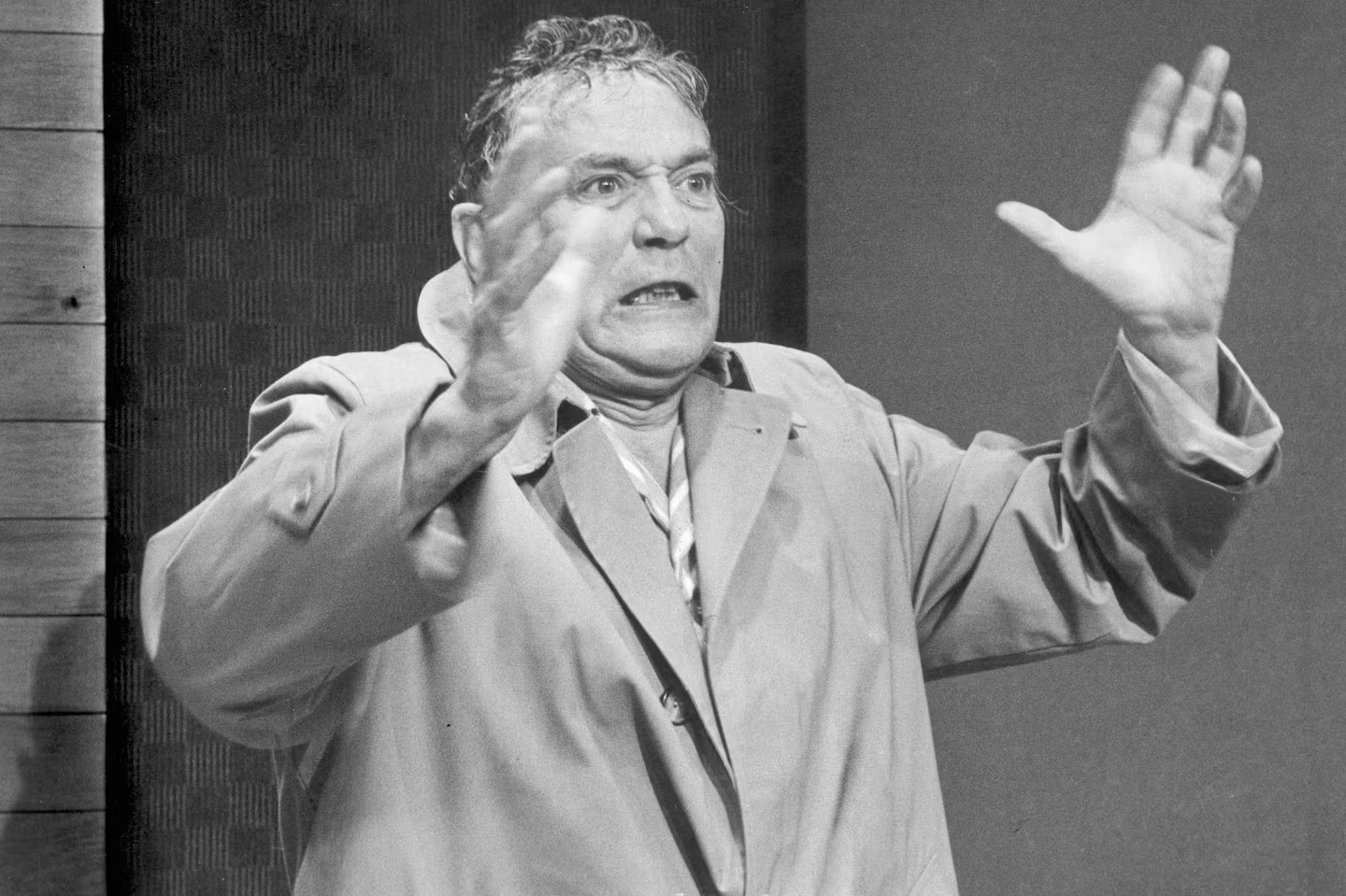
Though shockingly prescient in 1976, “Network” has lost all of its satirical sting. Today, screenwriter Paddy Chayevsky’s howl of rage now plays like a documentary, especially Ned Beatty’s spectacular monologue to Peter Finch’s Howard Beale. “You have meddled with the primary forces of nature, Mr. Beale! And I won’t have it!,” Beatty’s corporate head, Arthur Jensen yells in the film’s best scene. Beale himself is a precursor to the current glut of “influencers” powerful enough to sway audiences into doing their bidding.
It’s no wonder “Rocky” won best picture. After all that heaviness, it must have felt like a breath of fresh air. However, had Sylvester Stallone scripted that his boxer protagonist won the fight, I guarantee you that something else would have won. The loss made it OK for the Academy to bestow best picture on a film that was, at its heart, a remake of “Marty” with boxing gloves.
What I find most amazing about “Rocky” is that its symbol of American success is Apollo Creed. A Black man is the film’s upper class representative versus the working class world of Rocky. Granted, Muhammad Ali was the inspiration for Creed, but this still seemed striking in 1976. Stallone would really lean into Apollo being as American as apple pie in the 1980s Cold War phantasmagoria that is “Rocky IV,” but you know what happens to Apollo in that one.

As for “Bound for Glory,” the Hal Ashby movie everyone forgets when they try to list the best picture nominees released in 1976: That gorgeous looking movie (it won the Oscar for cinematography) is a super-fictionalized biopic about Woody Guthrie (David Carradine), the folk singer who wrote “This Land Is Your Land.” “This land was made for you and me,” Guthrie sang, a line that may have been true in theory but never in execution.
Guthrie wrote “This machine kills fascists” on his guitar. Imagine how that would play today. The most forgotten of the 1976 best picture nominees might be the most controversial one of all in 2026.
Odie Henderson is the Boston Globe’s film critic.