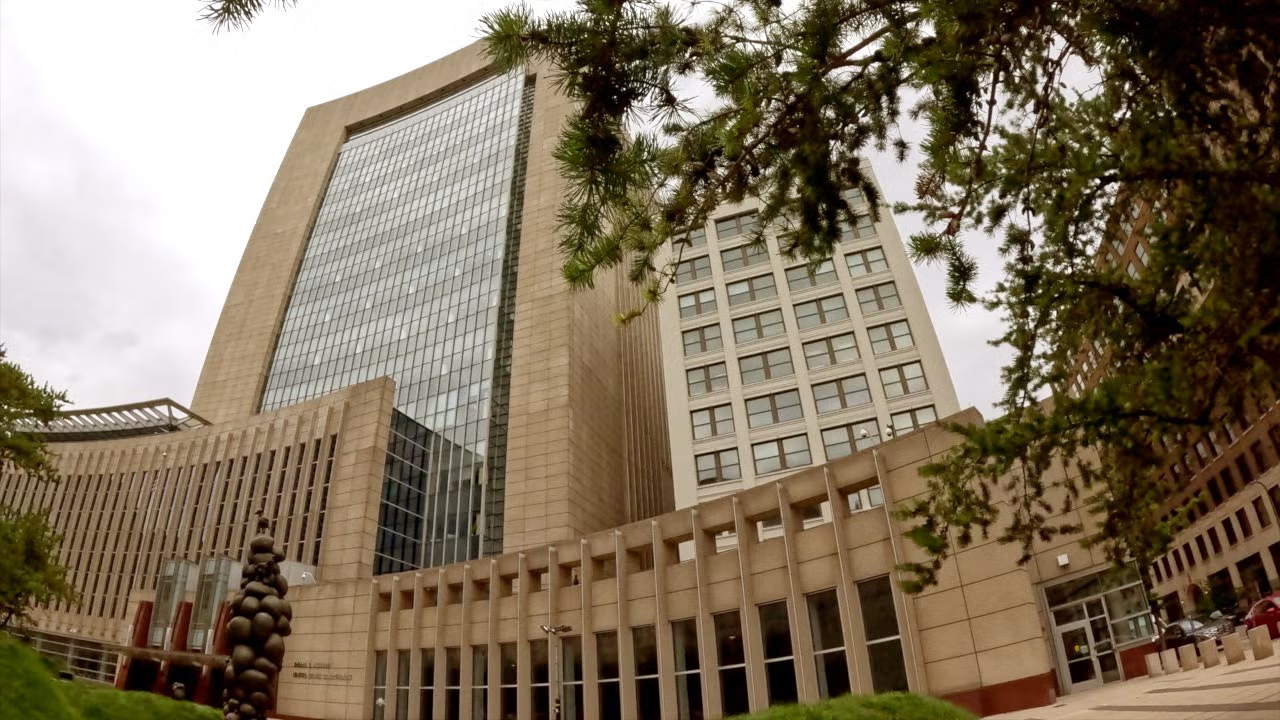
The government objected when a defendant in one of the Feeding Our Future fraud cases requested a new court-appointed attorney last year, citing an “irreconcilable breakdown in the attorney-client relationship” with his previous lawyer.
The defendant, Abdirahman Ahmed, also known as Chef Abcos, was a successful restaurateur in Ohio and prosecutors argued he should have been able to afford private counsel.
But the court still granted Ahmed a new set of free attorneys.
Ahmed has since pleaded guilty to money laundering, and his lawyer cited the “government seizure” of his client’s assets as a reason he could not afford to pay for his own defense.
5 INVESTIGATES found Ahmed is far from the only high-profile defendant who has made similar claims.
A review of federal fraud cases since the start of the Feeding Our Future investigation identified at least 34 people who told the court they could not afford to hire an attorney.
Federal prosecutors documented how some of those defendants owned expensive homes, luxury cars, and in one case, had enough money left over to rent a private villa on a honeymoon in the Maldives.
Eligibility questions
The potential conflict is a familiar source of frustration, according to former federal prosecutors, including former U.S. Attorney for Minnesota, Erica MacDonald.
“Those appointments should go to people who truly need it, not people who just don’t want to pay for their attorney,” she said.
MacDonald, who also served as a judge, acknowledges the challenge facing the courts and the need to protect all defendants’ constitutional right to counsel.
“As a judge, you want to make sure someone has competent representation, but if they can afford to hire their own attorney, they’re not entitled to a court-appointed attorney,” MacDonald said. “That’s it. Full stop.”
In a statement to 5 INVESTIGATES, the U.S. District Court of Minnesota said it “strives to be a sound financial steward of taxpayer funds while remaining faithful to the Constitution.”
The court also cited its Criminal Justice Act Plan, which outlines when a defendant may be entitled to a court-appointed attorney.
“The Plan requires that any doubts about a person’s eligibility should be resolved in the person’s favor; erroneous determinations of eligibility may be corrected at a later time,” the court said.
‘We have to take them at their word’
The Federal Defender’s Office in Minnesota provides court-appointed attorneys, but in cases such as Feeding Our Future with multiple co-defendants and potential conflicts of interest, representation can also come from a pool of private defense attorneys.
Ryan Pacyga is among those who represent defendants under the Criminal Justice Act (CJA) and has clients who have been charged in recent fraud investigations.
“I mean we never know for sure where the money went, right?” Pacyga said. “We have to take them at their word a lot of times and the courts do the same things.”
Attorneys’ fees are capped at $13,600 for felony cases under the CJA, but in complex cases such as Feeding Our Future, lawyers can petition the court to allow them to go over that amount.
That likely means taxpayers have been billed hundreds of thousands of dollars for fraud defendants who received free attorneys. A 5 INVESTIGATES data request for the total amount paid out by the court is still pending.
“No matter how much anger there is toward anybody or a class of cases – Fraud, Somali fraud… It’s very important to the courts that people really receive due process,” Pacyga said.
Safeguards
That guarantee of due process was recently extended to the most wanted fugitive in the Feeding Our Future investigation, Abdikerm Eidleh.
Second in command to Feeding Our Future founder Aimee Bock, Eidleh was recently captured in Somalia and returned to Minnesota. During his first court appearance last week, Eidleh told the judge he could not afford an attorney and he will now have one appointed to him later this month.
“There’s a righteous anger there and I felt it myself,” said Mark Osler, a former federal prosecutor and professor at the University of St. Thomas School of Law.
But Osler cautions that the consequences of denying someone an attorney can be significant if a defendant appeals their conviction on the grounds of ineffective counsel.
“There’s a way in which it benefits us all that those particular defendants have good attorneys because if they don’t… Then the whole case can come back again,” Osler said.
Defendants who want a court-appointed attorney must also swear to their financial situation under oath, and lying to the court can result in a new criminal charge.
Legal experts say court-appointed attorneys can also help protect taxpayer money in the long run.
“If we’re going to invest in something, investing in defense counsel is probably a good bet,” Osler said. “It does ensure a fair trial. It does ensure that we’ll only be doing this once.”

Read more stories like this by clicking the 5 INVESTIGATES banner above, and click here to follow on Instagram.