A series of airline technology failures and ground stops has raised concerns ahead of Thanksgiving travel. Experts share tips to avoid disruptions, protect your travel plans and understand your rights if your flight is delayed or canceled.
ARLINGTON, Va. —
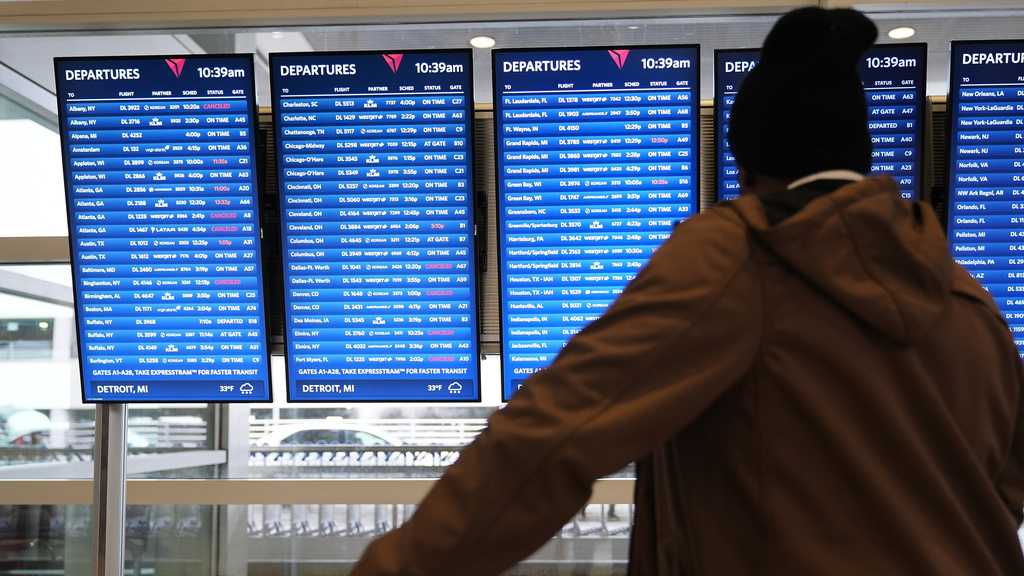
Millions of Americans are traveling for Thanksgiving this week following a series of technology failures at major airlines and another ground stop Monday at one of the nation’s busiest airports.
The disruptions began Nov. 13, when an Federal Aviation Administration network malfunction triggered a nationwide ground stop lasting nearly five hours. Three days later, United Airlines experienced a separate technology failure that disrupted departing flights.
On Sunday, Delta Air Lines experienced a problem with its automated aircraft weight-and-balance system. Roughly 2,000 Delta flights were delayed by Sunday evening, according to FlightAware. Delta said approximately 70% of its reported delays and cancellations were connected to the malfunction, with weather contributing to other disruptions.
Both airlines say their technology problems have been resolved.
But Monday brought another disruption. The FAA temporarily stopped flights headed to Chicago O’Hare International Airport because of air traffic controller staffing constraints.
The incidents come as AAA projects 5.96 million Americans will fly domestically during the Thanksgiving holiday travel period.
The White House said it has assembled a team of officials from the FAA, Transportation Department, Defense Department and intelligence community to prevent another nationwide air traffic control outage. The group has been meeting daily to identify vulnerabilities and improve system reliability.
The effort focuses on federal air traffic control infrastructure, while the recent United and Delta failures involved separate airline systems.
How travelers can prepare
Eric Rosen, director of travel content at The Points Guy, recommends monitoring flight information closely before leaving home.
“Before you head to the airport, make sure you’ve downloaded your airline’s app. Make sure you’ve turned notifications on,” Rosen told Hearst Television.
Travelers can also use flight-tracking services such as FlightAware or Flightradar24 to monitor the aircraft assigned to their flight.
Rosen also recommends researching alternative flights before leaving home, giving passengers more options if their original plans fall apart.
Paul Hudson, president of the passenger advocacy organization FlyersRights, told Hearst Television that travelers should be especially prepared for disruptions this Thanksgiving.
“Air travel has gotten less reliable and slower than it has been in many years,” Hudson said.
He recommends building extra time into holiday travel plans and having a backup option.
“We think everyone needs to have a Plan B,” Hudson said.
One option is purchasing a fully refundable ticket on a different airline.
“If the first flight is excessively delayed or canceled, you have a backup,” Hudson said. “If you don’t need that flight, you can cancel it without penalty.”
Travelers considering that strategy should carefully review the backup ticket’s refund conditions and cancellation deadline. They should also be prepared to temporarily pay for two tickets.
For travelers with flexible schedules, choosing an earlier flight can provide more opportunities for rebooking later in the day. Nonstop flights also eliminate the risk of missing a connection.
What airlines owe passengers
Under Department of Transportation rules, passengers are generally entitled to a refund if their flight is canceled or significantly delayed and they choose not to travel or accept alternative transportation.
A significant delay includes arriving at a destination at least three hours later than scheduled on a domestic itinerary or six hours later on an international itinerary.
Passengers who accept a replacement flight and complete their trip generally cannot also demand a refund of the ticket price. Additional assistance depends on the cause of the disruption.
When a delay or cancellation is within an airline’s control, such as certain mechanical or staffing problems, the airline may be obligated under its customer service commitments to provide meals, hotel accommodations or other assistance.
Disruptions caused by weather or air traffic control problems generally do not carry the same accommodation commitments.
Travelers can compare what individual airlines promise through the Transportation Department’s airline cancellation and delay dashboard.
Watch for scams and save your receipts
Rosen warns that scammers are taking advantage of travelers trying to rebook disrupted flights.
He said some passengers have been bilked out of “hundreds or thousands of dollars” after contacting fraudulent airline customer service agents.
Rosen recommends contacting airlines only through their official websites or mobile apps rather than relying on phone numbers found through online searches.
Travelers should also document disruptions by saving screenshots of cancellation notices, recording flight changes and keeping receipts for unexpected expenses, including meals, hotels and transportation.
Those records may be needed when requesting reimbursement from an airline or submitting a travel insurance claim.
Some credit cards offer coverage for qualifying flight delays, cancellations or interruptions, including certain circumstances outside an airline’s control.
Travel insurance may provide additional protection, but policies vary. Travelers should check coverage limits, exclusions and whether their disruption qualifies. Coverage generally must be purchased before a problem becomes known.
Passengers can also prepare for unexpected overnight delays by keeping medications, phone chargers, essential documents and a change of clothes in their carry-on luggage.
Which airlines have the most delays and cancellations?
New federal data offers a broader look at airline reliability heading into Thanksgiving.
According to the Transportation Department’s latest Air Travel Consumer Report, released Nov. 19, American Airlines had the highest cancellation rate among the nation’s four largest airlines during the first nine months of 2026.
American and its regional partners canceled 2.99% of scheduled flights, followed by Delta at 2.25%, United at 1.75% and Southwest at 0.96%.
Among all eight airline networks included in that comparison, JetBlue recorded the highest cancellation rate at 4.08%.
Southwest had the lowest on-time arrival rate among the Big Four, with 73.1% of its flights arriving on schedule. American followed closely at 73.3%, compared with 76.2% for United and 78.3% for Delta.
The figures cover January through September and do not include the recent technology failures or Thanksgiving travel disruptions.