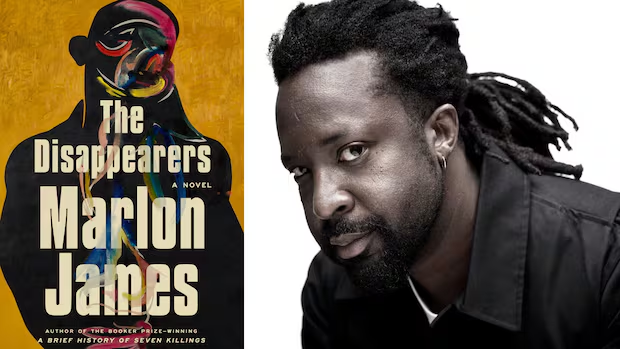
The new novel from Marlon James is based on a rumour … but it’s no rumour that James’ book is one of the year’s hottest titles.
The Disappearers is on the Booker Prize shortlist and the National Book Award longlist, and recently received a glowing review in The New York Times.
It’s an epic novel that centres on a group of gay men who were attacked in Kingston, Jamaica in the late 1980s. The story follows the men in the aftermath, as they seek connection, new identities, understanding and revenge.
James calls The Disappearers his most personal book yet, and it draws on his time as a young queer man in Jamaica and his own experiences with invisibility.
“Most stories that I write, certainly stories about Jamaica, have been hovering in my head, sometimes for decades,” said James on an episode of Bookends with Mattea Roach.
“This novel is based on an event that I knew happened, but I couldn’t prove it. And I knew it happened in the early 90s, which is over 30 years ago. So it takes me a few decades to process something to think I can write it.”
On Bookends, James shares the rumour that inspired The Disappearers, how he approaches writing about violence — and why he once called himself a “disappearer.”
This conversation has been edited and condensed. Interview produced by Katy Swailes.
The Disappearers and your other three most recent novels are over 600 pages. What appeals to you about writing these epic novels, these sweeping stories, with multiple narrative voices?
Part of it is what I used to read. There weren’t a lot of books around so I always grabbed the biggest ones to spend the longest time with. I’ve always loved the idea of just sinking into an epic book.
I also realize there are things I would tolerate in, say, a big novel, that I won’t tolerate in a short one. It’s almost like a double album. I’ll tolerate a weak song on a double album, but I’m not going to do it in a single.
But also, I have tried and failed so many times to write a story about Jamaica that would be short. You think it would be. It’s a small island. The country hasn’t even been independent for a century.
It’s easy to think: small island means small problems.
Jamaica does resist paraphrase. It resists edits. It resists summary.Marlon James
Yet, nearly every time I’ve tried to write something about Jamaica, the shortest outcome is like 415 pages. Jamaica does resist paraphrase. It resists edits. It resists summary. And if you’re going to try to capture it — I’m not sure I succeeded — you have to go big.
It’s a big book. It’s big in a lot of ways, and there’s a maximalist approach to the way that you depict sex that happens in Jamaica, that the way that you depict certain violence. It doesn’t shy away from these things. Why was it important to you as a writer to be really unreserved with those elements of the story?
Because I suspect literature that is reserved. I remember, I wrote a novel about slavery and somebody was telling me how hard it was to read. I was like, “I understand but you know it’s harder than reading almost slavery being a damn slave. So maybe just bear witness and shut up.” I’m usually not that harsh though.
Especially as somebody who writes from history, I sometimes embrace the term historical novelist. But I think if I’m going to write about history, if I’m going to read about how people live, I have to tell the truth. I think that we sometimes do the past a disservice by cleaning it up, by white-washing it, by giving it the PG-13 version.
Violence is violent. Sex is sometimes sexy and sometimes it’s horrendous. I think these are things that are sometimes extremes of human behavior.
It’s funny, the total body count of my entire catalog is probably around one third of the movie John Wick. I don’t say that as a criticism because I adore that movie, but there is a way in which we tolerate extreme violence.
We have no problem with a guy killing 100 men. If we don’t see the death, if we don’t see blood, if we don’t see suffering, if we don’t realize that these are fathers, brothers, sons, lovers who were killed and we don’t have to deal with the consequences of the death, then we’re perfectly fine with extreme violence.
Violence is violent. Sex is sometimes sexy and sometimes it’s horrendous.Marlon James
I can’t write violence without suffering. I can’t write violence without consequence. I can’t write violence without saying how people move on. I think that is what people find disturbing. I don’t think it’s volume because I actually don’t think I have that much violence in my novels. I think they resonate and I think they echo and I think they linger. And I think that is a challenge people have.

Jamaican author Marlon James holds his novel and the award after his book A Brief History of Seven Killings was named as winner of the 2015 Booker Prize for Fiction in London, on Oct. 13, 2015. (The Associated Press)
At the centre of The Disappearers, there’s a violent assault on a group of gay men in Kingston in 1988. The men are mostly amateur actors. They’re rehearsing a play. What was the real event that was the catalyst for this story?
A mob of straight men, some of them quite famous, descended on what may either be an AIDS support group or just a LGBT outreach program, something where they had to gather together.
But clearly they gathered together enough that people saw a pattern and they were attacked. I heard about it through gossip, through the grapevine, but there were no facts.
Certainly, it would never have made the newspapers. Nobody cares about what happens to homosexuals. So I wasn’t going to find it in any media. I heard about it through gossip until finally, a few years ago, I ran into a lawyer in Canada, in Toronto, who said, ‘Oh, it totally did happen.’ He arranged for the political asylum of some of the victims.
You talk about this as a historical project of writing about times that you lived through, but experiences that you didn’t personally have, but heard through the grapevine. But there are some things from your life that make their way into the book about being gay and living in Jamaica in the 80s.
Well, one thing that did happen in school was that game where we pull a live wire. And everybody grabs it and you have to grab the next person so the shock goes to them and you keep grabbing, grabbing, grabbing. When the person turned around to realize that I am the person they would grab, they decided to take the shock.
I was picked on in school. I was basically the class homo. I was called girl names and so on. I’m not somebody who could hide it. I thought I was hiding it really well. I wasn’t hiding it at all. The difference between this book and all the other books I’ve written is that the stakes feel like my stakes.
You don’t go through things like what you’re describing and not be significantly affected by that. How did that affect your coming of age as a young man then?
Well, what it did is turn me into a ‘disappearer.’ I became a ‘disappearer.’ So the book has a lot of resonance for me because I remember when I disappeared.
I remember almost being mathematical about it. “What is it about me you think is gay? What is it? What is it?,” I thought. Every time I opened my mouth, somebody said, “Sissy.” It must be my voice.
So between basically 15 and 17, I just stopped talking other than something absolutely necessary.
I realized that the cool kids who would pick on me would take, say, the 6 o’clock bus to school. I took the 6:15 bus. I got to school on time, but nobody was there to see me. I knew I’d pulled off my vanishing act when the next door neighbor came over and was asking for advice on foreign schools in the U.S. because she thought I went to one.