Works of fiction often come with a legal boilerplate disclaimer inside the front cover: “any resemblance to actual persons, living or dead, is purely coincidental”.
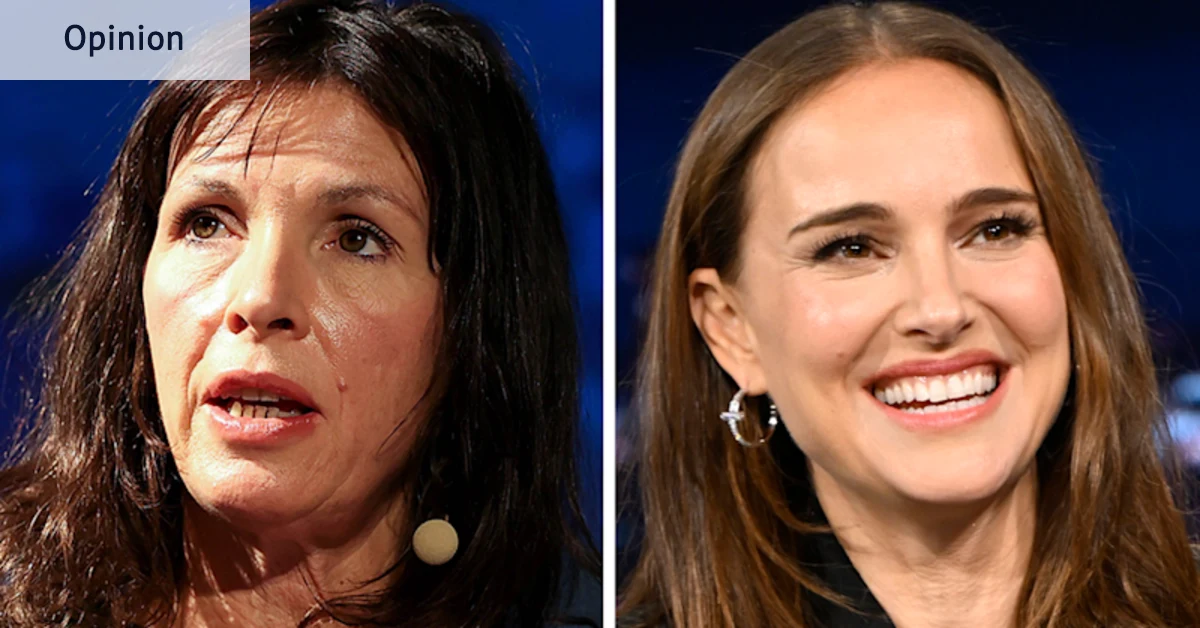
Not so the latest novel by Rachel Cusk, the Anglo-American author who reinvented autofiction with her “Outline” trilogy, in which she does away with character and plot.
It is a thinly veiled portrait of A-list actress Natalie Portman.
The Life of M barnstormed through literary gossip circles, well ahead of its US release on August 25.
It will be published in Australia on September 1, and I was lucky enough to receive an advance copy.
I devoured it, and not just for celebrity gossip reasons – although it is rare when lovers of literary fiction get to enjoy some lowbrow along with our highbrow.
The Life of M is many things, but it is definitely based on Portman, although the entire point of the book is that the narrator is projecting stories onto her celebrity subject, none of which are true.
In the opening scene of Cusk’s novel, the unnamed, cipher-like narrator tells us that “a little while ago, I told the actor M that I was thinking of writing her autobiography”.
Already we are confused – how can you write someone else’s autobiography?
For Cusk, that is precisely the point. All the stories we invent about other people are actually about ourselves.
Not for nothing is Cusk the queen of autofiction.
Next, the actress M asks the narrator: “Would you just make it up?” The enigmatic narrator doesn’t respond. Instead, she starts to tell her story.
The set-up is clear, but notwithstanding the postmodern trickery, the baseline facts of the character’s life are not at all made up. They are stolen from reality.
And not in a subtle way – the Life of M is not some roman à clef that can only be deciphered by those in the know.
The whole point is that celebrity culture means we know a lot about these people. They belong to the public imagination, and don’t enjoy the privacy that we normies do. So anyone with cursory knowledge of Portman’s resume can work it out.
Cusk exploits this vulnerability in a way that is either clever or cruel, but what she is doing, I believe, is showing us all how we are similarly cruel, or at least, complicit, we are when it comes to public ownership of celebrities.
In real life, Portman and Cusk both live in Paris. They know each other, and Portman is on record as being a big fan of Cusk’s work.
M lives in a city identifiable as Paris. M has played a ballerina in a highly successful movie, for which she went method and hung out with “chain-smoking ballerinas”, as Portman did for the critically acclaimed Black Swan.
M was a child star whose childhood ended when she was cast in a sexualised role. Aged 12, Portman played a sexualised role in the 1994 film Leon: The Professional.
M has also starred in a movie featuring a mass shooting, as did Portman. M is the face of a major beauty brand pictured festooned with pink flowers, just as Portman is in campaigns for Dior.
M has children and is going through a seemingly difficult relationship breakdown. Portman divorced the father of her children in 2024.
Once those facts are established, the character portrayal is brutal.
In her fabricated “autobiography” of M, the narrator portrays the star as an empty person so used to performance that she is unable to feel any authentic emotion. She play-acts her niceness and cannot empathise with a friend suffering from depression.
She is dissociated, in a tower of fame; “the ultimate entrapment in the self that is also a deliverance from it”. The narrator is a sub-in for all of us non-celebrities, existing on an ordinary plane of existence where we walk our dogs and tend to sick loved ones.
“It was hard not to feel ugly next to M,” she writes.
“Part of it was the ugliness of experience. For M it was the reverse. Her difficulty lay in her distance from the random violence of insignificance.”
“Personally,” the narrator continues, “I felt saturated with that violence.”
The tone, you might have gathered, is full of portent and misery.
Cusk is often called a pretentious writer.
Not all of us feel that our insignificance is violence visited upon us. Many of us quite enjoy it, and many writers, for that matter, make great art out of lives of little “significance”.
But what Cusk describes is a good literary approximation of what many people feel when they scroll an Instagram feed, full of celebrities beaming out fodder of perfect bodies, well-appointed homes, idyllic holidays and chummy catch-ups with other celebrities.
Much of the critical response to the Life of M has focused on Cusk’s parasitic, writerly cruelty. One critic called the book a “literary assassination”.
Cusk has form – she has been accused several times of stealing blatantly from reality to feed her fiction – her 2009 memoir, The Last Supper: A Summer in Italy, was pulped because a number of people recognised themselves in it.
Her other non-fiction memoirs, about motherhood, and the breakdown of her second marriage, were reviled by critics for being too revelatory, in a supremely nasty way.
Cusk herself has expressed shock at all the fuss – in an interview with The New York Times she protested that “I don’t think anyone could see me as a writer naturally drawn to celebrity culture”. An odd thing to say when she has just published a meditation on it.
She also said that the book was part of a need to “have some vacation from myself, some other place to go”.
“It was like, what would it be like to be able to lose yourself or leave yourself, and is that what the celebrity offers?”
I think that is precisely what the cult of celebrity offers. But with social media pushing the curated images of celebrities at us constantly, celebrity is both an escape and an oppressive, omnipresent reminder that our own lives are depressingly ordinary.
The other thing that offers the opportunity to leave oneself is, of course, reading books. But books are more likely to provide comfort than inspire envy, and more likely to demonstrate our human similarities, than highlight our difference from the one percenters.
Whether she meant to or not, Cusk has cleverly used celebrity culture as a Trojan horse to bring people to literature, and to get us all talking about a book.
For that, I will forgive her literary burglary. Although Natalie Portman may not.