The United States is widening its economic campaign against Iran beyond its oil trade, targeting financial and commercial channels involving gold, cryptocurrency, aviation, shipping and technology as Washington seeks to further isolate Tehran.
US Treasury Secretary Scott Bessent unveiled the expanded measures under “Operation Economic Outcast”, warning governments, companies and financial institutions that continue to support Iran could face secondary sanctions and potentially lose access to the US dollar system. The campaign comes after months of military pressure failed to produce a broader settlement with Tehran.
Bessent said the United States had mapped the networks used by Iran to generate revenue and evade sanctions, including intermediaries involved in oil, shipping and financial transactions.
“Our objective is to sever every economic lifeline that sustains this tyrannical regime until Tehran stands alone,” Bessent said.
The Treasury has identified five areas it considers particularly important to Iran’s economy: digital assets, technology, gold, aviation and shipping. The department has also sanctioned nearly 60 individuals, companies and vessels accused of supporting Iranian oil revenues, weapons procurement and cyber operations.
Cryptocurrency comes into focus
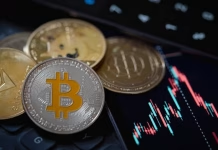
Digital assets have become an increasingly important target for Washington because they offer Iranian entities another route for moving money outside traditional banking channels.
The US Treasury has already designated several Iranian cryptocurrency exchanges and warned that foreign financial institutions and other non-US entities conducting significant transactions with those platforms can also face sanctions.
The latest campaign expands that approach by targeting participants in Iran’s wider digital-asset ecosystem.
Treasury officials have also identified individuals involved in processing cryptocurrency connected to Iranian oil revenues and the Islamic Revolutionary Guard Corps’ Quds Force.
Gold and technology added to the net
Gold is another focus of the new campaign because it can provide Iran with a way to convert or transfer value outside conventional financial channels.
The United States is also targeting technology networks involved in supplying Iran with equipment that can support its military and strategic programmes.
Bessent said Washington had identified the facilitators and networks involved in helping Tehran circumvent existing restrictions and warned that businesses could not claim they were unaware of the risks.
The administration has not immediately named every country that could face secondary sanctions. Instead, Bessent said governments and businesses would be given timelines to wind down activities identified by Washington.
“We are giving everyone the opportunity to remedy bad behavior. Why would I want to blow up the global financial system? We believe that it is important to level set and give people a cure period, but they should know that that will move very quickly and that we are serious,” Bessent said. (Democracy Now!)
Flights and shipping also targeted
Aviation and shipping have also been brought into the expanded sanctions framework, potentially affecting companies involved in transporting Iranian goods, people or revenue.
The US has already imposed pressure on Iran’s maritime trade through its naval blockade, while the Strait of Hormuz remains a major point of confrontation.
The waterway normally carries about one-fifth of global energy supplies, and disruptions have contributed to higher energy prices. Iran’s oil exports have fallen sharply, with maritime tracker Kpler estimating that exports through the Strait had dropped from around two million barrels per day before the war to about 400,000 barrels per day by mid-August.
The expanded sanctions are therefore aimed at closing alternative routes that Tehran could use to compensate for declining oil revenues.
China remains a major test
The biggest challenge for Washington could be enforcing the new measures against countries that maintain substantial economic ties with Iran.
China remains Iran’s largest foreign market for oil and a major trading partner. Iran also maintains significant commercial relationships with the UAE, Turkiye, India, Iraq and Pakistan.
Asked about potential action against Chinese entities, Bessent said no one was beyond the reach of US sanctions.
Beijing has already rejected the broader pressure campaign. Chinese Foreign Ministry spokesperson Lin Jian said, “Sanctions and pressure will not resolve disputes. They will only exasperate tensions and escalate the situation, which is not in the interest of any party.” Iran, meanwhile, has dismissed the latest measures and described the US campaign as economic warfare.
With oil, gold, cryptocurrency, aviation, shipping and technology now in Washington’s sights, the sanctions strategy represents a broader attempt to restrict not only what Iran sells, but also the channels through which Tehran earns, moves and accesses money.