The US has threatened to impose severe sanctions against any country or entity maintaining economic ties with Iran, hoping to achieve with economic measures what military means have so far failed to do.
It is unclear, however, how far the Trump administration is prepared to go in confronting China, Iran’s biggest trading partner, which has signalled its resistance to US economic pressure to cut off links with an ally.
Iran, meanwhile, vowed retaliation against any country that took part in the US-led isolation campaign.
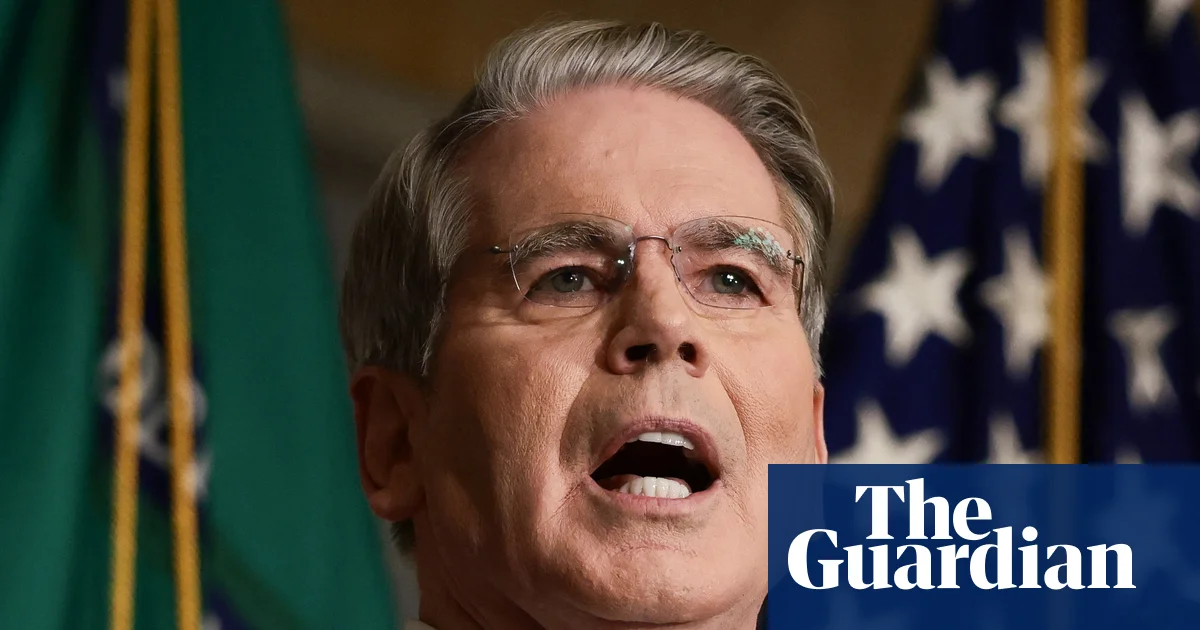
Launching what he called Operation Economic Outcast, the US treasury secretary, Scott Bessent, called it an unprecedented campaign and compared it with the D-day Normandy landings, a turning point in the second world war.
“Today, in that same spirit, we are launching an economic onslaught against Iran’s financial connections around the globe,” Bessent said on Monday. “Our objective is to sever every economic lifeline that sustains this tyrannical regime until Tehran stands alone.”
Asked whether sanctions would be applied to China, which bought an estimated 80% of Iran’s shipped oil last year, he replied: “We want to make clear here today that no one is above the reach of US sanctions. That if they facilitate transactions and are part of the ecosystem that turns Iranian oil into money, into repression, they will be targeted.”
Bessent said the US had identified those that continued to deal with Iran and each violator would be given a deadline to cut ties or face US sanctions. He said the deadlines imposed would depend on individual circumstances.
“Any entity that facilitates money laundering on behalf of Iran will be removed from the US dollar system,” he said. “The clock just started ticking.”
Bessent said Donald Trump was “making phone calls to world leaders with specific requests to cease their interactions with the regime”, but he did not specify whether the US president would talk to his Chinese counterpart, Xi Jinping.
China’s embassy in Washington told reporters: “Regarding the Iran issue, sanctions and pressure do not help resolve the problem. China calls on the relevant parties to take responsible actions and resolve the issue through political and diplomatic means.”
Tehran said it would retaliate against the sanctions using a range of measures. Maj Gen Ali Abdollahi, the armed forces’ chief of staff, said the retaliation could take the form of land, sea or air operations or cyber-attacks.
The announcement of secondary sanctions against Iran comes nearly six months after the the US and Israel launched an attack on Iran that killed its supreme leader Ali Khamenei. Early expectations that the regime in Tehran would collapse or agree to Washington’s demands to give up uranium enrichment and other key elements of its nuclear programme were dashed.
Hardliners appeared to strengthen their grip on government in Tehran and responded by declaring the closure of the strait of Hormuz, attacking ships that ignored its declaration. Trump imposed a counter-blockage on Iranian oil exports through the strait, leading to an impasse that has had profound effects on the global economy.
Sina Toossi, a senior non-resident fellow at the Center for International Policy, said: “After nearly six months without a military or diplomatic victory, Washington appears to be trying to accomplish through intensified economic strangulation what military force has so far failed to achieve. But Tehran is answering that zero-sum approach with one of its own.”
The US defense secretary, Pete Hegseth, however, said further military action was not off the table. “By no means are we foreclosing using kinetic strikes anywhere in the strait of Hormuz or around Iran,” Hegseth told reporters on Monday.
In apparent anticipation of the US measures, the United Arab Emirates, a close US and Israeli ally, announced it was suspending trade ties with Iran. Turkey, another trading partner with Iran, which has been critical of the US-led campaign against the Islamic Republic, has yet to respond to the US threat of sanctions.
Andrew Miller, a senior fellow at the Center for American Progress, said: “The announcement of new economic sanctions on Iran and those countries trading with it signals what is plain to all: this war has brought the United States no closer to eliminating Iran’s nuclear programme or crippling the Iranian regime. But while sanctions can be effective, it is highly unlikely they will produce a quick settlement favourable to the United States.”