Movies have a rare power. They can drop you into a trench in Normandy, a jungle in Vietnam, or a bombed-out street in Sarajevo, and make you feel the weight of something that you never lived through. That’s not a small thing; that’s everything. And no genre does it better than war movies.
War is stitched into the fabric of human history. Every generation has fought one, mourned one, or grown up in the shadow of one. So, it makes complete sense that we keep returning to these stories on screen. We’re not trying to glorify the violence, we’re reckoning with it. We want to understand it and to sit with it for two hours and walk away changed.
The thing is, most people’s war movie knowledge begins and ends with the same films. We all know Apocalypse Now, Saving Private Ryan, Full Metal Jacket, Schindler’s List, Dunkirk, and the like. And, look, those movies are untouchable. But the genre runs so much deeper, and in that depth lives a whole collection of war movies that are brilliant, brutal, and overlooked.
‘Joyeux Noël’ (2006)

It’s Christmas, 1914. German, French, and Scottish soldiers are locked in the trenches of the Western Front, killing each other by day and freezing by death at night. Then, on Christmas Eve, someone puts up a tree. Someone else starts singing. And before anyone fully understands what’s happening, enemies are sharing cigars, swapping photographs of their families, and playing football in No Man’s Land.
Joyeux Noël, directed by Christian Carion, is based on the actual Christmas Truce of 1914. It was one of the most extraordinary and least discussed moments in military history, and the movie treats that event with the warmth and reverence it deserves. It operates in three languages, and rather than creating distance, the fragmentation makes everything feel more real. It never pretends war has disappeared. The ceasefire was temporary, and the consequences for the soldiers who participated were severe. This one is clearly one of the most humanist war movies of all time.
‘Father of a Soldier’ (1964)

This Soviet Georgian film from 1964 will hollow you out completely if you let it, and yet, no one in contemporary movie circles ever brings it up. Father of a Soldier, directed by Rezo Chkheidze, follows Giorgi Makharashvili, an old and unassuming German farmer, who travels to the front during World War II after learning his son has been wounded.
At its core, the movie tells a story about a father’s instinct to simply find his child. However, the narrative transforms that tale into something larger and more painful. Giorgi ends up marching with Soviet troops all the way to Berlin and witnesses the entire machinery of war up close. In one scene, Giorgi discovers advancing troops destroying a German vineyard, and he throws himself in front of the vines to protect them and weeps. It’s a devastating image that proves that the movie understands grief, love, and the cost of war.
‘To Live’ (1994)

Directed by Zhang Yimou, To Live should belong on every cinephile’s shortlist. Based on Yu Hua’s novel of the same name, it follows Fugui and Jiazhen, a Chinese couple whose lives are constantly rearranged by decades of historical upheaval. The Civil War, the Communist Revolution, and the Great Leap Forward. Since there are no heroic charges or battlefield scenes, it’s not a traditional war movie. But the impact of war and political violence runs through every scene, electrocuting everything Fugui and Jiazhen are trying to build.
To Live is a genuinely heartbreaking war movie. Yimou shoots it with this warm, almost nostalgic palette, making the tragedies land harder. You are lulled into the rhythm of a family drama for a few minutes, and then history intervenes and takes something away. Ge You won Best Actor at Cannes in 1994, and the movie was a critical darling. It disappeared ironically and politically when the Chinese government banned it domestically, limiting its circulation significantly.
‘Cross of Iron’ (1977)

Sam Peckinpah, the man behind the 1969 Western epic The Wild Bunch, made a German war film. Let’s reflect on that for a second. Cross of Iron, shot on a modest budget and filmed largely in Yugoslavia, follows Corporal Steiner, a battle-hardened, deeply cynical German sergeant on the Eastern Front in 1943, at the point when the Wehrmacht was beginning its long retreat.
It’s a movie about survival versus honor. While the mud, blood, and exhaustion feel brutally authentic, it never asks you to root for Germany. It asks you to watch what war does to a man until there’s almost nothing left. Peckinpah’s signature violence is present throughout, especially in the opening battle sequence. The movie also gives us Maximilian Schell as Captain Stransky, a Prussian aristocrat desperate for the Iron Cross, and the dynamic between his vanity and Steiner’s nihilism drives the whole narrative.
‘The Fifth Seal’ (1976)

The Fifth Seal is one of those few movies that tackle war with a philosophical bite. Directed by Zoltán Fábri, it represents one of the great injustices of World War II. It is set in Budapest in 1944, during the final grinding months of World War II and the Nazi occupation of Hungary, and it opens with four men sitting in a bar, drinking, talking. One of them poses a hypothetical question: if you had to choose between being a happy slave or a suffering free man, which would you pick?
The conversations are riveting, long, and they completely absorb you. Then, Fábri detonates everything in the second half when the men are arrested by the Arrow Cross, Hungary’s fascist militia. The movie forces each character to confront whether their philosophical convictions survive actual consequences. It’s part chamber drama, part moral horror, and entirely unforgettable. It won the Silver Bear at the Berlin International Film Festival in 1977 and was Hungary’s submission for the Academy Awards. And yet, no one talks about it.
‘Pretty Village, Pretty Flame’ (1996)

Pretty Village, Pretty Flame captures the absurdity of war. It begins with two childhood friends – one Serbian, one Bosnian – as they get divided by the Bosnian conflict, and then cuts to 1992, where those same two men are on opposite sides of a war that has no clean villains and absolutely no winners. Milan and Halil grew up together, and now one of them is hunting the other.
The movie tells their story in fractured, nonlinear flashes that jump between the present siege, the men’s lives before the war, and a hospital where the survivors eventually end up. Although it sounds complicated, it plays out effortlessly. Director Srđan Dragojević just shows you ordinary people consumed by extraordinary hatred and asks you to sit with that discomfort. But since the Balkan wars occupied an awkward place in Western cultural memory, it’s not very popular. Watch it, and you’ll understand the 1990s differently.
‘A Hidden Life’ (2019)

A fairly recent addition to this list of forgotten war movies is Terrence Malick’s A Hidden Life. It’s a three-hour movie about an Austrian farmer who refused to swear an oath to Hitler, and it’s really a radical one to watch. The person in question is Franz Jägerstätter, a man from the mountain village of St. Radegund who, when conscripted into the Wehrmacht, simply said no. He wasn’t loud, and he wasn’t preaching anything. He was just saying no.
August Diehl plays Franz with an interior conviction that makes the character feel distinctly determined. Valerie Pachner plays his wife Fani, and their relationship is captured in stolen letters and sun-drenched farmland sequences. The backdrop of the Austrian Alps is wide, breathing, and almost delirious with beauty. The contrast between the landscape’s magnificence and the bureaucratic ugliness of what Franz faces gives weight to the story.
‘Tigerland’ (2000)

Before Phone Booth and before The Phantom of the Opera, Joel Schumacher made a lean, electric, near-forgotten Vietnam film on a shoestring budget and shot it on grainy 16mm like a documentary. Tigerland is set entirely in 1971, at a Louisiana training base called Tigerland, and it follows Roland Bozz (Colin Farrell), a Texas draftee who doesn’t believe in war, doesn’t want to fight it, and somehow manages to be the most alive person in every scene he’s in.
Farrell gave a magnetic performance. He’s loose, funny, dangerous, and surprisingly soft when the movie calls for it. Speaking of which, the Vietnam War barely appears on the screen. Schumacher keeps everything inside the base, inside the training, inside the psychological playground that turns civilians into soldiers. However, by the time the movie ends, you feel the war’s presence more than if you had watched a hundred jungle firefights or battlefield sequences.
‘A Midnight Clear’ (1992)
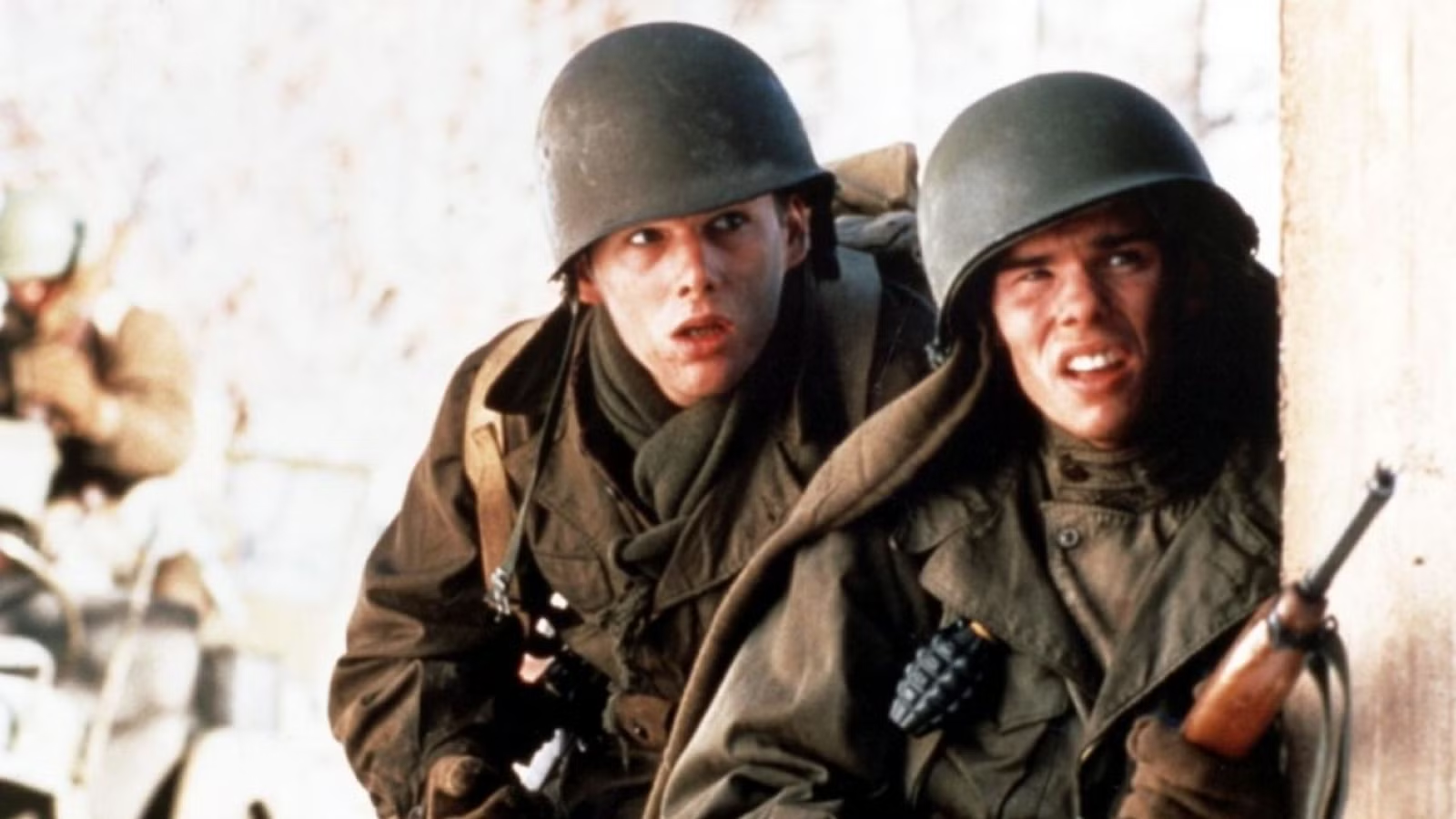
Set in the snowy forests of World War II, A Midnight Clear is a very intimate war movie. Ethan Hawke leads a group of American soldiers who stumble upon a German unit that’s equally weary of fighting. What follows is a fragile truce, filled with tension, humor, and the looming threat of violence. The movie strikes the perfect balance between the war’s brutality and moments of startling humanity.
Despite strong performances and critical praise, A Midnight Clear never found a wide audience. Its quiet, tender tone and lack of bombastic battle scenes likely kept it from mainstream success. However, that restraint allows the movie to show soldiers as young men caught in circumstances beyond their control. Overall, it’s too funny to be a tragedy and too sad to be a dark comedy, and it’s good to be forgotten.
‘Ashes and Diamonds’ (1958)

Directed by Andrzej Wajda, Ashes and Diamonds takes place on a single day: May 8th, 1945. The war in Europe is officially over, and Maciek Chełmicki, a young Polish resistance fighter, has been ordered to assassinate a communist official before the new political order takes hold. Zbigniew Cybulski, who plays Maciek, got the nickname “the Polish James Dean” because of his performance. He wears sunglasses indoors, moves with a practiced stillness, and falls into a brief romance with a barmaid named Krystyna.
Wajda frames the whole film in a bombed-out hotel on the edge of a new Poland that nobody asked for. In one scene, Maciek lights glasses of burned spirits as makeshift memorials for fallen soldiers, which is the most visually arresting moment in European cinema. Ashes and Diamonds was immediately hailed by critics, but Polish cinema has always lived in the periphery of mainstream film culture in the West, so it doesn’t get talked about much.
Is there a forgotten war movie you’d like to add to the list? Comment below.