Some movies are designed to push us to the edge. They are often vicarious experiences, so it only makes sense that those films that put their characters through the wringer, be it emotional, physical or mental, would want to immerse the audience in that feeling. As technology has advanced, and filmmakers have gotten more creative, this intensity has only increased in the 21st century, but all the technical prowess in the world isn’t a guarantee that a film itself will be intense.
Often, the bigger a film’s budget, the more polished it is, and the less ferocious it seems. Look no further than the remakes of The Texas Chainsaw Massacre or The Hills Have Eyes for 21st-century films with far more resources but which are far less effective than their 20th-century originals. Extremity is not synonymous with intensity, and what makes a film intense, whether it’s content, tone, or execution, can be subjective. Whatever the metric, the following ten films are all viscerally intense experiences that will leave the viewer gasping for air, often literally.
10
‘Good Time’ (2017)

A good measure for an intense film is how much anxiety it puts you through, and if there are any filmmakers of the 21st century who seem to exemplify stress-inducing cinema, it’s Josh and Benny Safdie. Together or apart, the Safdie brothers have given modern audiences plenty to sweat over with films like Uncut Gems and Marty Supreme, essentially feature-length panic attacks where we watch self-destructive protagonists royally screw up their lives for two hours. That descriptor could also be applied to their prior film, Good Time, which is by far the film most likely to get your pulse up to an alarming rate.
The protagonist hellbent on self-sabotage here is Connie Nikas (Robert Pattinson), a small-time criminal whose hair-brained bank robbery goes awry and gets his developmentally disabled brother Nick (Benny Safdie) arrested. The film then follows Connie as he makes one bad decision after another to try and get his brother out of jail. Pattinson has scarcely been better, and never more manic, than he is as Connie, recalling the frantic performance of Al Pacino in Dog Day Afternoon, and the direction by the Safdies is heir apparent to that of Sidney Lumet‘s crime classics. Good Time is a real bad time, and any viewing of it should come with a complementary Xanax.
9
‘The Strangers’ (2008)
.jpg?q=49&fit=crop&w=500&dpr=2)
When it comes to intense situations, it’s hard to imagine many that put people on high alert more than home invasions. The premise has been exploited for decades in film, all the way back to classics like The Desperate Hours, but the most nerve-wracking variety is when the invasion is done without cause. That randomly targeted violence is at the heart of films like Michael Haneke‘s remake of his own Funny Games, which suffers in comparison to the original, and Bryan Bertino‘s The Strangers.
Harkening back to the original Halloween, before Michael Myers was given a familial connection and was just a masked killer stalking unlucky babysitters, The Strangers similarly features protagonists whose fates are sealed simply because they were home. James (Scott Speedman) and Kristen (Liv Tyler) are a couple spending time away from home in an isolated house. Their strained relationship becomes the least of their worries when three masked assailants enter their home. Like many horror films of the aughts, The Strangers has the nihilistic intensity of the grueling classics of the ’70s, but amplified by a quiet dread.
8
‘Coming Home in the Dark’ (2021)

The same fear center that’s ignited by the thought of a home invasion is similarly lit up by the unknown terrors that await us on the open road. In the 21st century, those fears are still alive and well represented in movies like Joy Ride, Wolf Creek and, most intensely, Coming Home in the Dark. This New Zealand thriller, based on a short story by Owen Marshall and directed by James Ashcroft, is a white-knuckle ride predicated on past sins coming back to haunt a man and his family.
Hoaggie (Erik Thomson) is on a road trip with his wife and teenage children when they are robbed on the roadside by two modern-day highwaymen. When the men recognize Hoaggie, their simple robbery turns into a night of prolonged terror. Violence comes fast and furious, but the film digs even deeper into the psyches of both the perpetrators and the victim, with long-buried traumas resurfacing as vicious retribution. Coming Home in the Dark is a road trip through hell, paved with intensely crafted thrills and kills.
7
‘Green Room’ (2015)

Similar to the premise of home invasions and open road thrillers, the siege movie has given audiences all sorts of intense situations to stress out over. These movies are generally set in contained locations where protagonists must contend with outside forces that want to break in to do harm. Those forces can be supernatural, criminal, or just downright despicable, like the neo-Nazi skinheads in Green Room. The third film by Jeremy Saulnier sees the director dealing with another group of protagonists out of their depth with their violent surroundings.
The film follows a punk band who take a last-minute gig at a bar that turns out to be a major hangout for some white supremacists. When they witness a murder, the band finds themselves locked in the titular room, with bloodthirsty bigots outside. Saulnier ratchets up the tension with escalating consequences punctuated by spurts of intense violence, but what really makes the film such an intense watch is the disturbingly calm performance by Patrick Stewart as the neo-Nazis’ leader. The English, known for many roles as a commanding leader, turns his calming presence into a quiet intensity that will send shivers down your spine.
6
‘I Saw the Devil’ (2010)

Revenge may be the most primal desire we have as humans. It’s likely why watching violent retribution play out on screen is such a thrill for so many of us. Deep down, we all know it’s a hollow endeavor of violence that only begets more violence, but it doesn’t make it any less intense to watch. The most intense of these long stares into the abyss pale in comparison to those that have come out of South Korea, like the shocking Oldboy and the even more depraved I Saw the Devil.
What makes Kim Jee-woon‘s revenge thriller such an intense experience is how it draws out the vengeance. After the fiancé of Kim Soo-hyun (Lee Byung-Hun) is murdered by serial killer Jang Kyung-chul (Choi Min-sik), Soo-hyun’s path of revenge is laid out in front of him, and he takes his time going down it. He tracks and torments Kyung-chul, who responds with some violence of his own, causing a lot of collateral damage. By the end of the film, Soo-hyun is even more broken than when he began, and the bloody climax will leave you intensely disturbed.
5
‘The Night Comes for Us’ (2018)

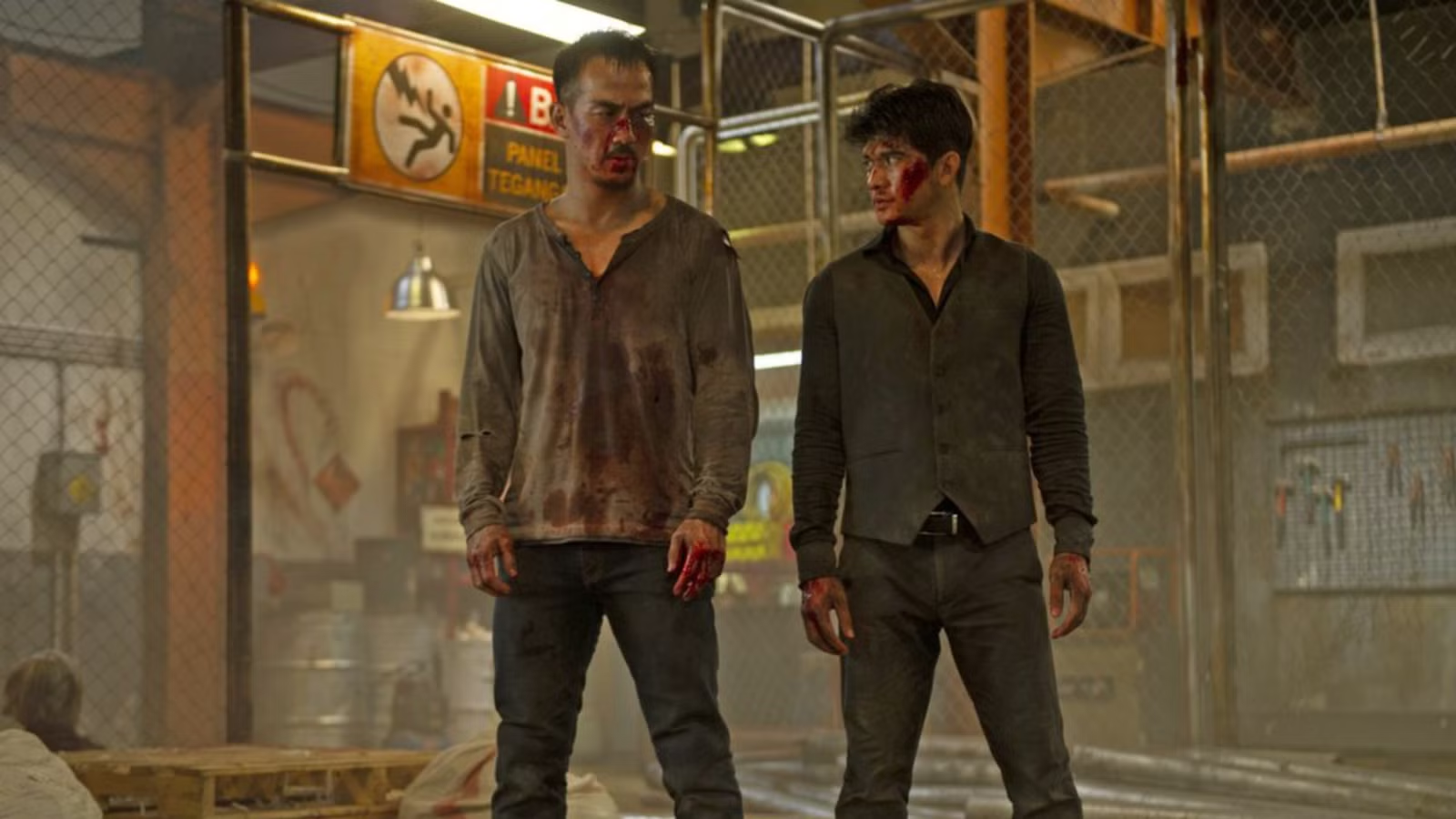
South Korean cinema ushered in a new era of action defined by an unflinching brutality, and international movies like The Raid have all put Hollywood on notice in the 21st century. The Raid introduced Western audiences to martial arts stars Iko Uwais and Joe Taslim, who would re-team in the even more intense The Night Comes for Us. Directed by Timo Tjahjanto, the film pushes the limits of how much punishment its characters, and the audience, can take, but never goes too far to make it numbing.
Ito (Taslim) is an enforcer for a crime syndicate who, after taking part in a massacre, turns against his employers to save the life of a little girl. The syndicate, through Arian (Uwais), sends wave after wave of killers after him and his ward, and the brutal efficiency with which he dispatches all of them is thrilling, but painful, to watch. Indonesian director Tjahjanto is among the most intense working in the action genre today, often bringing over the gore and intensity from his work in the horror genre. The balance doesn’t always work, but The Night Comes for Us is perfectly pitched action intensity.
4
‘Mad Max: Fury Road’ (2015)

By foot, car or any other means, plenty of movies in the 21st century have given us intense chases, but they can’t compare to the epic chase across the desert that makes up Mad Max: Fury Road. This belated follow-up to the beloved post-apocalyptic franchise finds director George Miller firing on all cylinders, putting the pedal to the floor from the first scene, and hardly letting up for all of its 120 minutes.
A consummate warrior of the wasteland, Max (Tom Hardy) survives on instinct and by remaining alone. He’s unwittingly brought into a conflict between the vicious warlord Immortan Joe (Hugh Keays-Byrne) and his war-rig driver Furiosa (Charlize Theron) after she helps Joe’s slave wives escape. The film is one long, furious chase, essentially the climax of Mad Max 2 stretched to feature length, but it never flags or becomes repetitive. Miller is in complete control of the frame and everything in it, making Fury Road an action masterpiece that thrives on intensity.
3
’28 Years Later: The Bone Temple’ (2026)

Similar to action, horror has absolutely gotten more intense in the 21st century. Blood doesn’t always translate to intensity, though, and sometimes a film can be all the more intense for how it juxtaposes its moments of horror with those of calm or even beauty. That’s been the contrast in every film in the 28 Days Later saga, which began with Danny Boyle‘s supercharged zombie movie in 2002 and got its most recent, and most intense, addition this year with 28 Years Later: The Bone Temple.
Directed by Nia DaCosta and written by Alex Garland, this sequel plays with many of the themes that have become principles in the zombie genre. The juxtaposition of the humanity of the rage-infected “monsters” and the inhumanity of the humans has never been more pronounced, as protagonist Spike (Alfie Williams) is taken in by a cult styled after real-life monster Jimmy Savile and led by the equally vile Jimmy Crystal (Jack O’Connell). The true depths of their depravity are depicted in the barn sequence that builds with an intensity even the most hardened horror hound might find unbearable. That this horror can be tonally balanced with Ralph Fiennes‘ beautifully committed performance and his bond with a beastly infected is a testament to DaCosta’s direction.
2
‘Enter the Void’ (2009)

Much of Gaspar Noé‘s output in the 21st century could comfortably fit within this list, but his greatest assault on the senses is the neon-soaked, psychedelic journey through the life and afterlife: Enter the Void. It’s an out-of-body experience presented in a way that only film can accomplish. Many viewers will find it hollow or pretentious, while others will suggest that the only way to watch it is under the influence. Personal taste and viewing habits set completely aside, it’s impossible to deny that Noé’s film is an intense and immersive experience.
Oscar (Nathaniel Brown) lives with his sister in Tokyo and deals drugs. When a deal goes bad and Oscar is killed by police, his soul wanders free from his body, visiting his loved ones and passing through time. Enter the Void is not terribly concerned with forward momentum in its narrative; instead, it’s a free-floating journey that puts us into some very bizarre points of view. The soundtrack is filled with thumping electronic music, and the visuals are alive with techniques that make them alternately disorienting and hypnotic.
1
’12 Years a Slave’ (2013)

No matter how cruelly intense any piece of fiction can be, it will never outpace reality. There’s nothing that can match the intensity of those well-made films that chronicle the darkest chapters in human history. Steve McQueen‘s harrowing 12 Years a Slave is based on the memoir by Solomon Northup and depicts his abduction and being sold into slavery. The film portrays all the ugliness of slavery with raw intensity.
Representing the story of Northup (Chiwetel Ejiofor) with relative authenticity, the film tracks his life in New York, where an offer of employment ends in his abduction, to his enslavement on a southern plantation. It should inspire fury and empathy in every viewer, but there’s also an intensity that pulls us through the narrative. It strains us like one of the strings on Northup’s violin, practically to a breaking point. 12 Years a Slave is an infuriating, heartbreaking, unbearable, brutalizing and, without a doubt, intense film to watch.