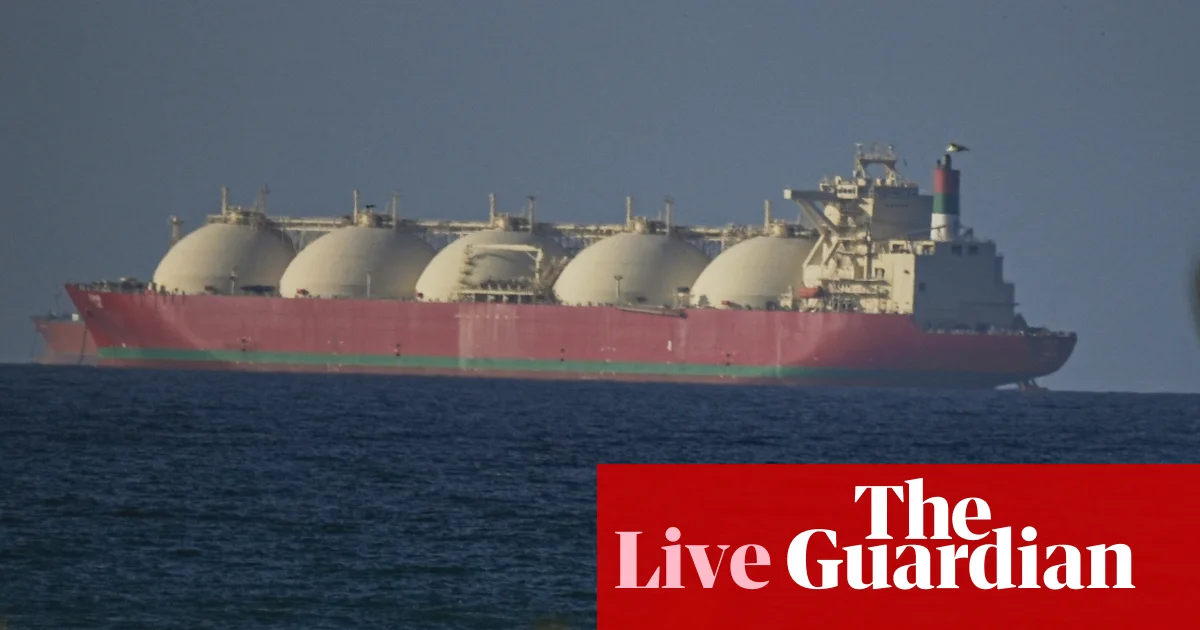
Oil tumbles 10% as Iran declares strait of Hormuz ‘completely open’
The oil price is tumbling, after Iran announced that the strait of Hormuz is now open.
Crude oil has plunged by 10% on hopes that energy supplies could resume after weeks of disruption.
Iran’s foreign minister, Abbas Araghchi, posted on social media that the waterway is ‘completely open’, following the ceasefire agreed between Israel and Lebanon overnight.
In line with the ceasefire in Lebanon, the passage for all commercial vessels through Strait of Hormuz is declared completely open for the remaining period of ceasefire.
Araghchi added that vessels must travel on the “coordinated route” previously announced by Iran’s Ports and Maritime Organisation.
Brent crude has plunged below $90 a barrel, a 10% fall.
Although that account, on X, isn’t verified, president Trump has also announced that Iran has reopened the strait.
Posting on Truth Social, he says:
IRAN HAS JUST ANNOUNCED THAT THE STRAIT OF IRAN IS FULLY OPEN AND READY FOR FULL PASSAGE. THANK YOU!
Optimism was already building in the markets after Axios reported that the US. and Iran are negotiating over “a three-page plan to end the war”.
One element under discussion being that the U.S. would release $20bn in frozen Iranian funds in return for Iran giving up its stockpile of enriched uranium, Axios reported.
Key events
Closing post
With Europe’s stock markets closed, it’s time to wrap up… A quick recap:
Oil and gas prices fell sharply on Friday after Iran said the strait of Hormuz would open to commercial shipping, potentially clearing the way for tankers holding millions of barrels of oil and gas to reach the global market.
Iran’s foreign minister said vessels would be free to transit the strait of Hormuz for the duration of the 10-day ceasefire between Israel and Lebanon, struck on Thursday.
Brent crude, the international benchmark, fell 12% to $87 a barrel. That is well below a high of $119 last month, but still higher than the $72 a barrel before the war.
Donald Trump later said the US naval blockade on Iran’s use of the strait would remain in full force until Washington had struck a deal with Tehran. He said the process “should go very quickly” because “most of the points are already negotiated”.
The benchmark European gas contract fell by about 8.5% to €38.80 (£33.80) per megawatt hour on hopes that diplomatic progress between the US and Iran could bring an end to the conflict.
Here’s the full story:
Our Middle East liveblog will be tracking all the latest developments
European stock markets have closed with solid gains.
Germany’s DAX led the way, up 2.25%, followed by Spain’s IBEX which gained 2.2% and France’s CAC 40 which rose by almost 2%.
UK borrowers could soon benefit from the reopening of the strait of Hormuz, given today’s market reaction.
Adam French, head of consumer finance at Moneyfactscompare.co.uk, explains:
“Markets have welcomed the reported reopening of the Strait of Hormuz, with two- and five-year swap rates falling back below 4% for the first time in a month. This strengthens the view that mortgage pricing may have peaked, particularly as we’ve seen the first week-on-week fall in average fixed mortgage rates since just before the conflict began. However, recent volatility shows how quickly pricing can shift again.
“For borrowers, this should begin to feed through into mortgage rates with more lenders moving towards selective cuts on fixed deals in the coming days and weeks. That said, many lenders will want to see a sustained downward trend in funding costs before passing on more meaningful reductions, especially while the peace process remains fragile.”
Shipping operators cautiously welcome Iran’s move
Shipping companies have cautiously welcomed Iran’s announcement that the strait of Hormuz is open but said they would require clarifications before vessels move through the entry point to the Gulf.
Arsenio Dominguez, secretary-general of UN shipping agency the International Maritime Organization (IMO), says:
“We are currently verifying the recent announcement related to the reopening of the Strait of Hormuz, in terms of its compliance with freedom of navigation for all merchant vessels and secure passage.”
The International Chamber of Shipping is also cautiously positive.
ICS Secretary General Thomas A. Kazakos said it is “imperative that full freedom of navigation is respected by all parties in accordance with international law”.
Kazakos explains:
This development offers a cautious measure of reassurance to the global maritime community and, most importantly, to the seafarers who have been placed in harm’s way and confined on board their vessels for more than seven weeks.
While this announcement is a positive step there is still much uncertainty around what it means in practice. Regardless it is essential that it marks the beginning of a broader and more durable return, beyond the current ceasefire, to freedom of navigation in one of the world’s most critical maritime corridors.
An orderly and sustained return to normal transit through the Strait will be essential. This will require close coordination between the International Maritime Organization, regional states, naval authorities, and the shipping industry to ensure that vessels can transit safely.
President Donald Trump has now told Reuters that the US will enter Iran at a “leisurely pace” to recover its enriched uranium and bring it back to the US.
US stock market up 2%
Donald Trump has now claimed that the strait of Hormuz will not be closed by Iran again, posting:
Iran has agreed to never close the Strait of Hormuz again. It will no longer be used as a weapon against the World! President DONALD J. TRUMP.
The US market is bouncing higher, with the Dow Jones industrial average up 2%, or 965 points, at 49,543 points.
London stock market closes higher
The UK’s FTSE 100 has closed at its highest level since early in the Iran war.
The blue-chip share index has ended the day 0.7% higher, up 77 points at 10,667.
That’s its highest close since 2 March, despite being dragged back by oil companies and electricity producers.
Precious metals miner Fresnillo ended the day as the top riser, up 6.5%, followed by airline group IAG (+6.2%) and copper miner Antofagasta (+5.3%).
The smaller FTSE 250 index posted a stronger rally – up almost 1.9%.
The process of returning to normal in the strait of Hormuz will probably take some times, explains Paul Diggle, chief economist at Aberdeen Investments:
“Further progress is being made in the US-Iran ceasefire, with announcements today about the strait of Hormuz re-opening.
That said, the normalisation of traffic is likely to be gradual, with plenty of uncertainties around maritime safety and whether Iran needs to give permission to individual ships, seemingly remaining.
So our economic forecasts incorporate a slight worsening in the global growth-inflation trade-off this year, relative to the pre-war outlook.
UK government bond prices are rallying as investors welcome the reopening of the strait of Hormuz.
This is pushing down the yield, or interest rate, on the debt.
Ten-year bond yields are down 9 basis points (0.09 of a percentage point) at 4.75%, while shorter-dated two-year bond yields are down 11bps at 4.1%.
That indicates that the cost of government borrowing has come down, as the City’s fears of an inflation surge from the Iran war ease.
“A huge sigh of relief to global markets”
The London stock mrket is higher too – with the FTSE 100 up 66 point, or 0.6%, at 10,655 points.
Axel Rudolph, chief technical analyst at IG:
“The reopening of the Strait of Hormuz, even on a temporary basis, has come as a huge sigh of relief to global markets, easing immediate fears around energy supply disruption with the oil price instantly dropping more than 10% and providing a degree of stability to shipping routes.
However, the conditional nature of the move, tied to the duration of the Lebanon ceasefire, means this is far from a permanent resolution. Investors will remain wary of how quickly tensions could resurface, and for now this looks more like a pause in volatility rather than a definitive turning point.”
Expectations that the Bank of England might raise interest rates more than once this year are fading.
The money markets are now only indicating around 23 basis points of increases to Bank rate by the end of this year, meaning one quarter-point rate rise is no longer fully priced in.
Earlier this week, the markets were indicating around 35bps of rises – meaning one rise was fully priced in, with the possibility of a second.
European stock markets are ripping higher.
Germany’s DAX and France’s CAC 40 have both jumped by around 2%.
Neil Wilson, Saxo UK investor strategist says the markets have received “a massive shot in the arm for risk sentiment”:
Iran says the Strait of Hormuz is open to all commercial shipping during the Israel-Lebanon ceasefire…a good chance for fomoop (fear of missing out on peace) trades to ratchet up into the weekend, though watch for what the US says and consider even if Iran says it’s open, how many will get through?
Also, risk remains for shooting to start again…nevertheless as I said before it’s less about the actual route being taken and all the various stops on the way, and more about the direction of travel – so markets are happy to roll on with this latest development being viewed as a considerable easing of tensions. Rotation is in play again – now watch airlines/travel/luxury for the pickup.
A senior Iranian official has told Reuters that transit through the strait of Hormuz will be through ‘designated safe lanes’ which Iran deems safe for maritime navigation.
UK gas prices down
UK gas prices have slumped too, on hopes of a pick-up in deliveries from the Gulf now Iran has announced the strait of Hormuz is open.
The month-ahead UK gas contract is down almost 8% at 98p per therm.
That’s still higher than before the conflict began, when it was below 80p a therm. But it’s also rather lower than the highs of 180p seen in March.
US stock market jumps at the open
Wall Street has hailed Iran’s announcement that the strait of Hormuz is fully open.
Stocks have opened higher in New York, with the Dow Jones industrial average jumping by 578 points, or 1.2%, to 49,157 points.
The broader S&P 500 index is up 0.7%.
Trump: the naval blockade remains in full force
The US is not, yet, lifting its own blockade on Iranian ports.
Donald Trump has posted on Truth Social that it will remain in place until a peace deal (or ‘transaction’, as he calls it) is complete.
The US president says:
THE STRAIT OF HORMUZ IS COMPLETELY OPEN AND READY FOR BUSINESS AND FULL PASSAGE, BUT THE NAVAL BLOCKADE WILL REMAIN IN FULL FORCE AND EFFECT AS IT PERTAINS TO IRAN, ONLY, UNTIL SUCH TIME AS OUR TRANSACTION WITH IRAN IS 100% COMPLETE. THIS PROCESS SHOULD GO VERY QUICKLY IN THAT MOST OF THE POINTS ARE ALREADY NEGOTIATED. THANK YOU FOR YOUR ATTENTION TO THIS MATTER! PRESIDENT DONALD J.TRUMP
Oil company shares are slumping, as the reopening of the strait of Hormuz threatens to end their earnings boost from the war.
BP (-6.7%) and Shell (-5%) are among the top fallers in London.
Airline shares jump
Shares in airlines are soaring after Iran announced the strait of Hormuz was ‘completely open’.
IAG, the parent company of British Airways, has jumped 6%, to the top of the FTSE 100 leaderboard.
Rolls-Royce, which makes and services jet engines, are up 5.5%.
Among smaller stocks, Wizz Air are up 10% and easyJet has jumped by 8.2%.