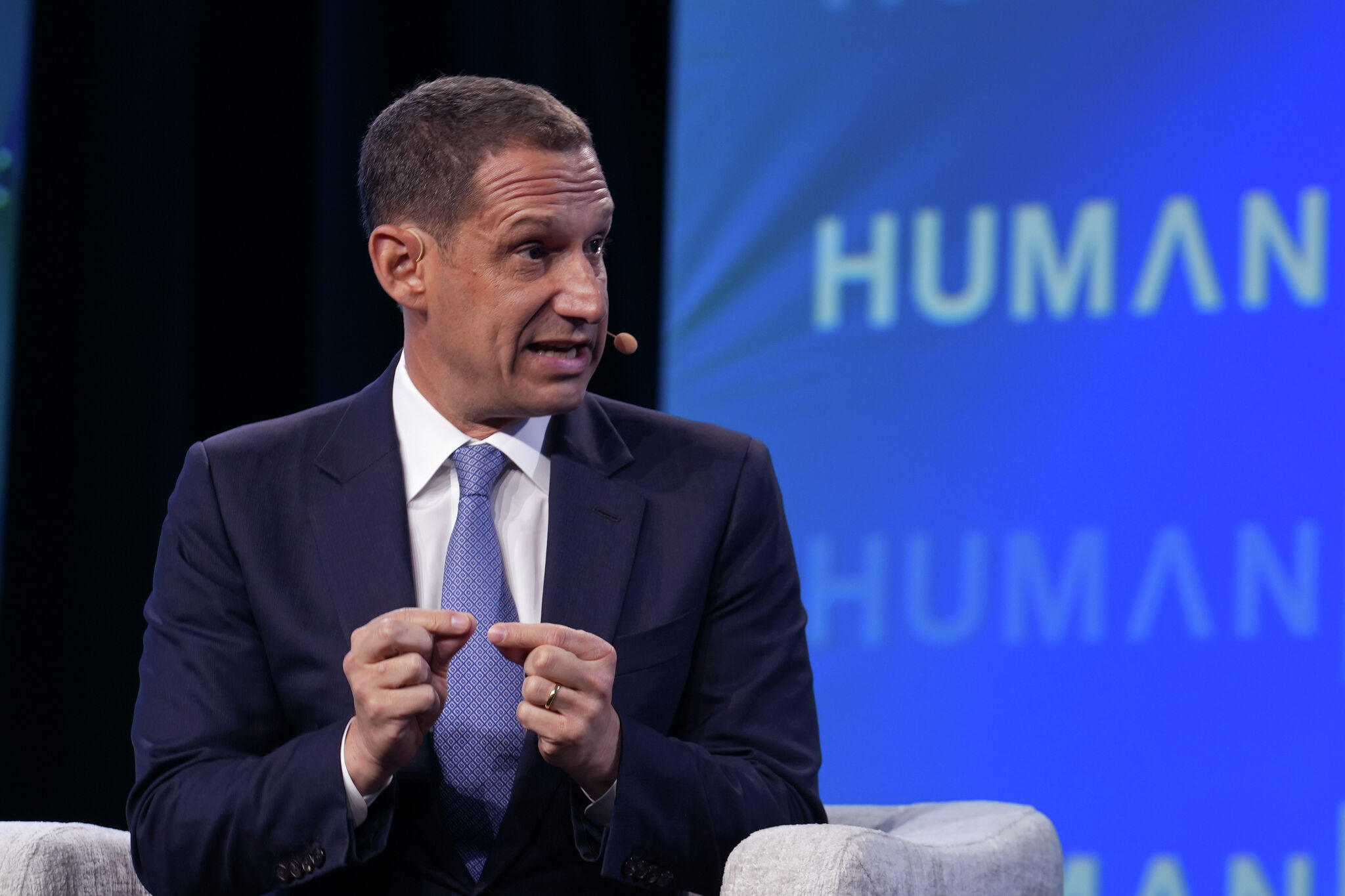

Mayor Daniel Lurie speaks onstage during the HumanX Conference at the Moscone Center on April 9, 2026, in San Francisco.
When the Huajiang Canyon Bridge in Guizhou, China, opened in September, it set a record as the highest bridge on Earth. In describing its scale for American audiences, many news outlets reached for a familiar reference point: San Francisco’s Golden Gate Bridge.

That comparison is fitting. San Francisco has long been a bridge in its own right between the United States and China. Though small in size, the city functions as a global metropolis. Before the pandemic, visitors brought nearly $10 billion annually into San Francisco, including more than $5 billion from international travelers, supporting tens of thousands of jobs across hotels, restaurants, retail and cultural institutions.
Article continues below this ad
“San Francisco’s No. 1 industry is not tech, it’s not AI — it’s actually tourism,” Mayor Daniel Lurie said onstage at the HumanX artificial intelligence conference earlier this month.
Historically, no group has been more central to that industry than travelers from China. Chinese visitors were among the highest-spending international travelers in San Francisco, often spending two to three times more per trip than domestic visitors, staying longer, shopping more, and contributing significantly to the local economy.
They traveled in groups — sometimes on tour buses — shaping the strength of our visitor industry. But Chinese tourism has not returned to its peak since 2017. I believe it can and it’s a must. And that is why Mayor Lurie’s trip to China matters right now.
Article continues below this ad
This is not abstract diplomacy; it’s practical local economic policy with a direct impact on San Francisco’s future. Strengthening the city’s ties with China to encourage visitation fuels our travel economy, refuels hotels, restaurants and shops, while also attracting capital into critical parts of our economy. The result is more jobs, stronger small business activity, a bigger tax base and renewed energy in our neighborhoods and downtown.
At a time when San Francisco is focused on recovery and revitalization, few actions could have a more immediate effect than the full return of the Chinese tourist. It also positions the city for what’s coming next.
Article continues below this ad
Lurie’s visit to two sister cities — Shanghai and Seoul — promotes tourism, specifically through cultural partnerships.
During his short time in China over the past few days, Lurie’s efforts are already yielding results. He fostered an agreement between the San Francisco Conservatory of Music and the Shanghai Conservatory of Music that will create artist exchanges and education programs between the two cities for five years. He then brokered similar collaborations for the San Francisco Opera, SF Ballet and the California Academy of Sciences.

San Francisco City Hall when Mayor Daniel Lurie hosted a Lunar New Year Celebration in February 2025.
The mayor is leveraging something that no other city has — San Francisco culture — to advance tourism in the next few years. In exchange, San Franciscans can expect an art scene with Chinese collaborators to begin budding very soon.
Article continues below this ad
Chinese culture is inseparable from the identity of San Francisco and the broader region. Our Chinatown, the oldest in North America, stands as one of the largest and most distinguished Chinese communities outside of Asia, but its influence reaches far beyond those historic streets. The contributions of our Chinese brothers and sisters have helped shape the economic, cultural and civic life of the entire city.
San Francisco has always been a gateway to Asia. That role carries even more weight today. Asia now drives a significant share of global innovation and economic activity, approaching half of global gross domestic product, and it continues to grow. San Francisco sits at the center of that momentum, especially in technology.
Just as important is access. Flights between the United States and China remain at a third of pre-pandemic levels, and visa processing still creates friction for travelers. Globally, cities like Paris, Tokyo and Singapore actively compete for Chinese visitors through targeted tourism campaigns, airline routes and business ties. Chinese outbound travel has historically been one of the largest and highest-spending in the world, and destinations are aggressively positioning themselves to capture that demand as it rebounds.
Article continues below this ad
The broader relationship between the United States and China has become more complicated in recent years. That puts local leadership at the forefront. Cities build connections. Cities create opportunities. Cities keep doors open when others cannot.
Lurie’s trip clearly sends that message. San Francisco succeeds when it looks outward. That has always been our advantage. Now is the time to strengthen that relationship that has helped power this city for nearly two centuries.
The bridge to China helped propel San Francisco onto the global stage. In the decades ahead, it will be the bridge that determines whether we remain at the center of the world’s innovation and economy.
Article continues below this ad