In “The Devil Wears Prada 2,” the offices of the fashion magazine Runway have become a moderately kinder, gentler place. Two decades after we first met her, Miranda Priestly (Meryl Streep), the indomitable editor-in-chief, still demands perfection from her staff, but her mid-meeting insults are more sniffy than withering, and even her sharpest glare no longer has quite the same serrated edge. Over the years, Miranda has been slapped on the wrist enough times by human resources to curb her abuses. Now, rather than flinging her coat at some trembling lackey, she has to hang it up herself, and you see her wince from the strain—a sign of age, perhaps, but also of humiliation. Even journalistically, she’s unusually off her game. Her opening scene involves a rare editorial lapse that tables her dream of a promotion to the top ranks of Runway’s parent company, Elias-Clarke. The magazine, too, is a shadow of its former self, and the horrors of corporate consolidation and downsizing loom. How bad can it get? In this movie, even Miranda Priestly flies coach.
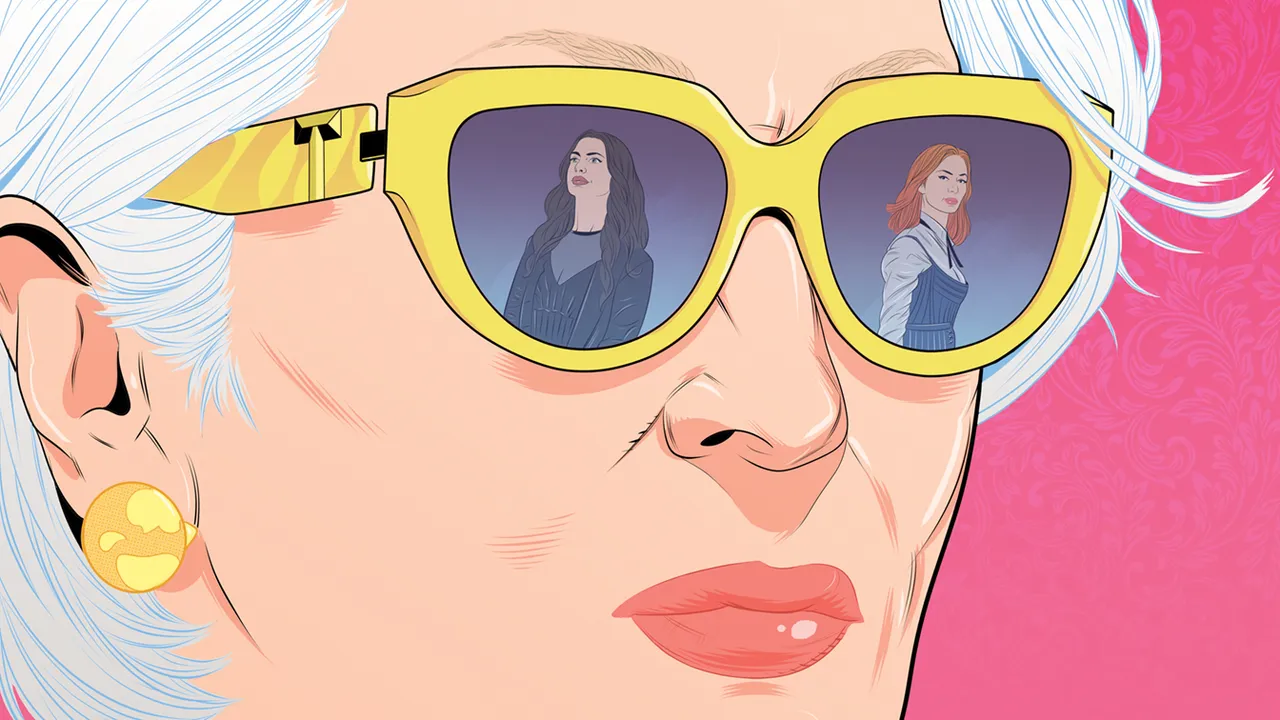
The first “Devil Wears Prada,” released to major success in the summer of 2006, was adapted from Lauren Weisberger’s best-selling 2003 novel, which drew on her experience as an assistant to Anna Wintour, then the editor-in-chief of Vogue. Weisberger’s book may have been an opportunistic takedown, but the director David Frankel and the screenwriter Aline Brosh McKenna spun it into one of the finer Hollywood entertainments of its era, with the pleasing sophistication and bitchery of a classic studio comedy from the forties or fifties. (Call it “All About Yves Saint Laurent.”) Miranda, a shrieking one-note villain on the page, was reborn, in Streep’s performance, as the most exquisite of holy terrors: a silver-haired, dulcet-toned fascist of the fashion world, as thoroughly impossible as she was ultimately irresistible. Streep’s second go-round, by contrast, unfolds as a series of micro-indignities—a plunge from her Olympian perch, one stumble at a time.
Rest assured that “The Devil Wears Prada 2” is, no less than its predecessor, a glossy Manhattan fairy tale, and one so overstuffed with top-of-the-line fabrics that cushy landings are all but certain. The sequel is also a first-class reunion tour, with at least three ludicrously extravagant stops—a villa in Vermont, a retreat in the Hamptons, an over-extended Milan Fashion Week—and all the principal players faithfully reporting for duty, Frankel and McKenna included. Stanley Tucci is back as Nigel, Miranda’s unfailingly loyal consigliere, who never butchers a bon mot or wears the same pocket square twice. Emily Blunt, whom the first “Prada” made a star, returns as Miranda’s chippy-chic former assistant Emily Charlton; she now oversees luxury retail at Dior, a position that allows her to exact the odd measure of revenge on her old boss.
The story’s most significant character, save Miranda herself, is Andy Sachs (Anne Hathaway), who once toiled alongside Emily in the assistant trenches and finally surpassed her. Andy was the magazine’s resident ugly duckling turned overachieving swan, though she ultimately abandoned the nest for a lowlier, ostensibly more serious career as an investigative reporter. Getting Andy back into the Runway fold is the first of the sequel’s many contrivances, but one with a queasy note of plausibility: early on, she and many of her newspaper colleagues are unceremoniously sacked via text message, a culling that might bring to mind, among other journalistic bloodbaths, the recent gutting of the Washington Post. With suspiciously fortuitous timing, Andy is snapped up as Runway’s new features editor—a move that Irv Ravitz (Tibor Feldman), the Si Newhouse-esque head of Elias-Clarke, hopes will salvage what remains of the publication’s credibility in the wake of Miranda’s bungle.
Miranda, for her part, scarcely remembers Andy, vehemently opposes her hiring, and waits, with sadistic patience, for her to fail. The two women are thus locked into the same power dynamic as before, and although Andy has the benefit of more clout and experience—plus the support of Runway’s next generation of assistants, deftly played by Helen J. Shen, Simone Ashley, and Caleb Hearon—she will once again have to earn Miranda’s grudging respect. The script has a shrewd manner, more endearing than exasperating, of repackaging the same elements under heightened circumstances, and Frankel and McKenna have largely mastered the art of the callback: shower steam being wiped off a bathroom mirror, a Madonna-scored dress-up montage. The best allusions are purely visual, and they remind us of the original film’s pop-cultural hold; at one point, we glimpse a familiar-looking turquoise belt that, in keeping with Miranda’s past prophecy, has trickled down from the most exclusive of ateliers to an open-air market. To some extent, the cool commercial logic of the fashion industry—which transforms beautiful, original works into cheaply reproducible goods, season after season—echoes that of Hollywood, which regularly cannibalizes and, yes, franchises its greatest successes. It’s a grind, but not always or entirely a soulless one, and we take its sturdy mechanics for granted at our peril. The very existence of art and beauty can be enough to make the relentless churn seem worth it.