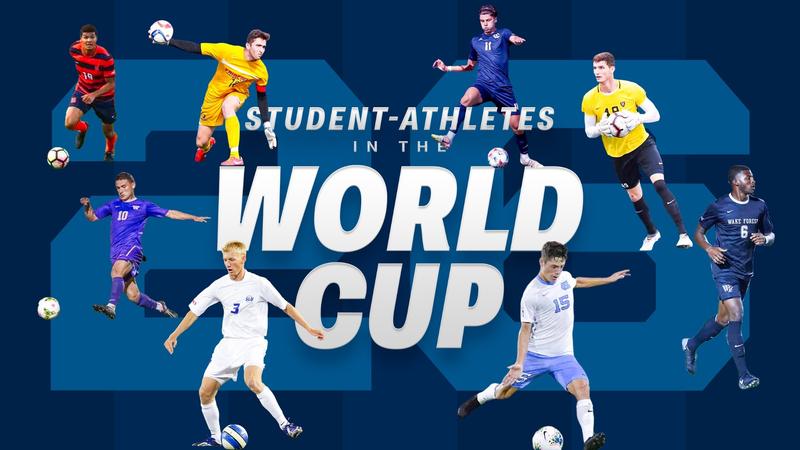
As the 2026 FIFA World Cup kicks off on an unprecedented scale in North America, it features many players who started their careers on U.S. turf at college.
With student-athletes hailing from the United States and Canada to New Zealand and beyond, college soccer programs have become a critical part of the player development pipeline feeding the world’s biggest sporting event. Colleges and universities across the country are producing World Cup-caliber talent, creating international pathways and even serving as training bases for national teams competing on soccer’s grandest stage.
As the tournament arrives in the United States, the influence of college athletics on global soccer has never been more visible.
The U.S. men’s national team’s college soccer connections
Several members of the U.S. men’s national team reached the World Cup after developing through college soccer programs.
Matt Turner — Fairfield
Goalkeeper Matt Turner walked on to the Fairfield men’s soccer team and recorded 39 appearances and 21 shutouts during his collegiate career. His rise from an overlooked recruit to a World Cup goalkeeper stands as one of the most remarkable development stories in American soccer.
Matt Freese — Harvard
Matt Freese earned second-team All-Ivy honors as a sophomore at Harvard before signing a professional contract.
Max Arfsten — UC Davis
Defender Max Arfsten attended UC Davis as a walk-on, earned a scholarship and was named to the Big West All-Freshman Team in 2019.
Mark McKenzie — Wake Forest
Defender Mark McKenzie played college soccer at Wake Forest in 2017 and was named to the Atlantic Coast Conference All-Tournament Team.
Tim Ream — Saint Louis
Tim Ream attended Saint Louis University from 2006-09, being named to the National Soccer Coaches Association of America All-Region first team and earning second-team all-conference honors while studying finance and economics.
Ream married Kristen Sapienza in 2012 after the two met at Saint Louis, where Sapienza starred on the women’s soccer team.
Miles Robinson — Syracuse
Center-back Miles Robinson played two seasons at Syracuse from 2015-16 and was named ACC Defensive Player of the Year his sophomore year before transitioning to a professional career.
Sebastian Berhalter — North Carolina
Sebastian Berhalter played one season at North Carolina, starting nine of 17 matches before signing a professional contract.
Cristian Roldan — Washington
Cristian Roldan played two seasons at Washington, scoring 10 goals and earning first-team All-Pac-12 honors twice.
Family ties
For many World Cup players, college soccer is part of a family tradition.
Antonee Robinson
U.S. defender Antonee Robinson is the son of Marlon Robinson, a former Duke standout who helped lead the Blue Devils to the 1982 NCAA championship match.
Auston Trusty
U.S. defender Auston Trusty is the youngest of six children, and all his siblings played collegiate soccer. Trusty committed to play at North Carolina before turning professional and never enrolling.
Christian Pulisic
U.S. captain Christian Pulisic comes from a family deeply connected to college soccer. His parents, Kelley and Mark Pulisic, both played at George Mason.
NCAA champions and Men’s College Cup stars
Canada’s Dayne St. Clair — Maryland
Canadian goalkeeper Dayne St. Clair starred at Maryland and was a member of the 2018 NCAA Division I championship team. During that title-winning season, he started all 23 matches and played every minute in goal for the national champion Terrapins.
St. Clair led the nation in goalkeeper minutes played (2,194), ranked 11th nationally in goals-against average (.66), finished 12th in save percentage (.833) and recorded 13 shutouts. He did not concede a goal during the final 500 minutes of the season, including Maryland’s entire NCAA tournament run.
St. Clair was also named to the 2018 NCAA Men’s College Cup All-Tournament Team.
New Zealand’s Joe Bell — Virginia
One of the most decorated players in Virginia soccer history, Joe Bell was named to the 2019 NCAA Men’s College Cup All-Tournament Team after helping the Cavaliers get to the national championship match. He was a finalist for the MAC Hermann Trophy, the first TopDrawerSoccer National Player of the Year from Virginia, the first United Soccer Coaches Scholar Player of the Year in program history, ACC Scholar-Athlete of the Year, consensus first-team All-American and the 2019 ACC Midfielder of the Year.
Canada’s Richie Laryea — Akron
Canadian defender Richie Laryea earned NCAA Men’s College Cup All-Tournament Team honors at Akron in 2015 before becoming a key contributor for Canada’s national team.
Canada’s Alistair Johnston — St. John’s (New York) and Wake Forest
Alistair Johnston began his collegiate career at St. John’s before transferring to Wake Forest.
As a senior in 2019, Johnston emerged as one of the ACC’s top defenders, earning third-team All-ACC and first-team All-South Region honors while helping Wake Forest reach the College Cup.
New Zealand’s NCAA pipeline
In addition to Joe Bell, several other New Zealand national team players were on NCAA college teams:
Michael Boxall — UC Santa Barbara
Michael Boxall played at UC Santa Barbara from 2007-10, making 78 appearances. He set the program’s single-season record with 2,185 minutes played in 2009 and finished with 6,730 career minutes, the fourth-most in school history.
Francis de Vries — Saint Francis
Francis de Vries appeared in 79 matches from 2013-16 while scoring 15 goals. He earned three NSCAA third-team All-America honors and was also recognized as a second-team Academic All-American.
Jesse Randall — Northern Kentucky
Forward Jesse Randall scored 10 goals in 17 appearances during the 2021 season at Northern Kentucky and was named Horizon League Freshman of the Year before earning a place on New Zealand’s World Cup roster.
Haiti’s NCAA pipeline
Derrick Etienne Jr. — Virginia
Midfielder Derrick Etienne Jr. played one year for Virginia and was named to the 2015 ACC All-Freshman Team.
His father, Derrick Etienne, played college soccer at VCU and internationally for the senior Haitian national team.
Markhus “Duke” Lacroix — University of Pennsylvania
Duke Lacroix started in all but one game in his four years at Penn. He earned All-Ivy honors in all four seasons, just the third player in program history to do so. In addition, The Ivy League named Lacroix its Rookie of the Year in 2011 and Offensive Player of the Year in 2013.
Frantzdy Pierrot — Northeastern, Coastal Carolina
As a senior at Coastal Carolina, Frantzdy Pierrot was named to the 2017 MAC Hermann Award Watch List and voted to the United Soccer Coaches All-Southeast Region first team. In the same year, he earned Sun Belt Conference Player of the Year and first-team All-Sun Belt honors. At Northeastern, he was named Coastal Athletic Association Rookie of the Year.
Additionally, Jordan’s Mohammad Abualnadi played for Pittsburgh and Notre Dame. Sweden’s Hjalmar Ekdal played for the University of North Carolina Wilmington.
World Cup on campus
The influence of higher education extends beyond individual player development.
Several national teams have selected college campuses as their official FIFA World Cup 2026 base camps. Among the confirmed sites:
- Algeria — Kansas.
- Austria — UC Santa Barbara.
- Curaçao — Florida Atlantic.
- Egypt — Gonzaga.
- France — Bentley.
- Germany — Wake Forest.
- Ghana — Bryant.
- Haiti — Stockton.
- Jordan — Portland.
- New Zealand — San Diego.
- Norway — UNC Greensboro.
- Paraguay — San Jose State.
- Qatar — Westmont.
- Senegal — Rutgers.
Campus connections, continued
For decades, college soccer was often viewed as secondary to professional academies in the global development landscape. The 2026 FIFA World Cup tells a different story.
College soccer has become a vital contributor to the modern game. Universities are not only developing elite talent but also hosting national teams and supporting one of the largest sporting events in history.
As the World Cup unfolds across North America, the fingerprints of college athletics will be everywhere — on the field, on the sidelines and throughout the tournament’s infrastructure.
The result is a powerful reminder that the pathway to the FIFA World Cup increasingly runs through college campuses.