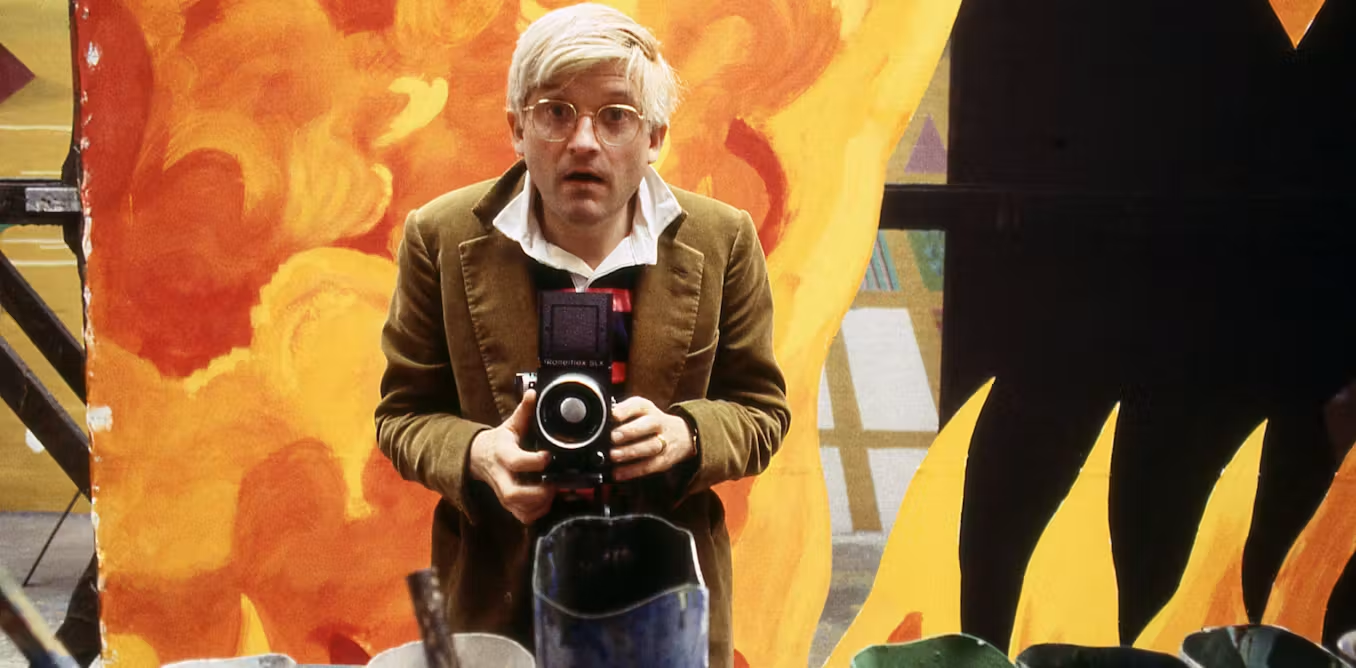
Born in Bradford and shaped by northern art-school discipline, David Hockney brought a working-class, almost punk refusal to British art: do the work, trust the eye, do not ask for approval. Hockney made success look effortless: all colour, good humour, great glasses, cigarettes and smoky charm. But for a young gay artist from a northern mill town, nothing about that journey was effortless.
Hockney knew what it was to be judged before he was properly seen. In Britain, class prejudice travels through accent. His Bradford voice carried history, poetry and bite, but at the Royal College of Art in London it was mocked. Looking at the drawings of his fellow students who laughed, he simply outdrew them.
Bradford educated Hockney. The north was not a cultural desert waiting to be rescued by London, but a place of serious art schools, teachers, makers and visual traditions. What it lacked was not talent or discipline, but the automatic authority granted to those formed by privilege.
Hockney refused the lot assigned to him. He opened gates for those who followed, showing that art college, success and cultural authority were not reserved for those born inside old networks of taste and confidence. His answer to class prejudice, regional snobbery, homophobia and aesthetic gatekeeping was not to become deferential. He clocked into a lifelong art-making shift, working harder, looking harder and making more until the cultural gatekeepers had no choice but to rearrange around him.
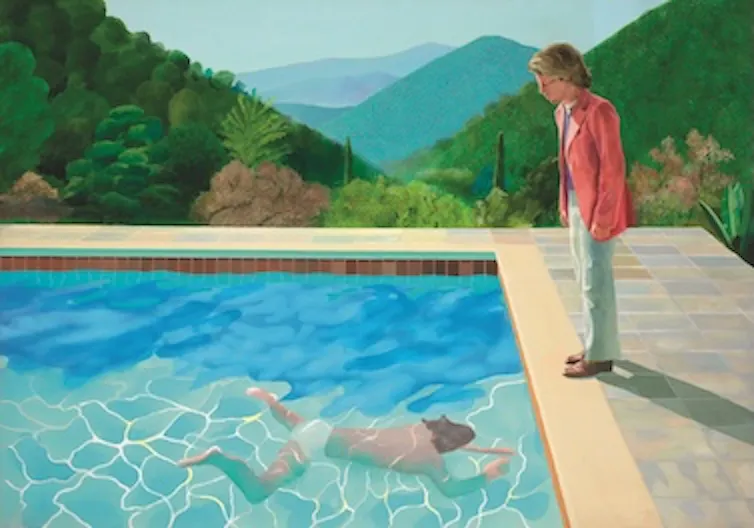
He made works of pleasure, colour, friendship and innovation. He portrayed gay life, not through struggle – but through domesticity, tenderness and desire, a brave and piercingly clever approach before the partial decriminalisation of sex between men in England and Wales in 1967.
Like Boy George in pop, Hockney made difference visible through colour, humour and style, in a form large audiences could enjoy before they necessarily understood its politics. Against the grey weight of inherited prejudice, he offered something bright, accessible and quietly radical. By showing ordinary happiness, he helped make the prejudice against it look ridiculous, making acceptance feel overdue.
Hockney’s late career also challenged ageism and disablism. Using a wheelchair in later life, he refused the assumption that older or disabled bodies mean diminished cultural agency. Like the infirm Henri Matisse making cut-outs in his last decade, Hockney made old age active, inventive and publicly consequential.
Christie’s / Wikipedia
The art of seeing
Beyond swimming pools and California light, Hockney insisted that art is an experiment in seeing. He never treated looking as passive. He embraced Polaroid, photo-collage, iPad, projection and immersive display. He lived in the now by continually adopting whatever helped him see.
His work with physicist Charles Falco on the historical use of lenses, mirrors and optical devices in painting was not a sideline, but part of a lifelong enquiry into the technologies of vision.
In Pearblossom Hwy (1986), Hockney used hundreds of photographic prints to fracture space and test perception, while refusing to accept the camera as the final authority. A mountain could be made from all the photographs that have failed to capture the majesty of a bush, an oak tree, a rolling hill or a mountain itself. For Hockney, seeing was not the same as recording: the camera could seize an instant, but landscape required time, attention, weather and the bodily experience of being there.
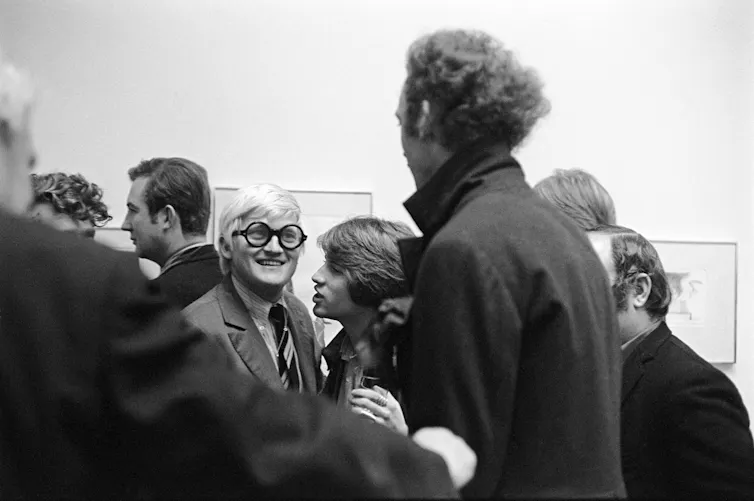
Homer Sykes / Alamy
His later work made that fight to catch time explicit. Again and again, Hockney asked how a flat image could hold colour, light and the passing seasons. This reached monumental form in A Year in Normandie (2020), a printed iPad frieze more than 90 metres long.
Here, time is made spatial. We walk its length, moving through winter, spring, summer and autumn as if moving through life itself. The work captures time, but also lets it slip away, teaching human frailty and humility through the simplest things: a road, a tree, a field, a burst of hawthorn blossom.
Seen alongside another northern artist, LS Lowry, Hockney’s landscapes gain further force. Lowry’s industrial worlds, social, bodily, smoky and crowded, are now – in much of the UK – pictorial memory. Hockney’s roads, trees, fields and blossoms may one day carry a similar charge. They record not only place, but a fragile idea of land, season and belonging.
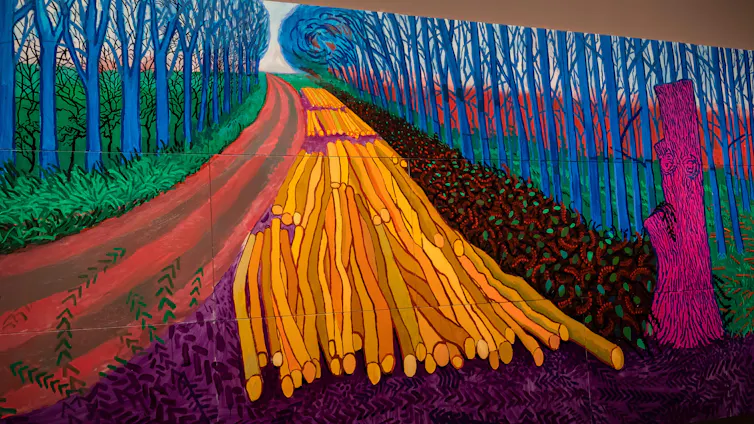
Bosiljka Zutich / Alamy
In an environmental age, looking carefully at blossom by the roadside, at trees, seasons and shifting light, is not an escape from politics. It is a radical act and a condition of care. In a country where 44% of adults now spend three hours or less outdoors each week, Hockney’s insistence on slow looking feels less like nostalgia than a warning.
Hockney did not try to escape the north or his background – instead he made the north impossible to ignore. Using the digital tools of now, he asked us to look slowly at local spaces in the round. His legacy is not only that he entered the art canon. It is that he made the canon warmer: more northern, more queer, more popular, more colourful, more technologically curious and more open to joy and pleasure.
Hockney made humour, friendship and pleasure into serious forms of exchange. At a time when some voices profit from division, and when environmental crisis and war press heavily on daily life, Hockney’s sign-off message, “love life”, feels more striking than ever.