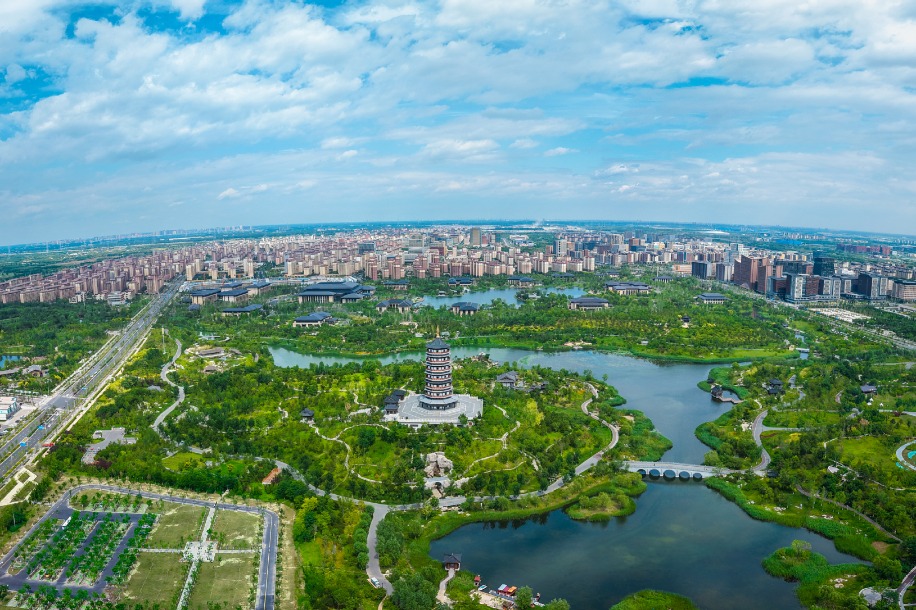
In an era when soaring housing prices and intense competition are driving young professionals away from major cities, China”s Xiong’an New Area is emerging as a magnet for highly educated talent.
With generous living subsidies, affordable housing and a carefully planned urban environment, the city is luring a growing number of young entrepreneurs, researchers and graduates looking to build both careers and lives.
Among them is 27-year-old doctoral student Zhang Zequn, who leads research and development at AnYing Technology, the company behind what it describes as the world’s first portable non-invasive cerebral hemorrhage detection analyzer.
For Zhang, the decision to settle in Xiong’an was straightforward.
The local government provides doctoral degree holders with a monthly subsidy of 3,000 yuan ($442) for five consecutive years, an amount he says largely covers daily living expenses.
“In Xiong’an, that subsidy is enough to pay for housing and food, with money left over,” Zhang said.
Rental costs remain significantly lower than in nearby Beijing. According to Zhang, an 80-square-meter apartment typically rents for between 1,600 and 1,700 yuan per month.
The talent support program also offers monthly subsidies of 1,000 yuan for bachelor’s degree holders and 2,000 yuan for those with master’s degrees.
Beyond financial incentives, many young residents cite quality of life as a major attraction.
Zhang’s daily commute is just over one kilometer on foot, with green parks lining both sides of the road. He also praised the city’s “15-minute living circle,” an urban planning concept that ensures essential services and amenities are within a short walk or bike ride.
The abundance of green spaces and clean air has become a distinctive feature of the rapidly developing city.
For entrepreneurs, Xiong’an offers more than just affordable living.
Li Qiang, chairman of Xiong’an Huaqing Zhiyan Technology, relocated his company’s headquarters to the area in early 2025. He believes the city’s long-term growth potential outweighs the fact that many industries are still in their formative stages.
“Xiong’an is a new city with enormous room for development,” Li said. “The industries it prioritizes have strong growth potential and create opportunities for innovative companies.”
His company completed recruitment, office setup and capital investment in Xiong’an within just three months.
As more technology firms establish operations in the city and several universities prepare to expand into the area, local officials say interest among students and young professionals continues to grow.
For many of China’s next generation of innovators, Xiong’an is increasingly offering something difficult to find elsewhere: a place where ambition does not have to come with a prohibitive cost of living.