Faced with mounting public concern about power- and water-hungry data centres, the B.C. government has taken action to limit the amount of electricity BC Hydro is willing to supply, forcing companies to bid for the right to connect.
But the province doesn’t just have one electrical utility: Southeastern British Columbia is served by FortisBC.
In this area that spans the Kootenays and Southern Interior, these new rules won’t apply, and the province has far less sway over which projects can go ahead.
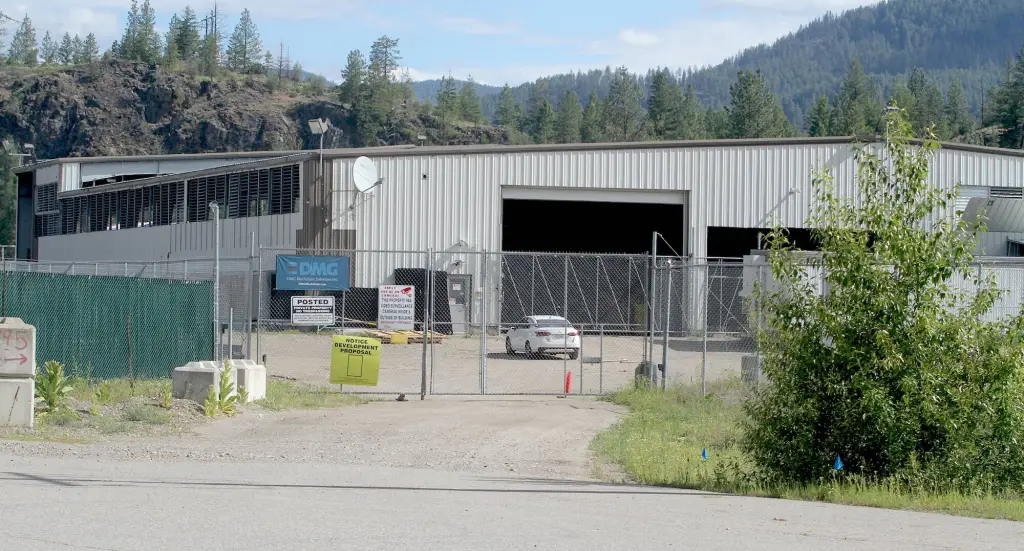
This has rattled the locals in Christina Lake, where DMG Blockchain Solutions is retrofitting a cryptocurrency operation into an AI data centre. The plan is to more than quadruple the facility’s power draw from its original 15 megawatts to 65 megawatts.
DMG’s dedicated substation can go even further, up to 85 megawatts — more than 10 per cent of the total capacity on the Fortis grid.
Despite this surge in potential usage, the Regional District of Kootenay Boundary wasn’t looped in by Fortis or DMG that the changes were in the works.
“I’m not against data centres,” said Grace McGregor, RDKB’s Area C director, who heard about the plan through a company news release. “What I am against is that nobody lets you know what’s going on.”
Local zoning rules in most of the RDKB, where they exist, do not allow data centres. But this property is different. DMG began operations in Christina Lake on a parcel of land close to the U.S. border about eight years ago, renovating a defunct finger-joint plant into a cryptocurrency mine.
As the operation developed, the company worked with the regional district to create specific zoning rules for the site to allow “data warehousing,” a definition that includes cryptocurrency mining and AI data centres. There was a public hearing in 2022, and it was approved.
Still, McGregor feels the use has changed since the public hearing, and many locals are calling her office to complain and voice concern about water and power as they watch construction activities at the site. She says there are a bunch of sea cans now sitting next to a building on the property that looks like it has been “opened up like Swiss cheese.”
And while McGregor knows the facility already needs a lot of power, she has no way to know the details of its agreement with Fortis. She wants the province to step in to regain control of the situation to ensure the local community can have its say.
The regional district passed a motion in May to send to the Union of B.C. Municipalities to urge the province to create more regulations for the sector.
“Nobody tells you what the oversight is of these, and the community deserves to hear that,” she said.
DMG president Sheldon Bennett spoke to Black Press Media and defended the changes, emphasizing his company’s transparency as a public company that issues quarterly reports. He argues the proposed changes involve swapping out the servers, but that it is otherwise a continuing operation.
He also sought to assuage worries about water usage, saying that DMG will use a closed system that will not regularly draw on local water sources. This glycol cooling system does not require adding or discharging water.
McGregor is still worried about spills, but Bennett says the solution isn’t harmful to the environment because it is vegetable-based, and the company has a remediation plan.
“It’s a closed-loop system where we purchase water that’s purified with glycol added to it,” he said. “And it runs sort of like a radiator in your car; that same loop goes over and over and over.”
Bennett also detailed some of the DMG facility’s power needs. The cryptocurrency version had access to 15 megawatts of firm power the company could use continuously. The new AI servers need another 50 megawatts, but this will be intermittent, allowing Fortis to shut it off when demand is high, like it is on exceptionally cold mornings.
The company will install battery backups to help cope with these shifts, and plans to power up or down with advance notice from Fortis.
All of this runs through an 85-megawatt substation separate from the local Christina Lake electricity supply.
Rob Goehring, executive director of the AI Network of BC, an industry advocacy group, guesses that some of the local worries about data centres might have more to do with watching outcry grow over the massive projects being built in the United States.
“We are hearing a lot about the problems that are happening in some of the data centres, primarily in the U.S., where there are absolutely horrendous, horrific things happening to the water table,” Goehring said.
Goldman Sachs estimates data centres’ power demand in the U.S. will hit 41 gigawatts this year, and 66 gigawatts by the end of next year. Many of these sites must use massive amounts of water to cool down servers laden with advanced chips.
In B.C., the amount of electricity used by data centres pales in comparison to these, and there is a much stronger regulatory structure. But the grid is also smaller, so there is a finite amount of power to go around.
B.C.’s overall energy picture
Most of the province is served by BC Hydro, a public utility which provides almost 13,500 megawatts of capacity, operates several major dams and is responsible for vast electrical infrastructure.
But a small slice of B.C. is Fortis territory, where the private utility serves customers with about 800 megawatts of power supply capacity. With only so much power to go around — mills, mines and homes all need their share — a decision to allot power to one business can mean others lose out.
Because BC Hydro is a Crown corporation, the provincial government has authority over these decisions in most places.
And the provincial government enacted new rules in December that prevent data centre projects from drawing power from BC Hydro’s grid without going through a competitive bidding process.
These new regulations limit new data centre electrical connections to 200 megawatts per year for the next two years and ban new connections for cryptocurrency mines altogether. They also require the government to consider the environmental implications and social benefits of each centre.
Not so with Fortis. These new rules do not apply in the private utility’s service area.
So Fortis doesn’t need to limit these projects, and can do what it wants provided it doesn’t require buying more power from BC Hydro. Jason Wolfe, the company’s director of energy solutions, says it assesses connection requests on a “case-by-case” basis, considering the cost, the tie-in line, and the overall implications for the grid.
“We serve any of these large requests, whether they be from data centres or pulp mills or mines or anything like that, in a similar fashion,” he said.
Wolfe said Fortis has several open requests for new data centre hookups, but would not divulge details of individual applications.
There are still a couple of ways the province can influence these decisions — the B.C. Utilities Commission determines rates, for example — but ministry officials won’t be able to decide what types of projects are allowed to connect like they will in BC Hydro service areas.
Government dealing with soaring demand
BC Hydro is seeing massive increases in demand not just from data centres, but also from liquefied natural gas and mining projects. The utility expects this to continue, forecasting a 20-per-cent increase in demand by 2030 and a 50-per-cent increase by 2050. Plans are in the works to develop more capacity and tamp down home energy demand.

B.C. Energy and Climate Solutions Minister Adrian Dix said his goal is also to ensure “best practices” for new data centres and prioritize those in the public interest, while protecting ratepayers and ensuring industries that create more jobs have access to power. Hence the plan to create a controlled bidding system.
He expects to announce the first tranche of bid winners in September.
Goehring, of the AI Network of BC, likes the new system, saying it will allow worthwhile projects to move ahead, rather than allowing the good ones to get stuck in the queue behind those with less public benefit. He also thinks this will help protect Canada’s data sovereignty.
“The reality is there’s only so much power, and I think that the best projects are going to be the ones that get approved,” he said, giving examples of healthcare and other critical applications that need domestic data infrastructure.
For these reasons, he is pleased to see the Christina Lake centre switching from cryptocurrency mining, which he does not see as having much public benefit.
Projects already underway not impacted by new rules
But many projects were already in BC Hydro’s connection queue before the Crown corporation introduced the new rules. These will be grandfathered in, public benefit or not.
“You don’t retroactively put the gate on,” Dix said.
This includes the Telus projects in Vancouver and a centre in Nanaimo that have led to angry and anxious protests. Those Vancouver projects alone need 150 megawatts, although the excess heat will be used in 150,000 homes, potentially saving energy as well.
Other projects through the “gate” include new data centres operated by the Australian IT company IREN, located in Mackenzie, Prince George and Canal Flats. These use 80, 50 and 30 megawatts, respectively, according to a company spokesperson.
And BC Hydro regulation can do little to stop new projects that plan to generate their own power — though a Ministry of Energy and Climate Solutions spokesperson said they are unaware of any projects planning to self-power.
Fortis can still be forced to adopt a bidding process similar to BC Hydro’s if the government wants to, according to Wolfe, but for now the utility plans to proceed as is. Like BC Hydro, it expects demand growth, and is planning to add power capacity.
But the question resulting from all this is whether less desirable data centres — those that can’t get through the BC Hydro bidding process — will flock to south-central parts of the province to plug into the Fortis grid.
Goehering thinks this is a possibility.
“In a typical capitalist kind of way, the projects are going to seek out their best chance of success,” he said.
READ MORE: ‘Insatiable demand’: B.C. seeks more control over who plugs into its energy grid
READ MORE: Site E, Homathko dam proposals divide B.C. First Nations, confound Site C critics