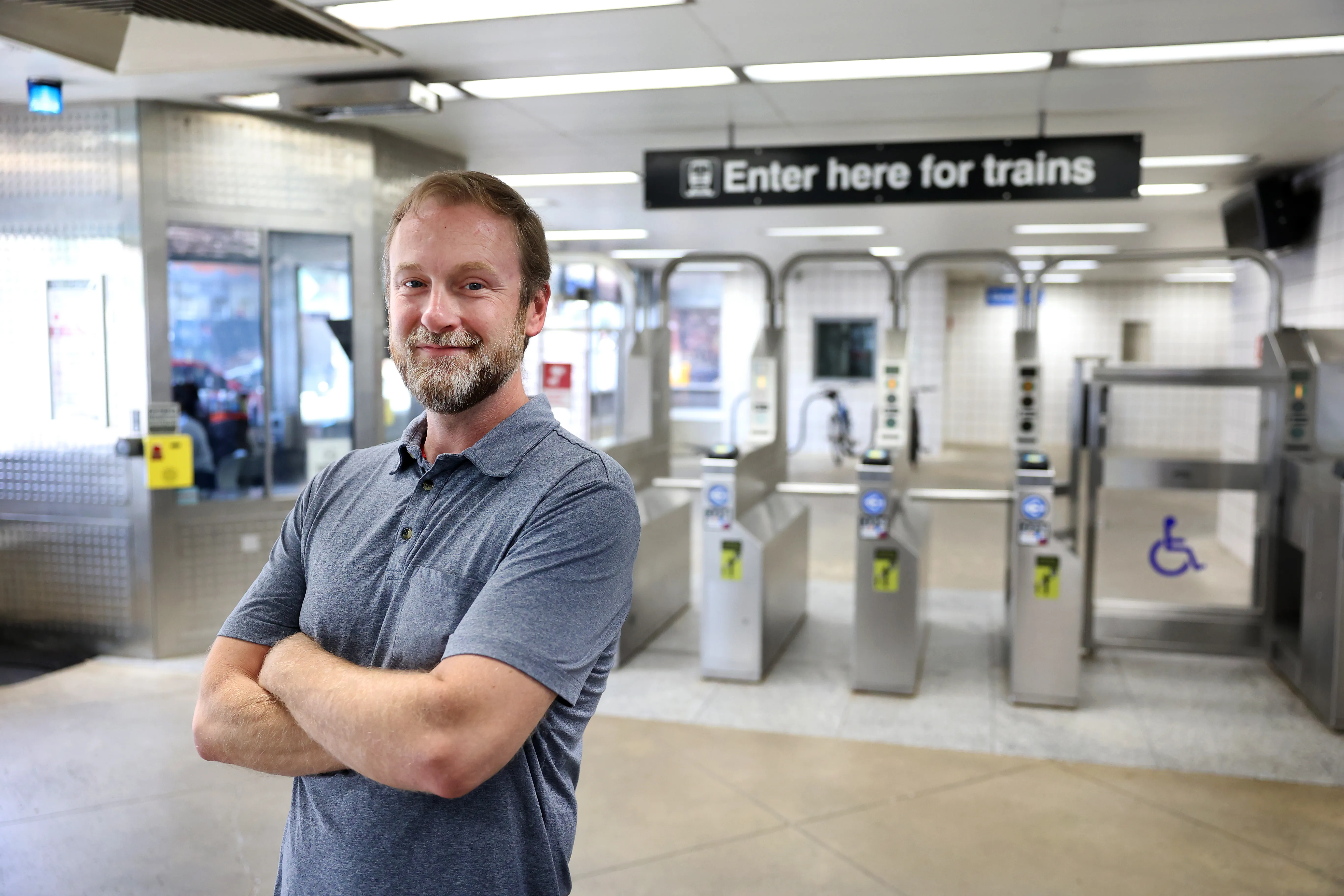
Forty hours a week used to be enough for Christopher Dever, 42, to make a living as a Lyft driver. But as the cost of a full tank of gas crept up from $60 to $80, he found himself living in what he calls “a cycle of scarcity,” working 60-hour weeks to scrape by.
Although Lyft offered a temporary fuel relief program for eligible drivers, it wasn’t enough to offset Dever’s costs, and he increasingly found himself paying high prices out of pocket. On his drives, he planned trips to the suburbs or northwest Indiana to save money on gas.
Still, there was often little left of his paycheck after paying his bills. “Just that little bit extra that I was paying at the pump was having an impact on my entire life,” Dever said. “I’m working all these hours, I’m making all this money for this company, yet it’s all going back into just being able to operate my vehicle.”
Gas prices have surged since late February at the start of the war in Iran. Following a brief reprieve in June and July, gas prices in Illinois are climbing once again and Chicago drivers are feeling it. After bottoming out at a multimonth low of $3.89 in early July, the average cost for a gallon of gas rebounded to $4.28 this week, according to the U.S. Energy Information Administration.
In the Chicago area, AAA placed the average gas price at around $4.35 this week, compared with $4.04 nationwide.
Illinois tends to see higher gas costs than surrounding states because of a stack of federal, state and local taxes, along with environmental surcharges. This week, Illinois drivers paid an average of about $0.75 more per gallon than those in Indiana.
Surveys show that rising costs have left many people worried. According to a July Pew Research Center poll, around 56% of Americans say they are very concerned about gas prices, up from 34% in January. And a July CNN poll found that 74% of Americans now say rising gas prices have caused them at least some financial hardship, compared with 63% in March.
Public transit and biking as cheaper alternatives

In April, Dever, the Lyft driver, started a new job as a design engineer at an audiovisual company. While he had planned to keep driving part time, consistently high gas prices pushed him to quit entirely by May. Rising costs also changed his personal habits and he said he now opts for public transit to run errands and tends to stick within his Pilsen neighborhood.
Kennedy Furnace, a 29-year-old lawyer who lives in the south suburbs and works on a hybrid schedule, said rising prices have discouraged her from traveling to her Loop office as much as she used to, as the price to fill her tank increased by about $15 to $20 from the start of the year.
“I don’t think it’s worth me commuting 30 miles into the city with gas prices this high,” she said.
Furnace, who is planning to move to the city later this year, said she’s considering leaving her car at her parents’ house and ditching driving entirely. Instead, she plans to switch to public transit and walking to get around.
“I don’t want to pay for city parking and I certainly don’t want to pay city gas prices,” she said.
Jordan Harris, a data analyst living in Bridgeport, said he also turned to the CTA after deciding it didn’t make sense to drive amid surging gas costs.
“I thought it was just going to last a few weeks or months,” he said. “Since then, it hasn’t really gone down.”
The tipping point came when Harris realized a drive home to St. Louis had become more expensive than a round-trip Amtrak ticket.
Harris, 26, said he now drives only when necessary, which generally works out to a couple of times per month. Along with taking transit, he also bikes and walks more.
“One of the biggest benefits has been being able to take care of my health in a passive way while navigating the city,” he said.
Still, Harris said he sometimes misses the convenience of a car because of “gaps” in public transportation. Journeys that should be straightforward can require multiple connections and take significantly longer than they would in a car, he said.
“I’m going to continue not driving my car a lot until gas prices go down, because it’s just not worthwhile,” he said. “Even if it takes me an extra 20 minutes to get to Pilsen or Bronzeville or anywhere else in the city that I want to go.”
Viktor Köves, founder of the photo project Chicagoans who Bike, said gas prices have led many Chicagoans, like Harris, to consider biking a more affordable option.
“In general, the sentiment I’m getting is that people are looking really critically at how they move around the city,” Köves said. “They’re thinking ‘How often do I use this, how much do I need to use it, and are there other options?’”
At J.C. Lind Bike Co. in Old Town, owner Jon Lind said business has been growing as prices continue to surge.
“We’re seeing more people come through the door and we’re seeing more sales. They’re rethinking, do they really need a car?” he said.
In particular, Lind said he has seen the most growth among customers who didn’t previously consider themselves cyclists.
“As gas prices rise, there are people who may not have considered themselves somebody who was into cycling two years ago. But they’re looking at it through a whole new lens when gas prices go up,” he said.