Hybrids are taking an increasingly larger share of new-vehicle sales. On average, monthly payments for hybrids are lower than those for fully electric or internal combustion engine models.
The trend is among those highlighted by Experian’s State of the Automotive Finance Market report for Q2 2026, and it suggests that hybrids are being assisted at some level by OEM incentives.
According to Experian, hybrids accounted for 16.8% of new-vehicle financing in the quarter, up from 13% in Q2 2025, while the EV share of new-vehicle financing declined to about 8.2%, from 9.2% a year ago.
Although the market’s shift toward hybrids has been a long time coming, it’s been spurred along this year by the loss of EV tax breaks, high gas prices and the Iran war. This recent surge in their popularity appears closely correlated to affordability.
“It looks subvented,” said Melinda Zabritski, head of automotive financial insights for Experian Automotive, in a phone interview with WardsAuto to review the report, which was published Aug. 27.
“Hybrids carry a lower monthly payment than other vehicle segments,” the report said. The average monthly payment for a new hybrid vehicle loan was $646 in the second quarter. The average monthly payment for new EVs was $692, and for new gasoline-powered vehicles, the average was $721.
This also held true for new-vehicle leases. According to the report, the average monthly payment for hybrids was $566 in Q2, and $602 for ICE vehicles. While the average monthly payment for EVs was $641.
Top-selling hybrids supported by OEMs at finance level
The Experian report doesn’t include data on incentives, but Zabritski said that the average interest rate on loans for several of the top-20 volume-selling hybrids in Q2 was well below the industry average. That implies finance rates were supported by respective OEM incentives.
In addition, Zabritski said, that captive finance companies dominate financing for hybrid vehicles. That dovetails with a high level of factory support, since these companies typically have exclusive access to their respective OEM incentives.
For example, the Subaru Crosstrek had an average interest rate for Q2 of about 3.2%; the Mazda CX-50 Hybrid, 4.3%; the Hyundai Tucson Hybrid, 4.2%. Interest rates in this story are rounded up to one decimal place, while Experian Automotive reports to two decimal places.
For context, the average new-vehicle loan rate was 6.4% in the second quarter, down from 6.8% a year ago, the report said.
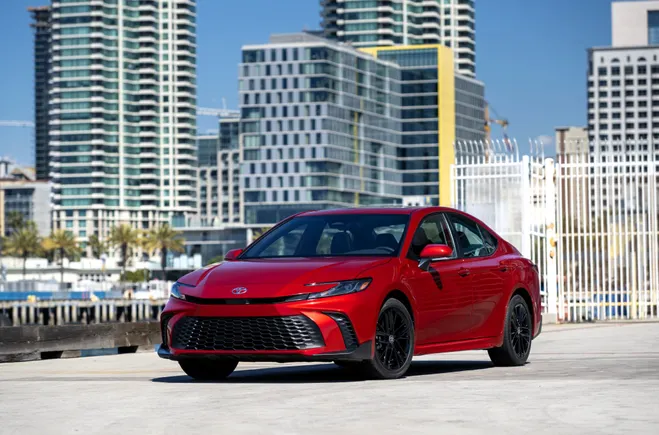
The Toyota brand, which for many years has consistently promoted hybrids over electric vehicles, accounted for three of the top 5 most-financed hybrids for the quarter, according to Experian Automotive, led by the Toyota Camry, at No. 1.
The others were the Toyota RAV4, which had record sales in June, and the Toyota Grand Highlander. The Honda brand accounted for the other two of the top 5 most-financed hybrids, namely the Honda CR-V and the Honda Accord.
Toyota not leaning on incentives
Toyota Motor North America said separately in a July 1 sales report that sales of its electrified vehicles, including hybrids, plug-in hybrids, and EVs, were up 35% in June versus June 2025, including both Lexus and Toyota brands. In Q2, Toyota sold 383,091 electrified vehicles, up 19.5%.YoY. The majority of these were hybrids.
According to Experian Automotive data, the average interest rate for the two highest-volume Toyota hybrids, the Camry and RAV4, were right around the overall industry average of 6.35%. The Grand Highlander wasn’t much lower, at about 6%. The automaker is known in the industry for keeping inventory and incentives low.