
The term “blockchain technology” is overused now, and its definition has become diffuse, in the best of cases. We tend to associate it with anything related to cryptocurrencies, or that uses their underlying technology, but the truth is that a blockchain, as such, is just one type of structure that cryptocurrencies can use as a building block. Other structures exist, like the Directed Acyclic Graph (DAG).
We can’t say one structure is better than the other, but they pursue different goals and offer different things. Let’s learn a bit about this.
How Does a DAG-Based Cryptocurrency Work?
As its name suggests, a ‘block-chain’ records transactions inside “blocks” of data that are added one after another in strict chronological order. They have different ways to reach consensus to ‘approve’ transactions; the most popular ones being with miners (Proof-of-Work/PoW) or “validators” (Proof-of-Stake/PoS). Bitcoin and Ethereum are blockchains. DAG-based cryptocurrencies, like
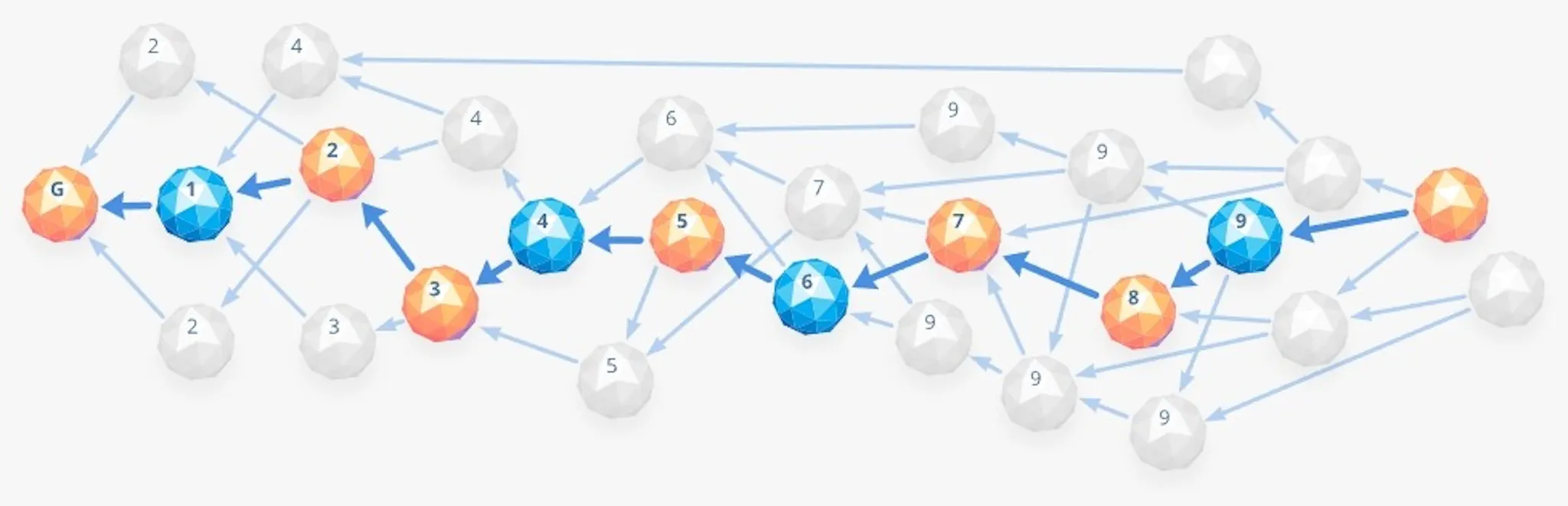 A DAG order example
Instead of blocks, we can say that a DAG builds a huge net of interconnected transactions. Before joining the ledger, a new transaction connects to one or more earlier ones, creating a web of links that expands over time. Each user is “their own miner,” as Sergio Demian Lerner, the first one to describe a DAG-based cryptocurrency,
“DagCoin is a cryptocurrency design that attempts to be highly decentralized by merging the concepts of transactions and blocks and making each user that transact a miner. Each transaction carries a proof-of-work and references one or more previous transactions. The resulting authenticated data structure is a Direct Acyclic Graph (DAG) of transactions where each transaction “confirms” one or more previous transactions.”
Of course, this was just an initial concept, and different DAG networks have applied it with different changes.
Obyte, for instance, is a DAG ledger built by its own users. Every user adds their own transactions to the ledger, and no one can stop them — ensuring the maximum possible decentralization. To establish chronological order of transactions, which are already in the ledger, Obyte has a group of
Other DAG tokens use different methods, so there’s no universal blueprint. Decentralization also depends on those methods.
Why Does This Design Matter?
New designs and protocols always matter in the crypto world, for a start. In a DAG-based system, transactions can form a graph of relationships, where multiple transactions can be added without all of them needing to fit into one single sequence. Some projects choose a DAG-like structure trying to increase throughput, while Obyte chooses it for the ultimate

Blockchains are decentralized to a degree, considering that anyone with the right equipment, knowledge, and/or enough funds can become a miner or “validator” to help approve transactions and receive rewards in exchange. Still, these miners or validators can be considered powerhouses or central parties by themselves. In some bad cases, they can even
Some of them still have central parties
For newcomers, the biggest takeaway is simple: Cryptocurrency isn’t built around one fixed recipe. Blockchain may dominate the headlines, yet alternatives continue to expand the field with fresh ideas. That diversity gives developers more tools to work with and gives users more options when choosing the technology that best fits their needs.