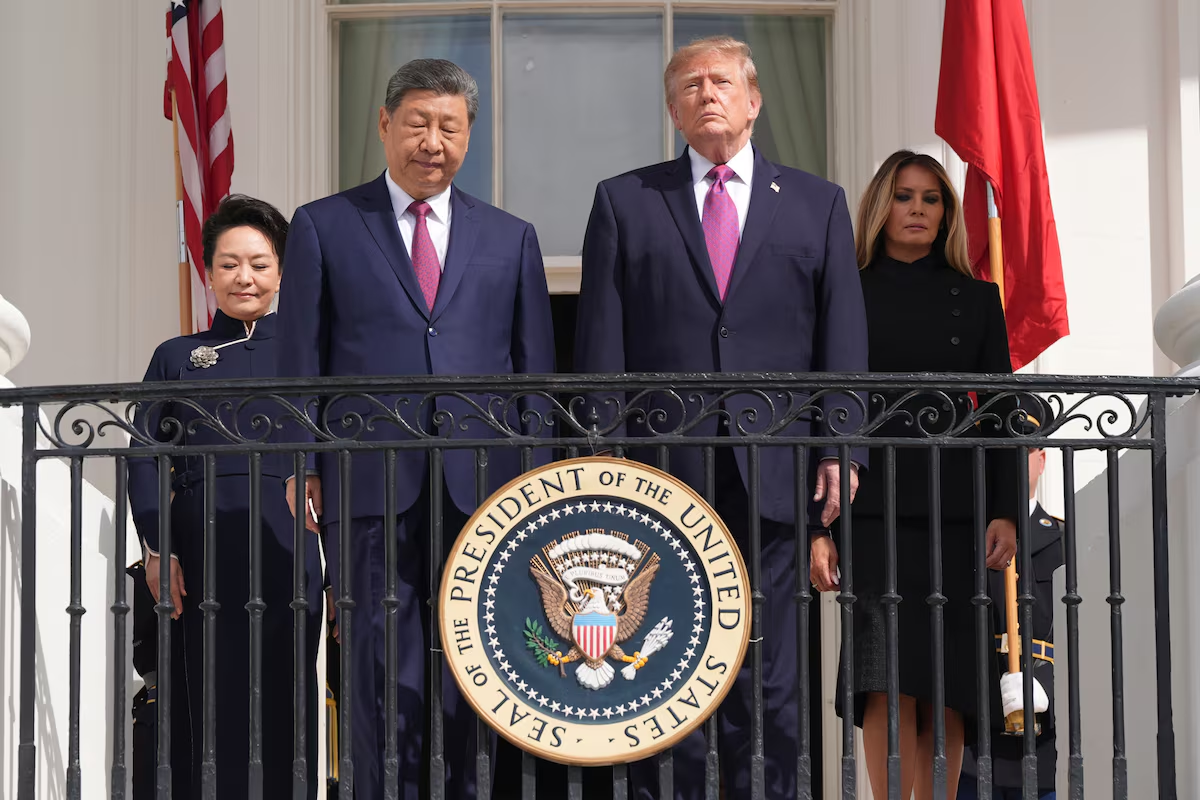
U.S. President Donald Trump and Chinese President Xi Jinping at the White House on Thursday. While they look like mirror opposites, the U.S. and Chinese economies are too alike.Alex Brandon/The Associated Press
John Rapley is a contributing columnist for The Globe and Mail. He is an author and academic whose books include Why Empires Fall and Twilight of the Money Gods.
We all wanted China and the United States to iron out their differences at this week’s summit – as the African proverb has it, when the elephants fight, the grass gets trampled. But what we need more than anything is for them to overcome not what divides them, but what unites them: A structural commonality that’s causing problems for the world economy.
This similarity isn’t visible on the surface. Instead, the fundamental tension between the two countries is that they appear to be mirror opposites, with the U.S. spending too much and China too little. The U.S. spends too much in that it runs large fiscal deficits, which then support a trade deficit, since Americans can now import more stuff.
China spends too little because almost half its economic output is reinvested, creating a surplus of manufactured goods. These then flood the world market, driving producers elsewhere out of business. Some of those lost businesses, of course, were American, and deindustrialization helped drive the political ascent of U.S. President Donald Trump after he promised to bring back manufacturing jobs with a trade war on China.
Trump rolls out the red carpet for China’s Xi as both sides seek stability
But while trade wars and their truces have been at heart the running story of the relationship between Mr. Trump and Chinese President Xi Jinping, the basic tension may be that in one respect, the U.S. and Chinese economies are too alike: Both countries suffer from overinvestment and underconsumption, and how they are resolving that imbalance creates trouble for the rest of us.
In China’s case, this claim is uncontroversial. The country’s extraordinarily high rate of investment is sustained by households which, stung by the collapse in the real estate market, have taken to socking away a large chunk of their earnings in their bank accounts. To keep the economy growing, therefore, the government ends up investing heavily in new infrastructure and subsidizing the expansion of local producers – something which is done largely by regional governments which compete with one another to meet growth targets set in Beijing. The result is a lot of new output that local consumers don’t buy. Hence, China’s constantly rising trade surplus with the rest of the world.
Mr. Trump speaks to reporters during a tour of the South Lawn of the White House with Mr. Xi on Thursday.Alex Brandon/The Associated Press
At first glance, the U.S.’s fiscal deficits, born of expansive government spending when Democrats are in the White House and unfunded tax cuts when it is the Republicans’ turn, complete this picture. But while it’s true that American profligacy may appear like the polar opposite of Chinese prudence, in fact, it actually reflects a common orientation.
In the U.S., the labour share of national income has been falling for decades and recently reached an all-time low, with the profit share conversely reaching an all-time high. Exacerbating this widening income distribution have been changes to the tax system that have taxed labour more heavily and assets less so, leaving the rich even better off. Thus, even amid the recent stock-market boom, real wages have been flat or even declined in some periods. The rich, in contrast, further benefiting further from the One Big Beautiful Bill, are richer than ever.
So that excess U.S. consumption has to be put in context. In today’s “K-shaped” economy, it’s the top half who are spending like sailors on shore leave, while the bottom half are just getting by – hence the resonance of the cost-of-living issue in the congressional election campaigns under way. What has made the top half so rich is, in fact, the stock-market boom, and that’s where the U.S.’s massive fiscal deficits come in.
Opinion: The U.S.-Canada trade war is really about what alignment means – and about China, too
Since 2020, U.S. corporations have raked in more than US$19-trillion in profits, which is why share prices have risen so far. However, more than half of those profits have been funded by fiscal deficits, which in turn are rising twice as quickly as the economy – for every two dollars of added government debt, the country is getting only one dollar of economic output.
In short, the U.S. economy is being kept afloat by rich consumers, who are being kept afloat by the stock market, which itself is being kept afloat by government borrowing. As in China, the government is inflating the economy by stimulating investment, not consumption. This is plainly unsustainable, and the only way to keep it going is for the government to borrow ever more.
Until now, China’s trade surplus with the U.S. meant it could recycle its dollars into U.S. bonds, keeping interest rates down and enabling the U.S. to remain in the style to which it has grown accustomed. But as trade between the two countries drops, this model has run its course, and interest rates are rising – not just in the U.S., but in the rest of the world.
This can’t go on, and won’t. But if politicians don’t seize the reins and change course, the markets will do it for them. Unfortunately, little in this week’s summit gave any indication either leader is prepared to do that.