President Donald Trump’s flagging popularity isn’t the only problem Republicans face this fall.
A slate of strong Democratic hopefuls is putting in play Senate races long assumed to be heading for the Republican column. Stumbling GOP candidates in several pivotal contests, meanwhile, threaten to turn a tough November into an electoral collapse.
After years of struggling to connect with voters, some Democratic recruits have expanded the battlefield and are beginning to redress the failures in positioning, policy and language that helped fuel Trump’s dominance.
This is giving the party resurgent hopes of the net gain of four seats it needs to control the Senate, even as it moves into prime position to win a House majority next month.
In North Carolina, polls show two-term former Gov. Roy Cooper is popular with independents and is sufficiently competitive in rural areas to dent GOP margins.
In a more surprising turn, Iowa state legislator Josh Turek, a self-declared “common sense prairie populist,” is making a race of it in a state where the president romped home by 13 points only two years ago.
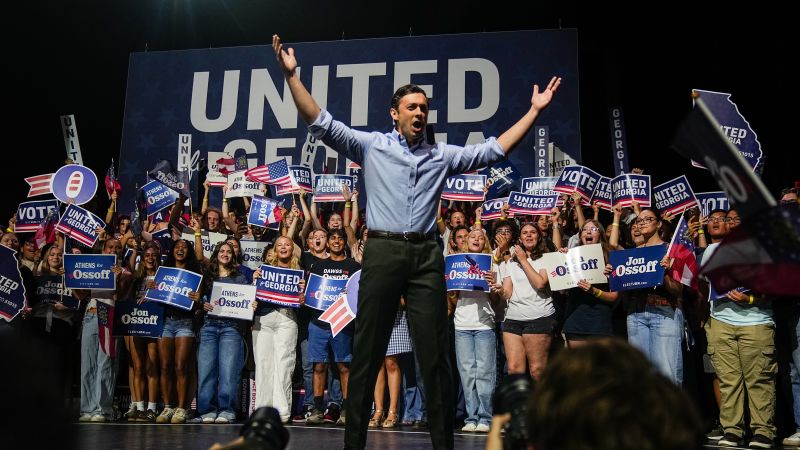
In Georgia, Democratic Sen. Jon Ossoff, another candidate representing generational change, has created a distinct political persona with disdainful critiques of Trump. His swing-state success and rising national profile have stirred speculation he may be what his party is looking for in the 2028 presidential campaign.

In Texas, James Talarico is testing out a bespoke infusion of economic populism and Christian faith to conjure Democratic hopes that the ever-shimmering mirage of a statewide victory can become reality for the first time in 30 years.
In Ohio, which Trump won at a canter in 2024, former Sen. Sherrod Brown has found that his perennial message of blue-collar populism is meeting its moment as an increasingly distant president pals around with billionaires.
Each of these candidates, is, in their own ways, seeking to capture something beyond Trump’s unpopularity and a sense of national economic unease; they are also trying to reinvent the brand of a party that squandered voter trust in recent years and drove some of its core voters toward the Republican president.
A roster of strong candidates is especially important to Democrats this year because the country still views the party largely negatively. A CNN/SSRS survey in late July showed that the public favors Democrats this fall by 8 points, but congressional Democrats and Republicans are about equally unpopular and there are low hopes for what possible Democratic majorities might achieve.
Some GOP candidate choices aren’t helping
Some Democrats lucked out with problematic GOP opponents — like MAGA champion Rep. Mike Collins in Georgia and scandal-plagued Attorney General Ken Paxton in Texas, who were backed by Trump over the reservations of establishment GOP leaders. In North Carolina, Michael Whatley is well known within GOP circles as a former Republican National Committee chair, but he has toiled to match Cooper’s name recognition.


Sometimes circumstances threaten to overwhelm even candidates regarded as well suited to their races. In Iowa, GOP Rep. Ashley Hinson, a relatable former TV anchor and strong communicator, is immersed in the state’s key issues. She’d normally be a favorite to win the Senate seat soon to be vacated by Joni Ernst, but the farm state is being hammered by Trump’s tariffs and high fuel costs.
Of course, any candidate can look like a genius if they win. And losers are always second-guessed.
The most intriguing Senate race may be in Michigan, where Abdul El-Sayed is the most high-risk Democratic candidate in a critical race. If he wins, the 41-year-old epidemiologist will be a herald of a new political generation and star of the progressive movement. But if former Republican Rep. Mike Rogers prevails, left-wing Democratic base voters who rejected the more moderate Rep. Haley Stevens will be accused of throwing away a seat, and possibly the Senate.
Candidates who blend skill, discipline and relatability while crossing ideological lines are like gold dust.
But there are two even more important qualities: luck and timing.
Maine Republican Sen. Susan Collins has often seemed to possess mythical survival qualities. But she’s facing her toughest reelection race yet in a dark national environment for Republicans. The clamor of the Trump era has roughed up her reputation for independence and forced choices that drag her between her base and more moderate voters — like her vote to confirm Supreme Court Justice Brett Kavanaugh. Now she’s being branded by her Democratic opponent as an enabler of Trump rather than a bulwark against him.
Nothing is settled a month from Election Day.
Recent Senate polls show no clear leader in Texas; a slightly better picture for Democrats in Iowa; and campaigns mostly leaning toward the party in Georgia, North Carolina and Ohio. But races often narrow late. In 2024, for instance, Brown led in the Buckeye state in late September but ended up losing his Senate seat to Bernie Moreno. And who can forget the Des Moines Register/Mediacom Iowa Poll that showed Vice President Kamala Harris beating Trump a few days before he trounced her in that state by the only measure that actually matters?

But Democrats are confident because the biggest influence on a midterm election remains the fortunes of the incumbent president. Trump’s low approval numbers and Americans’ concerns about high living costs, AI and the Iran war make this an especially dicey year for GOP candidates.
“When the president’s party controls Congress, the president is the referendum, but the party and their candidates are the targets,” said Michael Bitzer, a professor of politics and history at Catawba College in North Carolina.
Yet it’s not unusual for parties to fumble while in a good position. Trump’s backing for error-prone candidates like Mehmet Oz in Pennsylvania and Herschel Walker in Georgia in 2022, for example, helped Democrats cling onto the Senate despite then-President Joe Biden’s unpopularity. This is one reason why some in the party worry about the prospects of El-Sayed and the late replacement nominee Troy Jackson in Maine.
This is also a worry in the House.
Some Democrats fear that primary victories by ultra-progressive candidates may have produced nominees too radical for the electorate as the GOP warns that “communists” and “socialists” are running rampant. Most of these wins were in deeply blue states. But in California’s 22nd District, a key battleground that Trump narrowly won in 2024, Democrat Randy Villegas defeated a moderate primary rival preferred by the party’s Washington leaders. And in Maine, another progressive, Matt Dunlap, also defeated an establishment rival for the right to run in a key general election swing district.

Victories by Cooper or Turek in November could give Democrats important clues about how they widen their appeal after a period up to 2024 in which their policies on immigration, gender identity issues and inflation drove away some moderate voters.
Often, in the 21st century, the party’s cultural messaging appealed to the liberal cities and college-educated voters in the suburbs but alienated rural and working-class voters who once turned naturally to Democrats but deserted the party for Trump.
Cooper may be their answer in one Southern state.
The former governor is not running an overtly partisan Democratic campaign. He presents his candidacy as a chance for North Carolina to send an “independent” voice to the Senate. He’s using the key issue of the election — affordability — as a bridge to voters of both parties with his “Make Stuff Cost Less” tours and slogans like, “There is too much month at the end of the money.” Cooper’s earned the trust of moderates over long years in public office. He comes across as steady and understated and remembers working with Republicans in the state legislature as he courts voters who’ve tired of Trump’s chaos.
It seems to be working, with polls suggesting he holds a comfortable lead over Whatley. Bitzer, who has conducted polling that confirms findings in other surveys that Cooper leads among independents, says the former governor also does far better in rural areas where the GOP typically pads out wins in a state that hasn’t voted for a Democratic presidential candidate since Barack Obama in 2008.
This kind of coalition is important because polls show that while voters are looking to punish Trump, they are still skeptical of Democrats. This is one reason why elections expert Charlie Cook argues the midterms are seeing not a blue wave but a “red undertow.”

Bitzer said that Cooper’s experience equips him to “recognize that (in) North Carolina … that moderate middle can tip one way or the other. And he knows how to appeal both to his party’s base, but also to that moderate middle that may split their tickets.”
Turek is trying something similar in Iowa. He’s evoking the legacy of moderate Democratic Iowa Sen. Tom Harkin, who served 40 years in Congress for a state that went twice for Barack Obama and three times for Trump. He’s stressing the punishing affordability crisis, poor access to healthcare, high rates of cancer in the state and what he calls Washington “corruption.” But Turek largely avoids cultural and social issues at the center of much national Democratic and progressive messaging. He supports the Second Amendment and a strong border policy.
“The Democratic brand is certainly damaged,” Turek said on a recent edition of “The Weekly Show” with Jon Stewart, describing his ideological positioning as a member of Iowa’s state legislature. “There are times where I have more agreement with my moderate Republicans on issues than with my most extreme left-wing Democrats,” he said.
That stance may help shield Turek against GOP claims that the Democratic Party is careening toward its far-left flank.
And if the message is a winner this fall, it may provide the party with a blueprint that stretches beyond the midterms.