I muffled my sobs with a pillow so my family couldn’t hear me from the adjacent room. I was 19 years old and we were in Paris, staying on the top floor of an old six-story walkup where every step echoed through the thin walls. I was trying, and failing, to hide the emotional war I had decided to wage on my body. Who does that on a family vacation? In Europe, no less?
Pulling tear-soaked strands of hair off my cheeks, I stood in front of a full-length mirror and grabbed the fat of my thighs. If only I could just – I pictured ripping off fistfuls of my body and flinging them out the windows, where they would land on some unknowing French person six stories below. I had this vision often: pulling bits of myself off and casting them somewhere far away from me.
For years, spanning my teens and 20s, eating was either an indulgence to regret or a strategy to overplan. In high school, I chugged 32 ounces of cold green tea every morning, hoping it would burn belly fat like Instagram told me it would. While working at a deli one summer, I ate two bagel sandwiches each shift until my friend mentioned I was eating the carbohydrate equivalent of 10 slices of bread. My daily bagel intake promptly plummeted to zero. I forced myself to choke down a can of tuna in my college dorm before predawn weightlifting sessions. In my early 20s, I started experimenting with intermittent fasting: no food from 8pm until noon the next day.
Then I killed my own dinner, and everything changed.
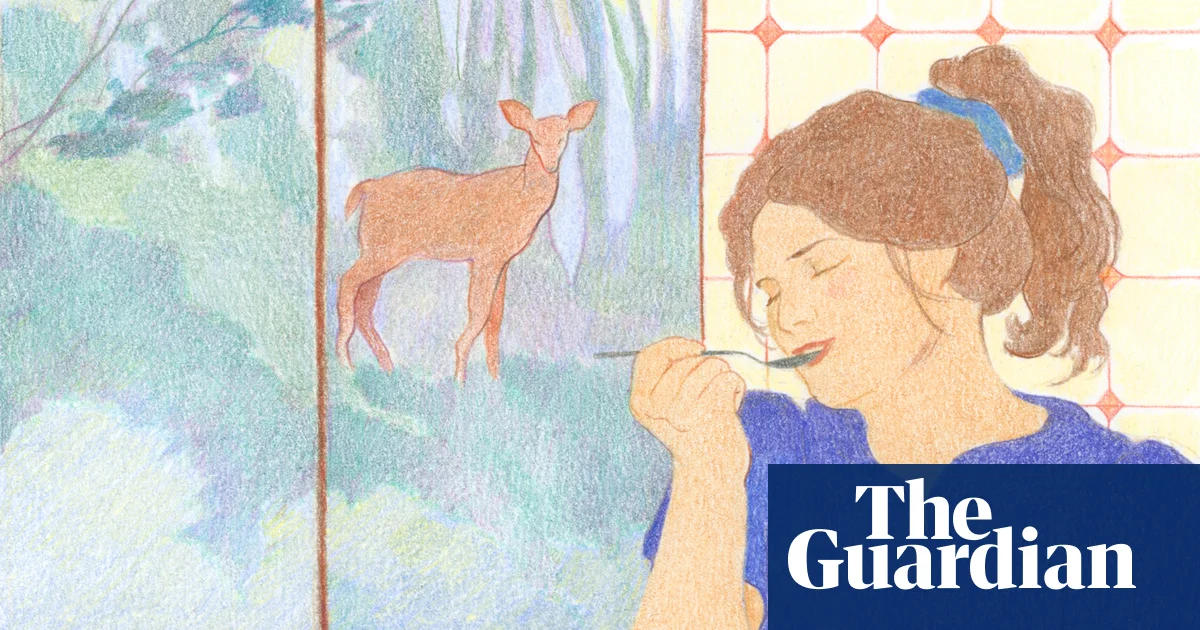
Five years after the family trip to Paris, I sat down at my dinner table in Belgrade, Montana, to eat a piece of meat from the first white-tailed deer I had hunted myself. My first taste of this venison took a lit stick of dynamite to every complicated emotion I would ever felt about eating. Regret was the least appropriate response to this meal, as it would reduce the animal’s death to waste. Gluttony wasn’t an option, either. I wanted the meat, in its precious scarcity, to last for ever.
I grew up eating a lot of venison and elk, thanks to my dad, who took an annual trip west to hunt deer and elk to fill our freezer. At 24, newly armed with a master’s degree and wanting to do cool stuff in the mountains, I took a job with MeatEater, the hunting media brand built around Steven Rinella’s television show, which premiered on the Sportsman channel in 2012.
After switching to Netflix in 2018, MeatEater found a much larger audience during the pandemic, drawing everyone from ethical vegans and newly curious outdoors enthusiasts to middle-class suburban parents gobsmacked by the skyrocketing price of meat. In March 2020, a pound of ground beef was $3.88. By June 2020, it was $4.74. Today, the same pound of ground beef is $6.92, or 78% higher than the pre-pandemic price.
A growing interest in hunting and conservation was becoming personal for me, too. In the fall of 2021, I hunted for the first time with my dad in Wyoming. I had a tag for a white-tailed doe, widely available in many parts of the country. Their overabundance can impact ecosystem health and other competing big game species like mule deer, iconic in the western United States but less adaptable to changing conditions than white-tailed deer.
On the final night of the trip, I shot a white-tailed doe from 184 yards away across an old pasture. My bullet passed through both her lungs, making for an effective and ethical shot. Her death came very fast, and she did not show much visible suffering. Kneeling next to her, I shook, cried and apologized. Then my guide, a family friend I had known since I was a kid, got to work teaching me how to field-dress her body, still warm with the recent memory of life.
She was full of fat. It encased her kidneys and cushioned her belly. The waxy, gelatinous goop began to congeal in the cold, eventually looking more like crumbled bar soap than organic matter. She was prepared for a long Wyoming winter with little nutritional intake. Barring an onslaught of desperate predators or some late-season freeze, she would have survived easily. I muttered to myself that the doe looked as if she was in great shape.
At that moment, I realized how hard I had been working out, running and dieting to meet the same standard. Except, in upper-middle-class white girl terms, “great shape” is predicated upon less body fat rather than more. The irony was bludgeoning.
Dr Hannah Carl, a psychologist based in Chicago who specializes in treating people with eating disorders, is familiar with this the nutritional chaos that shaped my adolescence, the rapid oscillation back and forth between “food as fuel” and “food as enemy”. She chalks up some portion of this discomfort to a fractured relationship with the origins of our food. It can be hard to consider any food precious or worthy of enjoyment when it’s always available in abundance right around the corner in a sterile, transactional environment.
“We are so disconnected from the process of procuring food,” Carl says. “I had this moment over the summer at the grocery store where the cashier was scanning my red bell pepper, and it cost $3. It suddenly felt horrifying that someone else grew this pepper so far away, put it on a truck, drove it all the way to the grocery store, and now I can just pay for it.”
This is a uniquely human problem, and a uniquely privileged one at that. In a country where about 47 million people face food insecurity, fearing food might seem perverse if that fear weren’t so deeply embedded in the language of western beauty standards. A dinner reservation with girlfriends might include heavy doses of “cheating”, “indulging” and deciding to “be bad”. We’re “tempted” by the dessert menu, but eventually we push it away and ask for the check, certain we’ll thank ourselves later for our “restraint”.
Ironically, for all our fussing over calories and nutrition labels, one thing has become abundantly clear: whatever we thought we knew about the relationship between food and weight has misguided us for decades.
“Diet is one of the remaining frontiers in medicine, in which clinicians and doctors really have no definitive answers,” writes Elise Loehnen, the author of On Our Best Behavior: The Seven Deadly Sins and the Price Women Pay to Be Good. “The adage of calories in and calories out is clung to but woefully outdated and overly simplistic. Tell any woman that the simple math of burning more calories than she consumes should correlate with her experience on the scale, and she’ll laugh.”
Deer and many other wild animals rely on seasonal weight fluctuation to survive. They eat calorie-dense foods all spring, summer and fall to rely on their fat stores through food-scarce winters, and their weight ebbs and flows as a result.
Meanwhile, we tell women that any amount of weight fluctuation means they’re broken, and they should always keep their sights set on some middle-ground perfection. They can’t lose postpartum weight fast enough, but they should also fill those jeans out more. Mild to moderate weight loss is still celebrated for its cosmetic value, and mild to moderate weight gain remains a perfectly good reason to fear for a woman’s wellbeing.
This persistent fatphobia is not without severe consequences. Loehnen cites one study in which 46% of 4,283 respondents, 83% of whom were women, would rather give up a year of their lives than be categorically obese. An additional 15% would rather give up a decade.
“These statistics reflect how bad it is to be perceived as having a deviant, or not ideal, body in today’s society,” Loehnen writes. “It makes me sad, and perversely grateful, that I don’t have daughters.”
But alongside the good old-fashioned body shaming that endures, a new taboo has emerged: expressing concern about someone’s weight loss, even when it appears extreme. Highly effective weight-loss drugs are now increasingly marketed to women who don’t have any medical need for it. When weight loss becomes visibly severe, even family and friends are instructed to suppress their concerns. We can’t decide whether to honor their autonomy with silence, sound the Karen Carpenter alarm, or make some complicated attempt at both. We fear accusations of disrespect; I’m starting to wonder whether, in our determination not to judge, we’ve made it harder to say when someone we love looks dangerously unwell.
What would happen if society saw human bodies the same way I saw my first doe, with fat as proof of life and health? What if we saw weight that fluctuates with the seasons of life as signs of health and abundance? Would the blurred line between healthy and unhealthy relationships with food come into clearer focus?
For me, it has, and I have hunting to thank. Beyond the freezer full of delicious meat, beyond the warm memories of shared meals with friends and family, beyond the quiet time spent outdoors, hunting has helped me confront my own mortality.
Life is fragile and fleeting, and someday, no matter how hard I fight to look a certain way or achieve a certain goal weight or fit a certain aesthetic standard, I will be reduced to the same limp, lifeless mashup of proteins, fats, calcium and water as the deer I kill. We all will.
When that time comes, if someone were to cut me open and eat my muscles to feed their own bodies, I would want them to know I didn’t die hungry.