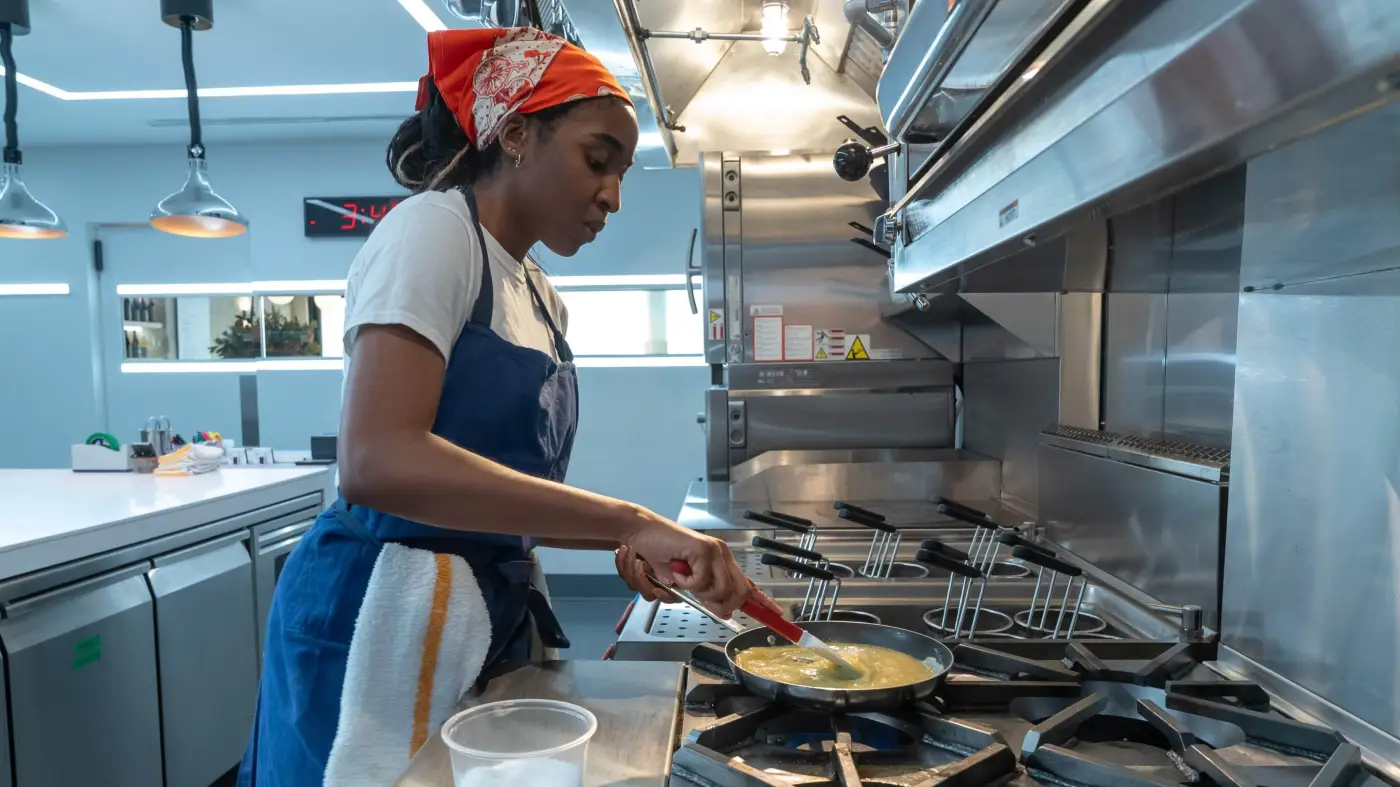

Ayo Edebiri in Season 2 of The Bear — crafting one very special omelette.
Chuck Hodes/FX
hide caption
Chuck Hodes/FX
Watching just the right thing at just the right time can make you happy, sad, scared, deeply moved — or hungry. Sometimes very, very hungry. Since we’re getting ready for Thanksgiving, our Pop Culture Happy Hour hosts have been thinking about the fictional meals that we’d love to sink our teeth into, quite literally.
The chocolate cake in Matilda (1996)
YouTube
I’m going to preface this by saying that this is a scene involving cruel child punishment, and so I recognize that this is an incredibly fraught pick — but I cannot help it. Since 1996, when I was an 8-year-old kid watching the movie Matilda in a theater with my dad and my sister, I have longed for that delicious, delectable, decadent, sumptuous chocolate cake from the Bruce Bogtrotter scene in Matilda.
Of course, this is the adaptation of Roald Dahl’s book, directed by Danny DeVito. It’s about a bookish girl named Matilda played by Mara Wilson, who’s the black sheep of the family. She’s got mean and abusive parents, an awful brother. She’s at this school, Crunchem Hall Elementary, and one of her classmates, Bruce (Jimmy Karz) has swiped a slice of Miss Trunchbull’s cake. Miss Trunchbull, of course, is the evil principal, played by Pam Ferris. To humiliate him, she insists that he eat what appears to be a three layer, gigantic cake — in its entirety — in front of the whole school. At first Bruce is like, no, I don’t really want that, because, as delicious as it is, that’s a lot of cake. But it becomes a dare, and despite the fact that this starts off as basically child abuse, this scene ends with Bruce triumphing, thanks to Matilda and the rest of the school cheering him on. He finishes every last bite of that cake.
I want that cake. I know this is going to freak some people out, but I would love it with a big glass of milk. — Aisha Harris
The omelette in The Bear (Season 2, Episode 9) (2023)
YouTube
Back in the second season of The Bear, as the new restaurant was about to open, pressure on everybody was very, very high. This included Carmy, who’s creating this new fine dining place, along with his unofficial cousin Richie. It included Syd, played by Ayo Edebiri, who was his partner in the restaurant. And it included his sister Nat, also known as Sugar, played by Abby Elliott, who is the business manager and takes care of everything from regulatory compliance to cash flow. And there’s a moment in Episode 9 when they’re getting really close to opening the restaurant, and Syd notices that Nat, who is super pregnant, just looks exhausted.
Syd makes this gorgeous, perfectly yellow cheese omelette which she tops with chives, and in maybe the most charming little touch of this scene, crumbled potato chips. She sets a glass of juice down beside it, and carries it into Nat’s office. It’s an act of love and care.

I have spent time trying to make this perfectly yellow omelette — it’s a very simple thing, but you have to master it because it’s a skill. If I ever master it, I’m definitely going to put potato chips on top of it. I think the scene underscores one of the things that the show did really well, which is to demonstrate how hospitality as an industry can also be hospitality as a virtue. — Linda Holmes
A tray of oysters in The Taste Of Things (2023)

Stephen’s pick: a tray of oysters in the movie The Taste of Things.
IFC Films
hide caption
IFC Films
The Taste of Things stars Juliette Binoche and Benoît Magimel. It’s set in France in the late 1880s. He is a gourmet and she is his personal chef, and they have this simmering romance. (The two actors used to be married, and I think that history kind of permeates their performances.)

This film takes the making of meals very seriously. They used real food, and these actors spent a lot of time learning cooking techniques, learning how to duplicate the making of extremely complex meals. Since this film is set in 1889, there are elements of the cooking that feels almost steampunk, because they’re not using immersion blenders, they’re not taking any shortcuts at all. There’s a lot of preparation of butters and the straining of butters. We’re getting a sense of how to make these flavors dance with each other, but we’re also getting a sense of just how much butter these meals require.
In one of the meals, he cooks for her. These are two very beautiful people, and she’s just sitting there being served these dishes, and each one looks more astounding than the one before. Including a plate of oysters. — Stephen Thompson
The malai kofta in The Lunchbox (2013)
YouTube
The Lunchbox is about a woman in Mumbai, Ila, played by Nimrat Kaur, doing everything she can to rescue her foundering marriage. Her main tactic is to make her husband delicious lunches that she sends to his office in a tiffin, a cylindrical, multi-tiered metal lunchbox. In Mumbai, there’s a system of food delivery called dabbawalas. Dabbawalas are famous for never screwing up a delivery. Well, guess what happens in this movie? The lunch she makes gets delivered to a depressed widower who is about to retire from his job at an accounting firm, played by the late, great actor Irrfan Khan. And he loves the food, of course, and he knows that at the end of lunch, the dabbawalas are going to come back through and collect the lunch boxes and send them back to the people who made the food. Kaur’s character, Ila, realizes there has been a mix up, but because there’s a connection, she keeps making him these amazing meals and they exchange notes. Does romance blossom even though she is married — and he is much older than she is? I’m going to let you watch the film.

But, the food: In The Lunchbox, it’s not about the food looking good, because it’s not served in any kind of rarified way. It’s in these workmanlike round tins and under horrible fluorescent office lighting. But what the film is particularly great at evoking is the aroma of the food. You can keep your 4DX nonsense, I just need to look at Khan’s face as he opens up that lunchbox for the very first time and can smell that this is not the crappy cauliflower he ordered. This is something else.
There is one particular recipe she makes in this movie, and we watch her make it. It’s malai kofta, or paneer kofta. It is the ultimate comfort food: balls of cheese and potato fried and suspended in this incredibly rich, luxurious, silky cashew cream sauce that starts as a lot of things in this cuisine do — by making a paste of ginger and garlic and frying that up. You can smell this food: the fenugreek, the garam masala, the cumin, the chillies. This movie was so popular in India and around the world that you can find home cooks online trying to make versions of this recipe. — Glen Weldon
If you want more festive fall listens, check out these episodes:
Our cozy, under the radar recommendations for fall
We debate: what’s the worst Christmas movie?
Connect with Pop Culture Happy Hour:
Support public media with NPR+ and enjoy perks for over 25 podcasts like this one. This show’s perks include bonus episodes and sponsor-free listening. Learn more at plus.npr.org.