
“It’s not smoking; it’s praying. Welcome to paradise.” Apple, the redheaded leader of a mall coven of mean girls, establishes the shaky vibe of Forbidden Fruits by offering each witch in her circle a joint and a commanding “blow me.” Apple (Lili Reinhart) has no goals and no character traits beyond being a hot mean girl. Why she’s the leader and what this communal joint means is anyone’s guess.
Forbidden Fruits is a horror comedy that’s neither scary nor funny. It tries to do a lot of things. It tries to be about witchcraft, but falls from grace in clumsy Christian metaphor and laughably shallow divapop rituals. It tries to be a fashion story, but wears a suit of cliché. It gestures at being about revenge, at making a saint of Marilyn Monroe, at exploring the volatility of female friendships and sisterhood. In the end, it is a dead mall: empty, disappointing, mostly plastic waste.

Fig (Alexandra Ship), Apple (Lili Reinhart), and Cherry (Victoria Pedretti) in Forbidden Fruits (2026) [MXN Entertainment]
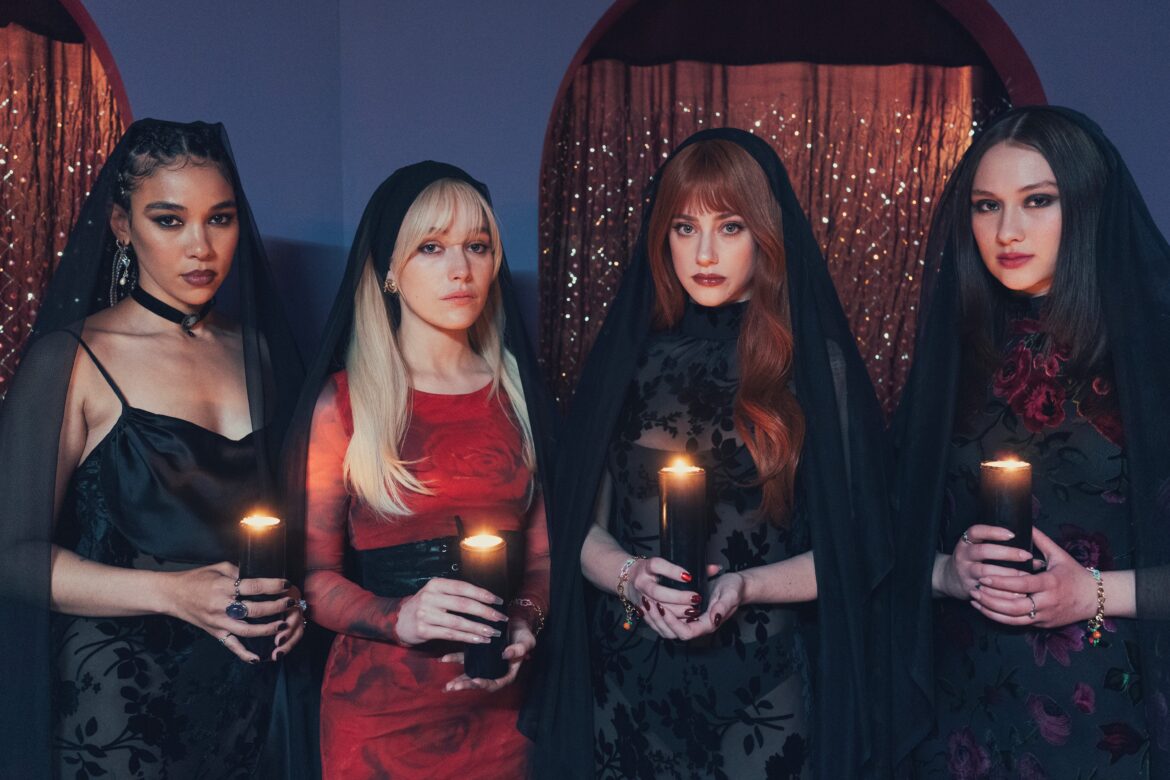
Apple’s dialogue does the only lifting here, and what it lifts cannot be said to be heavy. “Being a witch is being a sister. And we all need sisterhood to survive.” Sure babe, we are all primed to get that message. But then these vapid two-dimensional mannequins offer each other no version of sisterhood. Apple, Cherry (Victoria Pedretti), and Fig (Alexandra Shipp) are openly antagonistic toward a new hire who will nonetheless complete their circle. No one wants that to happen, and there’s no incentive for the new girl to join them. But this film is like four Barbies being bashed together during an episode of Bewitched on Nick at Nite, so let’s pretend these events happen for a reason. Any reason will do. Let us complete the circle.
Completing the circle means having a representative of each of the retail seasons. New girl Pumpkin (Lola Tung), takes her place as the holy autumn, when the fashion houses decree what’s new. Pumpkin confesses that she doesn’t believe in girls supporting girls, which comes off as a tweet from the toilet, signifying nothing. In the background, Pumpkin talks to her unseen mother.
Robbed of a makeover sequence, Pumpkin seeds herself and gets dressed overnight, out of sight, emerging by means of confession to the spirit of Marilyn Monroe and some unseen alchemy into a hot mean girl who helps run Free Eden, an overpriced and aspirational clothing shop in a Texas mall. Totems of femininity adorn these noli me tangerines, but none of their symbols carry meaning beyond aesthetics. After-hours rituals are all sparkle and no spark. The girls do sequin-drugs and dance to a club song from 2003 that director Meredith Alloway clearly remembers from her youth, but which makes no sense for these characters. (Do the kids still play DDR?)
The kids torture one another in the name of sisterhood. Fig is directed to self-castigate for the crime of heterosexual desire and recalls her mother’s own sublimation into heterosexual coupling. Cherry is secretly fucking every man she can find in the food court by dragging them into dressing rooms for quick try-on trysts. A flashback brings us the ballad of Pickle (Emma Chamberlain), the lost fruit who was cast out of paradise for falling in love with an ordinary boy. Pickle’s nameless NPC boyfriend is cursed into a coma, and Fig wants to save her own normal Norman from the same fate. Pumpkin pursues Pickle for a chance at some basic exposition, but is thwarted by a sacrifice that achieves no story beat and seems to serve no purpose.

Pumpkin (Lola Tung) and Apple (Lili Reinhart) in Forbidden Fruits (2026) [MXN Entertainment]
These girls have more changes of costume than character attributes. Even when they do baleful magic to protect their garden, they have no clear desires or reasons to exist. They turn themselves against a snake in the garden (yes it’s all very Pagan and definitely not a belabored analogy from the book of Genesis). Comparisons to The Craft and Jawbreaker seem inevitable, but the girls in those movies wanted something, worshiped something, and risked something to achieve their ends. These girls want nothing, worship nothing, drink out of a spangled boot, and risk nothing at all.
Uncultured and armed only with memespeak and psych 101, the girls are depthless and ditzy. Their high points include misquoting Virginia Woolf and getting excited about Ed Sheeran tickets. Fleecing retail customers and nonsense misandry seem to be the coven’s mainstays, but the girls insist on something called Shine Theory, whereby they agree never to dim one another. This is never explained; it is only randomly invoked late in the film’s plotless wander as a way to provoke a fight between Apple and Cherry that comes from nowhere. There’s a sapphic whisper delivered with such insincere inefficiency that a viewer might blink and miss it completely.
In the end, a story about four girls who do witchcraft turns out to be about Christianity’s Father God, who is out here cheating on wives, setting up franchises, and showing loyalty to none of his meaty little creations. Only the final scene with store manager Sharon (Gabrielle Union) takes any kind of swing at continuity, and by then it’s too little, too late, even for the ageless vampire actress who graces the scene.
Forbidden Fruits casts no circle, calls no quarters, and works no magic. It has all the charm of the Halloween clearance rack at Claire’s on November 10th, and brings nothing of value to the Witch who came to shop for a bargain in a dying mall. A witchier time can be had at Hot Topic. Or even Spencer’s.

Forbidden Fruits is streaming on AMC+.